Your business,
on autopilot.
One platform for creating, running and growing your business, powered by AI.
AI Employee vs AI Agent: The Difference That Actually Matters





Last updated: September 2026
There is usually no difference in intelligence between an "AI agent" and an "AI employee." It is frequently the same model, sometimes the same API call. The difference is what exists when you stop typing.
That sounds like semantics until you buy one. Microsoft's 2025 Work Trend Index, which surveyed 31,000 people across 31 countries, found 82% of leaders expect to use digital labour within 12 to 18 months. A lot of software is being renamed to meet that demand, and the rename is usually free while the capability is not.
- An agent is invoked. You prompt, it works, it returns, it forgets
- An employee is triggered. Work arrives on a schedule or an event, whether or not you are there
- The real dividing line is persistence: memory, a queue, an address, and standing rules
- Persistence brings a new failure mode. Agents fail in front of you; employees fail at 3am into a report nobody reads
The Actual Distinction
Strip the marketing and the difference reduces to four capabilities. Any product can be tested against them in about five minutes.
| AI agent | AI employee | |
|---|---|---|
| How work starts | You prompt it | A schedule or event triggers it |
| Memory | The session, then gone | Accumulates across runs |
| Reachable by | You, in its window | Other people and systems, at an address |
| When it hits a limit | Guesses or stops | Escalates with context |
| Smallest useful unit | One good answer | One owned, recurring lane |
None of these require a smarter model. They are product decisions about state, scheduling, and identity. Which is exactly why the label is so easy to apply and so often unearned.
The One-Question Test
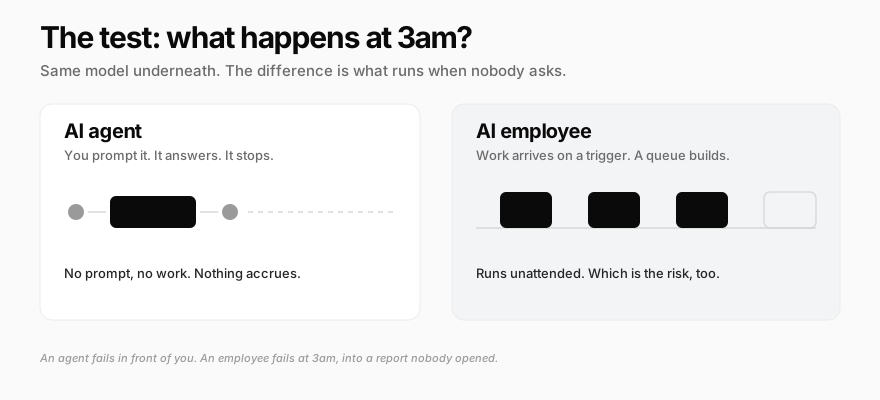
Ask a vendor this: what happens if nobody talks to it for a week?
If the honest answer is "nothing," you are buying an agent. That may be exactly right, and it is usually cheaper. But you are buying a tool that waits.
If the answer involves a queue, a schedule, accumulated notes, or a message waiting for you, you are buying something closer to an employee. Now ask the follow-up that matters more: where does that memory live, and can I take it with me?
The Four Things You Are Actually Paying For
1. A trigger, not a prompt
The shift from "I ask" to "it arrives" is the whole product. It means defining what fires the work and what a finished run looks like, which is real work you do once. Note that trigger coverage varies a lot between products. Grok Bot, for example, supports schedules and event triggers such as a Slack message, but has no email trigger, so inbox workflows run in batches instead of on arrival.
2. Memory that survives the session
Without this, nothing else matters. An "employee" that starts cold every run is an agent with a cron job attached. The test is whether a correction you make today still holds in a month, after other work has happened. That depends on where the correction gets written down, which is the job of an AI agent knowledge base.
3. An address
Something an employee has that an agent does not: other people can reach it. An inbox of its own, an @-mention, a channel. This is what lets work route to it without going through you, and it is the difference between delegating and relaying.
4. Escalation instead of improvisation
The most underrated one. A system that stops and asks when it hits the edge of its authority is far more useful than one that confidently proceeds. Judge products on how well they escalate, not on how rarely they need to.
Where the Metaphor Breaks
Being honest about this matters more than the definitions, because this is where people get hurt.
An employee is accountable. Software is not. If a human sends the wrong invoice to 400 customers, there is a person who owns it. If your AI employee does, the accountability is entirely yours. The word "employee" quietly implies a transfer of responsibility that does not happen.
An employee exercises judgment about scope. A human notices that a task is a bad idea and says so. Current systems mostly do not. They are excellent at executing a well-specified lane and poor at questioning whether the lane is right.
An employee builds context you did not give them. They overhear things, notice patterns, and bring you problems you did not ask about. An AI employee knows exactly what you wired into it. Nothing more.
So the term is useful as a description of persistence and useless as a description of responsibility. Use it for the first, never for the second.
The Failure Mode Nobody Warns You About
Here is the genuine cost of persistence, and it is not the subscription.
An agent fails loudly. You prompted it, you read the output, you saw it was wrong, you fixed it. The feedback loop is immediate and free.
An employee fails silently. It ran at 3am on a schedule you set six weeks ago, against a description that has since gone stale, and produced a confident report that nobody opened. The error compounds quietly until something downstream breaks and you trace it back.
Three habits that actually help:
- Make "nothing to report" an explicit output. If a run cannot say that clearly, it will invent findings on quiet days
- Have every scheduled run log what it did, because platform run history is usually shallow and will not be there when you need it
- Re-read the standing instructions monthly. Anything you hardcoded about prices, people, or process is now partly wrong
So Which One Do You Need?
An agent is enough when the work is occasional, you are present anyway, each request is different, or you are still figuring out the process. Do not buy persistence for a workflow you have not stabilised, because you will just automate the wrong version of it.
An employee earns its keep when the work genuinely recurs, someone other than you needs to reach it, context from last month changes what it should do this month, and the cost of it being a day late is real.
Most people need one lane of the second and several of the first.
Where Crevio Fits
Straight about the scope: Crevio is not a general-purpose AI employee you hand arbitrary errands to. It can work in a connected Gmail inbox and research the web, but everything it does is aimed at one job: running a business you sell through.
Crevio is an AI business builder, and it takes the memory half of this distinction seriously, because that is the half that is hard. The agents work on top of one shared view of the business: products, Stripe-powered checkout, subscriptions, customer records, and analytics are real features rather than facts you re-supply every session. A full REST API means that context stays portable, which matters given the question above about whether you can take your memory with you.
Where it genuinely loses: no general purpose task execution, and no physical products, inventory, or shipping. It is not a Shopify replacement. Transaction fees apply on every plan (5% on Starter, 2.5% on Pro, 1% on Business), so there is no 0% tier.
Starter is free with 20 AI credits a month and 2 published products. Pro is $20/month with 1,000 credits and unlimited products. Business is $50/month with 2,500 credits, a custom domain, and unlimited seats.
And honestly about the frontier: nobody's agents are fully autonomous today, ours included. We would rather describe it as a partner that automates real work and takes on more over time. The longer version is in can AI run a business.
What Nobody Tells You
- The setup is the job. Most of the value comes from writing down a process you had only ever held in your head. That work is yours either way, and it is why the second lane is far easier than the first.
- The label tracks pricing, not capability. "Employee" tends to mean per-seat billing. Check what changes technically before you accept the pricing model that comes with the word.
- Portability is the question to ask early. Accumulated context is the entire asset. If it cannot be exported, switching later means starting from zero.
- Persistence multiplies whatever you built. A well-specified lane compounds. A vague one compounds too, in the wrong direction, unattended.
- Nobody reads the 3am report after week three. Assume this and design for exceptions surfacing loudly, not for diligent daily review.
AI Employee vs AI Agent FAQ
Is an AI employee just an AI agent with better marketing?
Sometimes, and it is worth checking. The label is earned when four things are true: work starts on a trigger rather than a prompt, memory survives between runs, other people can reach it at an address, and it escalates instead of guessing. If a product has none of those, the word is doing the work the software is not.
Do AI employees replace human employees?
Not on current evidence. They absorb bounded, recurring work, which is genuinely valuable, but they carry no accountability, exercise little judgment about scope, and only know what you wired into them. Treating one as a headcount replacement rather than a capacity gain is the mistake that produces the horror stories.
What is the difference between an AI employee and an AI assistant?
Mostly initiative. An assistant helps you with what you are already doing and waits for direction. An employee owns a lane and produces work whether or not you engage that day. We compared the practical tools in our AI executive assistant guide.
How many AI employees should I start with?
One, and only for a process you already do reliably by hand. Persistence amplifies whatever you specify, so a vague first lane produces confident mess on a schedule. We covered when adding more actually helps in a team of AI employees vs one generalist.
What should I ask a vendor before buying an "AI employee"?
Three questions. What happens if nobody talks to it for a week? Where does its memory live and can I export it? And what does it do when it hits something it is not authorised to decide? The answers separate the category from the branding faster than any feature list.
Buy the persistence if you need it. Just do not buy the accountability, because it is not for sale.
Related Blog Posts
- A Team of AI Employees vs One Generalist: How to Actually Decide
- AI Executive Assistant: The 2026 Guide for Founders and Solopreneurs
- Can AI Run a Business? What's Actually Possible in 2026
- What Is an Autonomous AI Company? The 2026 Definition, Levels, and How to Build One
- AI Business Builder vs Hiring a Team: The Honest 2026 Comparison
What will you sell today?
Describe what you want to sell — Crevio builds, launches, and grows it. Products, payments, and marketing, all on autopilot.
Start for free

