Your business,
on autopilot.
One platform for creating, running and growing your business, powered by AI.
AI Business Builder: 8 Platforms That Actually Build and Run Your Business (2026)





Last updated: October 2026
Nearly 60% of U.S. small businesses now use AI tools, but most are still stitching together ChatGPT prompts and Zapier workflows by hand. A new category of platform has emerged in 2026: the AI business builder. These platforms don't just assist with tasks. They build your website, set up payments, create products, and run marketing automatically. The promise is real, but the differences between platforms are enormous.
The market is moving fast. Solo-founded startups jumped from 23.7% to 36.3% of all new companies on Carta by mid-2025, and the global AI market is projected to reach $826 billion by 2030, growing at 28.6% annually. AI business builders sit at the center of this trend: they're the infrastructure behind the one-person billion-dollar company movement, letting one person do what used to require a team.
- An AI business builder is a platform that creates business infrastructure autonomously, not just a tool you operate yourself
- Pricing models vary wildly, from free tiers to a percentage of every sale plus payout holds, and the wrong choice can cost thousands
- No platform does everything well, so matching the right builder to your business type is the most important decision you'll make
What Is an AI Business Builder?
The term "AI business builder" gets thrown around loosely. A chatbot that writes emails isn't a business builder. A website template with AI-generated copy isn't one either. Here's the distinction that matters.
An AI business builder is a platform that takes a description of what you want to build or sell and produces working business infrastructure: storefronts, payment processing, product pages, marketing funnels, or workflow automations.
The key distinction: You describe the outcome. The platform builds it.
This separates AI business builders from two adjacent categories:
| Category | You Describe | It Produces | Example |
|---|---|---|---|
| AI tools | A task ("write an email") | Task output (an email draft) | ChatGPT, Claude, Jasper |
| AI automation | A workflow ("when X, do Y") | Automated sequences | Zapier, Make, n8n |
| AI business builder | A business ("I sell fitness courses") | Working infrastructure | Crevio, Durable, Polsia |
If you want a deeper breakdown of these three levels, we covered the framework in detail in AI That Runs Your Business: What's Real vs. Hype.
Quick Comparison: The Best AI Business Builders in 2026
| Platform | What It Builds | Starting Price | Best For | Key Limitation |
|---|---|---|---|---|
| Crevio | Website, products, payments, email, marketing, support | Free (5% fee on sales) | Running a business that sells, with you in control | Built around selling, not software experiments |
| Durable | Websites, CRM, invoicing | Free; $22/mo | Service businesses | Limited to website + CRM |
| Lindy | AI agent workflows | $29.99/mo | Operations automation | Requires workflow design |
| B12 | Websites with human review | Free; $24/mo | Professional services | Client tools cost $78/mo |
| Polsia | Full business (website, marketing, ops) | Plan per company + 3% of sales | Hands-off idea testing | 31-day payout hold, rare results |
| n8n | Workflow automations | Free (self-hosted) | Technical builders | Requires technical setup |
| Sintra | Role-specific AI employees | $39/mo per helper | Content and communications | Narrow to specific roles |
| Make | Visual workflow automations | Free tier | Non-technical automation | Not a full business builder |
The 8 Best AI Business Builder Platforms
1. Crevio: AI That Builds and Runs Your Business
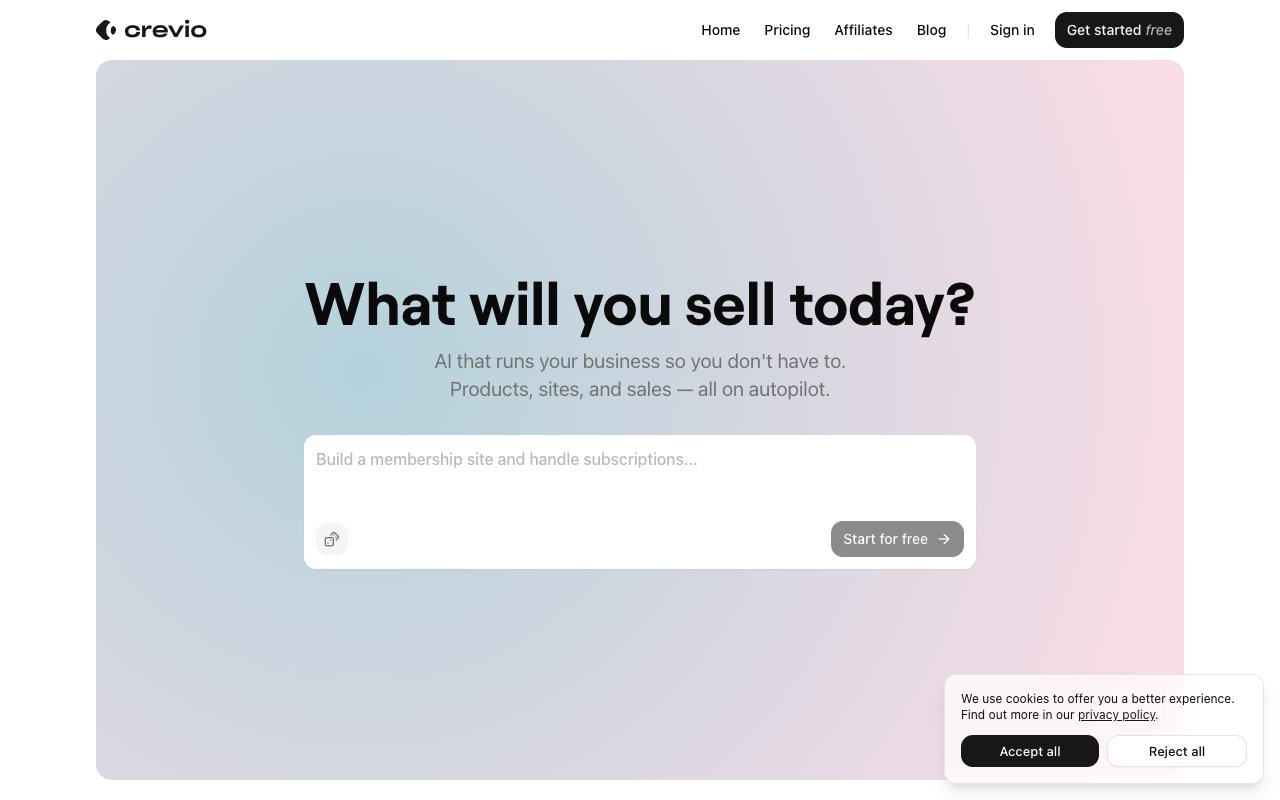
Crevio is AI that runs your business. You describe what you want to sell, and Crevio builds the website, lists the products, takes the payments, answers email, posts to social, runs ads, and reports on what worked. Its agent has its own computer, so scheduled work keeps running when your laptop is closed.
The difference from fully autonomous tools like Polsia is control. You choose which actions wait for your approval, such as refunds, customer emails, or ad changes, or you run a task supervised so every change arrives as a draft. Payments go into your own Stripe account on Stripe's normal payout schedule, and you can roll your site back to any earlier published version.
What it builds: Real websites and web apps with their own database, products and courses, checkout and subscriptions, a mailbox on your domain, a CRM, social posting, and ads, plus 3,000+ integrations with the tools you already use.
Pricing:
| Plan | Monthly | Fee on sales | Highlights |
|---|---|---|---|
| Starter | Free | 5% | 20 AI credits/mo, website, up to 2 products |
| Pro | $20/mo | 2.5% | 1,000 AI credits/mo, unlimited products, custom domain, scheduled tasks, integrations |
| Business | $50/mo | 1% | 2,500 AI credits/mo, custom features, API access, unlimited team, no Crevio branding |
Yearly billing saves 20%, and Pro and Business offer higher credit tiers.
Strengths: It covers the whole loop from building to selling to operating, so you're not stitching together a website builder, a payment tool, an email platform, and an automation tool. The free plan lets you test an idea with real customers before paying anything, and the fee on sales drops to 1% as you grow.
Limitations: Crevio is built around selling and operating a business, not autonomous software experiments. The free plan's 20 credits are enough to try it, not to run a business on.
Best for: Founders, creators, and small businesses selling products, courses, memberships, or services who want AI doing the work without handing over the keys.
2. Durable: AI Website and CRM in 30 Seconds

Durable generates a complete business website with CRM, invoicing, and marketing tools in under a minute. You enter your business type and location, and the AI produces a working site with copy, images, and structure.
What it builds: Business websites, contact forms, CRM, invoicing, and basic marketing tools. It generates content, selects stock photography, and structures pages for your industry.
Pricing: A free plan on a durable.site subdomain, then $22/month (Launch) and $49/month (Grow, $41 billed annually). No transaction fees on revenue.
Strengths: The speed is genuinely impressive. Thirty seconds from description to live website is not marketing exaggeration. For service businesses (plumbers, consultants, photographers), this is a fast path to online presence.
Limitations: Durable builds websites and basic business tools, not full business operations. There's no product creation for digital goods, no course hosting, and limited e-commerce. If you need to sell anything more complex than booking a service, you'll outgrow Durable quickly. For readers comparing options in that situation, we broke down the best Durable alternatives for 2026.
Best for: Service businesses and local businesses that need a professional website, CRM, and invoicing tool fast.
3. Lindy: AI Agents for Business Operations

Lindy isn't a website builder. It's a platform for creating AI agents that handle specific business operations: email triage, lead follow-up, meeting scheduling, CRM updates, and more. Think of it as hiring a team of AI employees, each with a defined role. For a broader look at this category, including options that live inside your chat workspace, see the best AI agents for Slack.
What it builds: Custom AI agent workflows. Each agent handles a specific task or sequence of tasks across your existing tools.
Pricing: A 7-day free trial with $50 in credits, then the Team plan from $29.99/month for 3,000 credits. Extra usage costs $10 per 1,000 credits.
Strengths: Multi-agent coordination means you can create an entire operations team: one agent handles email, another manages your calendar, a third updates your CRM. Lindy integrates with hundreds of tools, so it layers on top of your existing stack rather than replacing it.
Limitations: You need to design the workflows yourself. Lindy gives you powerful building blocks, but the "business building" is up to you. Credit-based pricing can also surprise you if agent usage spikes; our Lindy AI review shows what 3,000 credits actually buys.
Best for: Founders and operators who want to automate specific business processes without switching platforms. Lindy sits in a crowded category — see our roundup of Tasklet.ai alternatives for a head-to-head with Carly, Relay.app, and Zapier Agents.
4. B12: AI Website Builder With Human Designers
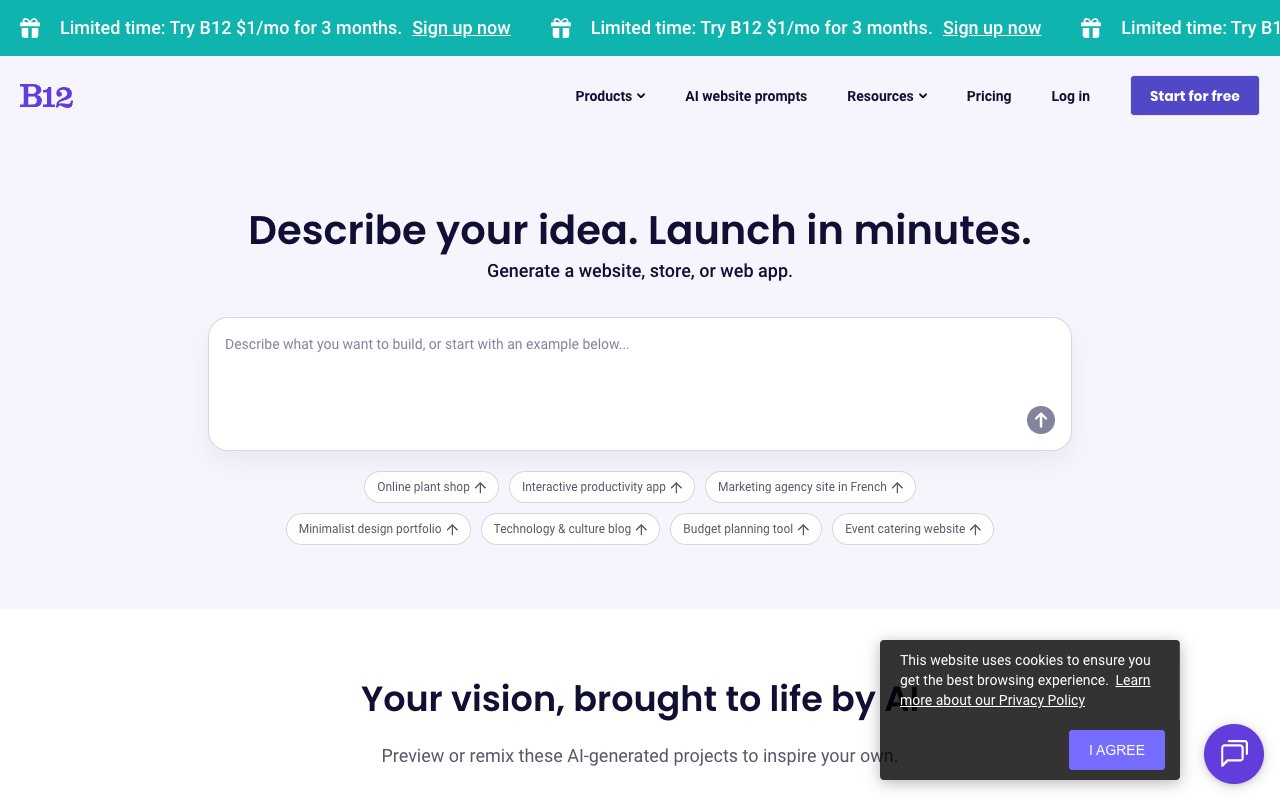
B12 combines AI-generated websites with human designer review. The AI creates a first draft in 60 seconds, then human designers refine it. This hybrid approach produces higher-quality results than pure AI generation.
What it builds: Professional websites, scheduling, invoicing, email marketing, and contracts. Focused on professional services (law firms, financial advisors, consultants).
Pricing: A free plan, then $24/month for the Website plan and $78/month for Website + Client Engagement (scheduling, invoicing, email marketing).
Strengths: The AI-plus-human model produces websites that look genuinely custom, not templated. For professional services where first impressions determine whether clients sign, that quality difference matters. Built-in scheduling and invoicing reduce the number of tools you need.
Limitations: The client tools sit on the $78/month plan, well above Durable's $22 Launch plan. That's worth it if design quality wins you clients, but it's a significant jump for an early-stage business. Like Durable, B12 is focused on service businesses, not product sales.
Best for: Professional service providers who need a polished, trustworthy web presence.
5. Polsia: Full Autonomous Business Runner

Polsia is the most autonomous platform on this list. It claims to build and run entire businesses autonomously: the AI creates your website, generates marketing content, runs ad campaigns, handles customer outreach, and optimizes for growth. You describe the business. Polsia builds it.
What it builds: Complete businesses including websites, marketing campaigns, social media content, email outreach, and sales funnels.
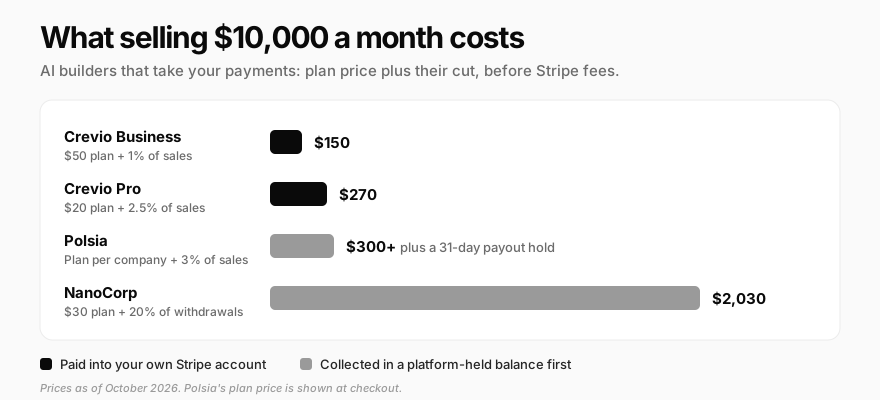
Pricing: A monthly plan per company, plus extra task credits from $19/month. Its current terms take 3% of every customer payment, hold payouts for a 31-day settlement period, and add a 20% platform fee to ad budgets it runs.
Strengths: The scope is genuinely broader than any other platform here. If you want to test a business idea quickly without touching any tools yourself, Polsia comes closest to the "describe it and forget it" promise. Fortune covered Polsia's approach in March 2026, and the company is attracting significant attention.
Limitations: Results are rare. Polsia's founder said in May 2026 that about 10% of companies on the platform had made at least a dollar, and that around half of customers leave in their first month. Customer payments also wait 31 days before you can withdraw them.
Polsia launched in February 2026 and has raised $30 million since. Users report that AI-generated marketing content can feel templated and that free credits run out before a working result. For a more detailed analysis, see our Is Polsia Legit? review — and for a head-to-head comparison with the closest competitor in the autonomous AI company space, see our NanoCorp alternatives breakdown.
Best for: Entrepreneurs who want to test business ideas hands-off and are comfortable with the AI acting without check-ins.
6. n8n: Open-Source AI Workflow Builder
n8n is an open-source workflow automation platform with 400+ connectors. It's not an AI business builder in the turnkey sense, but it's the most flexible tool for building AI-powered business workflows from scratch.
What it builds: Custom automation workflows connecting any combination of tools, APIs, and AI models. You can build lead generation systems, content pipelines, customer support flows, and more.
Pricing: Free when self-hosted (you pay for server costs, roughly $20-30/month on a VPS). Cloud plans start at €20/month, billed annually.
Strengths: Complete control over your automations with no vendor lock-in. The visual workflow builder makes complex automations accessible, and the open-source community contributes new connectors regularly. At 100,000+ tasks per month, n8n self-hosted costs a fraction of Zapier or Make.
Limitations: Self-hosting requires technical knowledge (Docker, server management). There's no pre-built business template: you're building everything from components. The learning curve is steeper than any other platform on this list.
Best for: Technical founders and developers who want maximum flexibility and cost efficiency for business automation.
7. Sintra: Role-Specific AI Employees
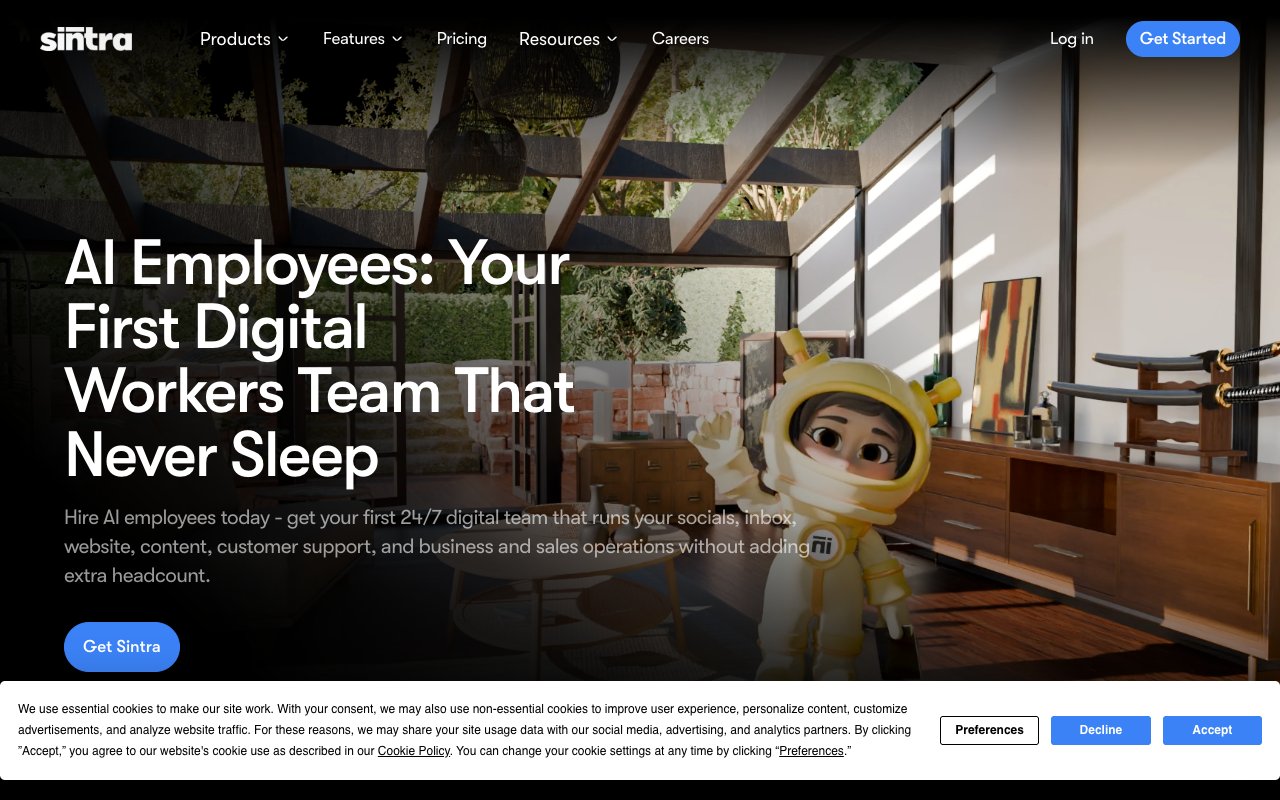
Sintra takes the "AI employee" metaphor literally. Instead of building workflows, you hire AI agents with specific roles: a marketing manager, a content writer, a customer support agent, a social media manager. Each agent shares a common understanding of your business through a shared profile.
What it builds: Role-based AI agents that handle specific business functions. The shared business profile means agents produce consistent, on-brand output.
Pricing: $39/month per AI helper, or $97/month for all 12, with discounts on longer commitments.
Strengths: The role-based model is intuitive. Instead of designing abstract workflows, you think in terms of job descriptions, which is how most business owners already think about delegation. The shared business profile reduces the "generic AI output" problem that plagues other platforms.
Limitations: Sintra is strongest for content and communications. It won't build your website, process payments, or create product infrastructure. It's a team of AI content and marketing employees, not a full business builder. Before you buy, read our Sintra AI review: its Trustpilot score is withheld over review incentives, and credits run out fast.
Best for: Solo founders who need help with content creation, social media, and marketing communications.
8. Make: Visual AI Workflow Automation

Make (formerly Integromat) is a visual workflow automation platform with 3,000+ app integrations. Like n8n, it's not a turnkey business builder, but its drag-and-drop interface makes building AI-powered automations accessible to non-technical users.
What it builds: Visual automation workflows connecting your business tools. Built-in AI modules let you add language processing, image generation, and data analysis to any workflow.
Pricing: Free tier available (1,000 credits/month). Paid plans start at $9/month with higher operation limits.
Strengths: The visual builder is the most intuitive of any automation platform. The free tier is generous enough to test real workflows. 3,000+ integrations mean Make can connect virtually any combination of tools in your stack.
Limitations: Like n8n, Make is a workflow tool, not a business builder. You're connecting existing tools, not generating business infrastructure. Complex automations can hit operation limits quickly on lower-tier plans.
Best for: Non-technical users who want to automate business workflows without writing code or managing servers.
AI Company Builder vs. AI Business Builder
You'll also see the term AI company builder. It usually means the most autonomous end of this category: you give a one-line idea, and the platform creates the company and runs it with as little input from you as possible. Polsia and NanoCorp are the best-known examples, and we compare seven of these tools in the best AI cofounder tools.
| AI company builder | AI business builder | |
|---|---|---|
| Starting point | A one-line idea, or none at all | The business you want to run |
| How much you steer | Little: agents pick tasks and act | You set direction and approvals |
| Typical result | Many quick experiments, few earning businesses | One business you keep growing |
| Examples | Polsia, NanoCorp | Crevio, Durable, B12 |
If you want to see what AI does with an idea, a company builder is a fun experiment. If you want a business with real customers, pick a builder that keeps you in charge of what matters. We explain the levels of autonomy in What Is an Autonomous AI Company?
How to Choose the Right AI Business Builder
The "best" AI business builder depends entirely on what you're building. Here's a decision framework:
| If you are a... | Choose | Why |
|---|---|---|
| Anyone running a business that sells (products, courses, services) | Crevio | AI builds and runs the business, with approvals you set |
| Service business (plumber, consultant, photographer) | Durable | Professional website + CRM + invoicing in 30 seconds |
| Founder automating operations across existing tools | Lindy | AI agents handle email, CRM, scheduling without switching platforms |
| Professional service firm (law, finance, consulting) | B12 | Polished website with human design quality builds client trust |
| Idea tester who wants maximum automation | Polsia | Broadest autonomy, but a 3% cut, 31-day payout hold, and few earning companies |
| Technical builder who wants full control | n8n | Open-source, self-hosted, maximum flexibility at lowest cost |
| Solo founder drowning in content work | Sintra | Role-based AI employees for marketing, social, and communications |
| Non-technical user who needs workflow automation | Make | Drag-and-drop builder, 3,000+ integrations, generous free tier |
The quick test: If you can describe your business in one sentence, try Crevio or Polsia first — they'll build the most from a simple description. If you already have tools and want to connect them, start with Make or Lindy. If you need a website fast, go with Durable or B12.
What AI Business Builders Can't Do Yet
As Sam Altman noted in a January 2026 blog post: "We are now confident we know how to build AGI as we have traditionally understood it." But even he acknowledges that today's AI excels at execution tasks while struggling with open-ended judgment.
Every platform on this list has real limitations. Here's what no AI business builder handles well in 2026:
| Area | What AI Does Well | What Still Needs You |
|---|---|---|
| Brand & positioning | Generates competent copy and visuals | Voice, differentiation, and brand direction |
| Customer relationships | FAQs, routine support, lead follow-up | Negotiations, partnerships, crisis management |
| Strategy | Optimizes within your parameters | Knowing when to pivot your entire model |
| Creative direction | Remixes existing patterns | Making your business feel distinctive, not derivative |
The most effective approach is treating AI business builders as a leverage multiplier: they handle the 80% of business operations that are execution and process, freeing you to focus on the 20% that requires human judgment, creativity, and relationships. If you want to see the complete AI toolkit for building a one-person business, we break down the best tool for each business function. A Stanford study on generative AI adoption found measurable productivity gains across industries, and that number keeps climbing as these platforms mature. We covered this framework in detail in our post on what AI can and can't do for your business.
The bottom line: The best AI business builder isn't the one that promises to do everything. It's the one that does exactly what your business needs, reliably, at a price that doesn't eat your margins. Start free, test with real customers, and upgrade only when the revenue justifies it.
FAQ
An AI business builder is a platform that creates working business infrastructure from a natural-language description. Instead of configuring tools manually, you describe what you want to build or sell, and the platform generates storefronts, payment processing, marketing funnels, or workflow automations automatically. This distinguishes AI business builders from AI tools (which complete individual tasks) and AI automation platforms (which execute predefined workflows).
AI can build the infrastructure of a business: websites, product pages, payment processing, and marketing sequences. Several platforms on this list do exactly that. However, a successful business also requires strategy, customer understanding, brand voice, and judgment calls that AI doesn't handle well yet. The most effective approach is using an AI business builder for infrastructure and operations while keeping human oversight on strategy and customer relationships.
Costs range dramatically. Free options exist (Crevio Starter, Durable, B12, n8n self-hosted, Make) for getting started. Paid plans mostly cost $20-$80 a month. Watch the percentage models too: Crevio takes 1-5% of sales depending on the plan, and Polsia takes 3% of every payment and holds payouts for 31 days. For a complete solopreneur AI stack, annual costs typically range from $3,000 to $12,000 depending on which tools you combine.
For complete beginners with no technical skills, Crevio and Durable are the best starting points. Durable generates a business website in 30 seconds — you just enter your business type. Crevio lets you describe what you want to sell and builds your website, products, and payments automatically. Both have free or low-cost entry points, so you can test before committing. Avoid n8n and Lindy if you're non-technical, as they require designing workflows yourself.
An AI website builder (like Wix AI or Squarespace AI) generates a website — pages, layout, and copy. An AI business builder goes further: it creates the business infrastructure behind the website, including payment processing, product delivery, customer management, marketing automation, and analytics. Think of it this way: a website builder gives you a storefront. A business builder gives you the storefront plus the operations team running it.
Most AI business builders in 2026 are optimized for digital products and services, not physical goods. If you sell physical products, you'll generally need a dedicated e-commerce platform like Shopify (which has its own AI features) or WooCommerce. Platforms like Durable and B12 work for service businesses that sell time or expertise rather than inventory. Crevio is built around products, courses, memberships, and services sold online.
For most solopreneurs and small teams, yes. Building a business manually means stitching together 5-10 separate tools (website builder, payment processor, email platform, CRM, analytics). According to Deloitte's 2024 SMB survey, small businesses using integrated digital tools earn 2x more revenue per employee than those using disconnected tools. An AI business builder replaces that fragmented stack with a single platform, saving both time and integration headaches.
Related Blog Posts
What will you sell today?
Describe what you want to sell — Crevio builds, launches, and grows it. Products, payments, and marketing, all on autopilot.
Start for free

