Your business,
on autopilot.
One platform for creating, running and growing your business, powered by AI.
AI Business Builder vs Hiring a Team: The Honest 2026 Comparison




Hiring a five-person launch team in 2026 costs roughly $32,000 a month. An AI business builder doing 80% of the same work costs about $50. That gap is why solo-founded startups jumped from 23.7% to 36.3% of all new companies on Carta by mid-2025, and why Matthew Gallagher took Medvi from $20,000 to a $1.8B run rate with a team of two.
The honest answer is not "AI is always better" or "you still need humans." It is more specific: AI now wins on five of the seven jobs a small team used to do, and humans still win on the other two. The trick is knowing which is which before you spend the money.
- AI business builder wins on: speed (hours vs weeks), cost (60-100x cheaper), iteration speed, and the boring parts (copy drafts, page layouts, basic ops).
- A human team still wins on: original strategy, brand taste, regulated work, and high-stakes negotiations.
- The hybrid wins on everything: AI for execution, one or two specialists for the 20% that decides whether the business actually works.
The 60-Second Answer
| Dimension | Hiring a small team | AI business builder | Winner |
|---|---|---|---|
| Cost (first 90 days) | $80,000-$120,000 | $50-$600 | AI |
| Time to first launch | 6-12 weeks | 2-5 days | AI |
| Iteration speed | 2-3 cycles/month | 10+ cycles/week | AI |
| Strategic judgment | Strong | Weak | Humans |
| Brand taste | Strong | Adequate | Humans |
| Customer support volume | Capped by headcount | Scales infinitely | AI |
| Regulated work (legal, medical, finance) | Required | Cannot do alone | Humans |
If you are pre-revenue or under $50K MRR, an AI business builder is almost always the right starting point. Hiring before you have product-market fit is the most common reason solo founders run out of money in 2026.
What "Hiring a Team" Actually Means in 2026
The fair comparison is not "AI vs one designer." It is AI vs the smallest viable team you would otherwise need to launch and run an online business. That team usually looks like this:
| Role | Typical US rate | Monthly cost | What they do |
|---|---|---|---|
| Web designer | $80-$120/hr | $4,000-$6,000 (part-time) | Site design, branding |
| Developer | $100-$160/hr | $6,000-$10,000 (part-time) | Build site, integrate Stripe |
| Copywriter | $75-$125/hr | $3,000-$5,000 (part-time) | Product pages, emails, launches |
| Marketing manager | Salaried | $7,000-$10,000 | Campaigns, social, ads |
| Customer support | Salaried/VA | $2,500-$4,500 | Inbox, refunds, basic help |
| Total monthly burn | $22,500-$35,500 |
That is $270K-$425K a year before benefits, software, or onboarding overhead. For a business that has not yet proven anyone wants to buy what you sell.
An AI business builder like Crevio covers the working draft of all five of those jobs for $0-$50 a month. The drafts are not as good as a senior specialist's work. They are usually better than a junior's first attempt, and they ship in hours instead of weeks.
Where AI Actually Wins (Honestly)
1. Time-to-launch
A senior team needs roughly 6-12 weeks to take a new product from idea to a live, payment-processing storefront. An AI business builder gets you to a working store with copy, checkout, and email sequences in 2-5 days. For most pre-revenue founders, that 8-week head start is the entire difference between launching and not.
2. Cost per iteration
Iterations are where most products die. A team has to schedule meetings, write briefs, and ship in two-week sprints. An AI agent rebuilds a landing page in 10 minutes. You can run 20 versions of a checkout flow this week instead of 2 next month. Cheaper iteration compounds into faster learning.
3. The boring 80%
Most of "running an online business" is not glamorous design work. It is product page templates, email subject line variants, refund replies, FAQ updates, social captions, and analytics summaries. AI does the 80% that drains a human team's morale and budget. Your humans (if you have any) get to spend their time on the 20% that matters.
Picking which part of that 80% to hand over first matters more than it sounds, and the intuitive answer is usually wrong. We mapped it out in which lanes to hand an AI agent first.
4. Scaling support without hiring
Customer support is the role most likely to break a small team. One viral launch and your inbox triples overnight. An AI agent answers Tier-1 questions (order status, refund policy, login problems) at 2 AM without a salary. A human still handles disputes and VIPs. You staff for the exceptions, not the volume.
5. The shipping ratio
A team of five can probably ship one major thing a week. A solo founder with an AI business builder can ship one major thing a day. Whether that compounds into a real business depends on your judgment, but the capacity to ship is no longer the bottleneck.
Where Hiring Still Wins (Also Honestly)
There are four areas where AI is still meaningfully behind a competent human, and pretending otherwise will cost you money.
Original strategic bets
AI is excellent at optimization. It is bad at deciding whether to enter a category nobody is in yet. Gallagher did not ask ChatGPT whether to start Medvi. He read regulatory shifts and buyer intent and made a human bet. Your "should we even build this?" call is the most expensive decision you will make. Do not outsource it.
Brand taste and identity
AI will happily ship 50 brand variations. It cannot tell you which one feels right for your audience. Picking the version that lands is still a human judgment call. The best operators use AI for drafts and a human (often themselves, sometimes a contracted designer) for the final 20%.
Regulated relationships
If you are touching legal, medical, financial, or insurance work, you need licensed humans in the loop. Medvi works because Gallagher outsourced licensed physicians and compliance to specialists. He did not try to get AI to practice medicine. The pattern is: keep humans inside the regulated core, use AI for everything around it.
High-stakes human-to-human work
Closing a six-figure enterprise deal. Firing someone. Negotiating a partnership. Pitching an investor. AI can prep you, script you, and rehearse with you. It should not be the one in the room.
The Real Cost Comparison Over 12 Months
Below is what the same business looks like under both models. Assume a digital product business doing $0 → $200K in year one (the realistic high-end for a well-executed solo launch).
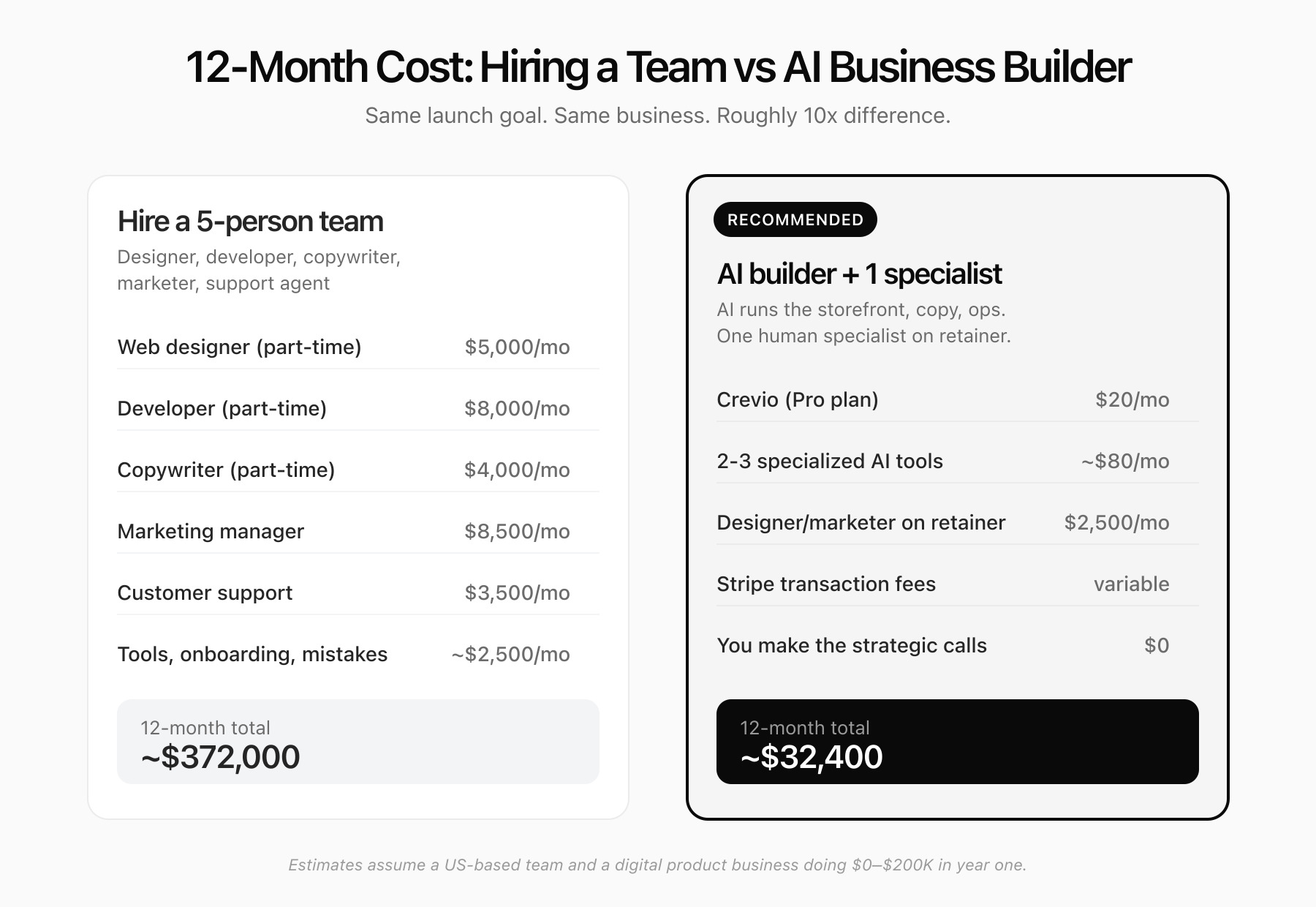
The team approach assumes everything goes right. In practice, half of new hires need replacing within a year, scope creeps, and tools multiply. The AI approach has its own failure mode (founder burnout from making every strategic call alone), which is why "AI plus one human specialist" almost always beats either extreme.
The Hybrid Setup That Actually Wins
After watching a hundred solo founders try this, the pattern that works is not "AI does everything." It is a three-layer stack:
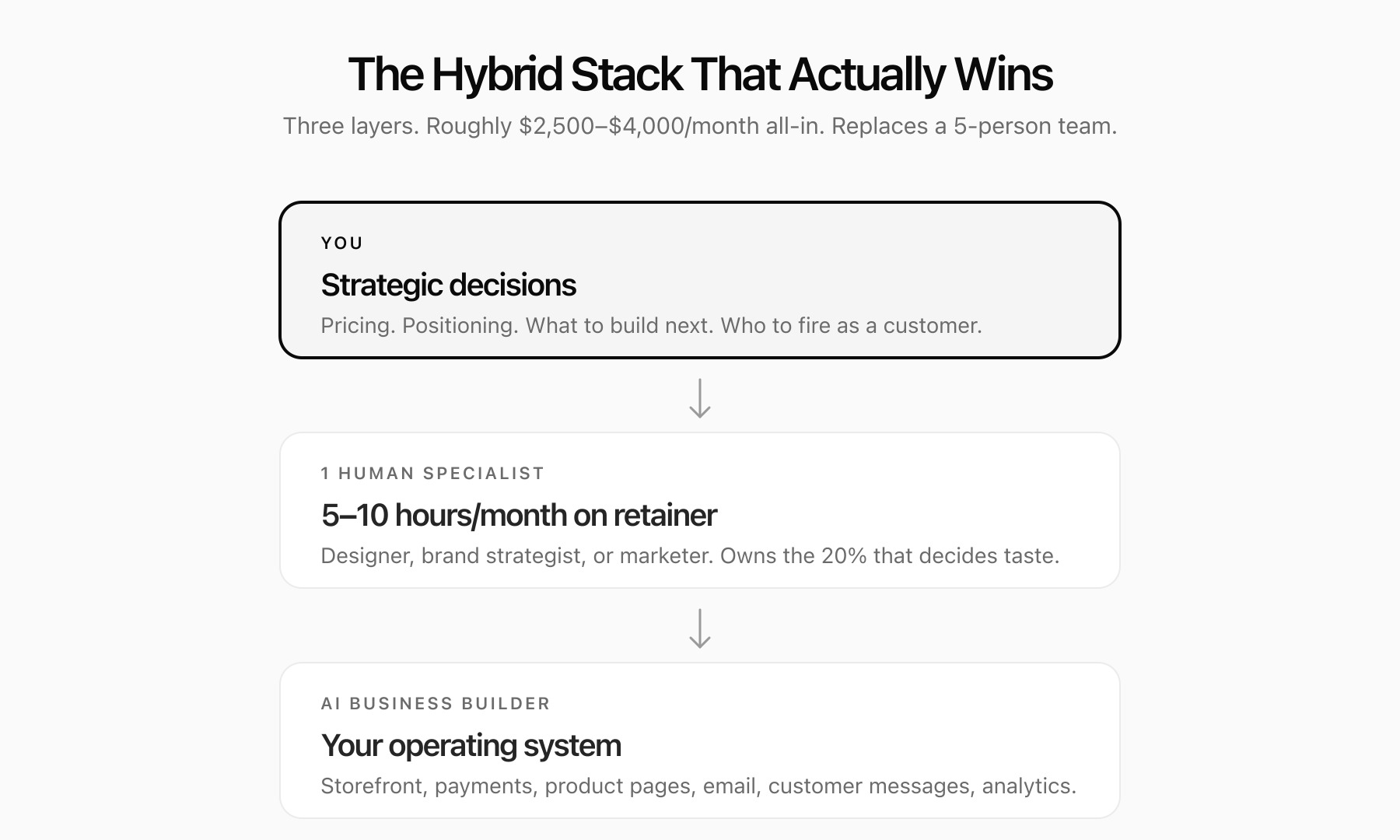
- AI business builder as the operating system. It runs the storefront, payments, product pages, email sequences, customer messages, and analytics. This is your full-time team replacement.
- One human specialist on retainer. Usually a designer, brand strategist, or marketer. Five to ten hours a month. Their job is the 20% that decides whether the business feels right and positions right.
- You make the strategic calls. Pricing, positioning, what to build next, who to fire as a customer. AI advises. You decide.
This costs roughly $2,500-$4,000 a month all-in. It replaces a team that would cost ten times more, and (this is the part nobody tells you) it usually moves faster than the team would.
The Part Nobody Writes About: Your Bottleneck Moves
When AI takes over execution, your bottleneck does not disappear. It moves. It shifts from "I do not have enough people to ship" to "I do not have enough conviction to decide fast enough."
Most founders are mentally unprepared for this. When you had a team, your job was managing the team. When AI runs the team, your job is making 5-10 strategic calls a day with less context, because you are no longer in the weeds of the work that produced them.
The fix is not a tool. It is the habit of deciding fast on reversible calls and slow on irreversible ones, and writing down the difference so you can improve. The founders who get this earliest are the ones who turn an AI-run business into a scaling one. The ones who do not end up frozen and call it "AI burnout."
For the deeper version of this argument, see can AI run a business.
Where Crevio Fits
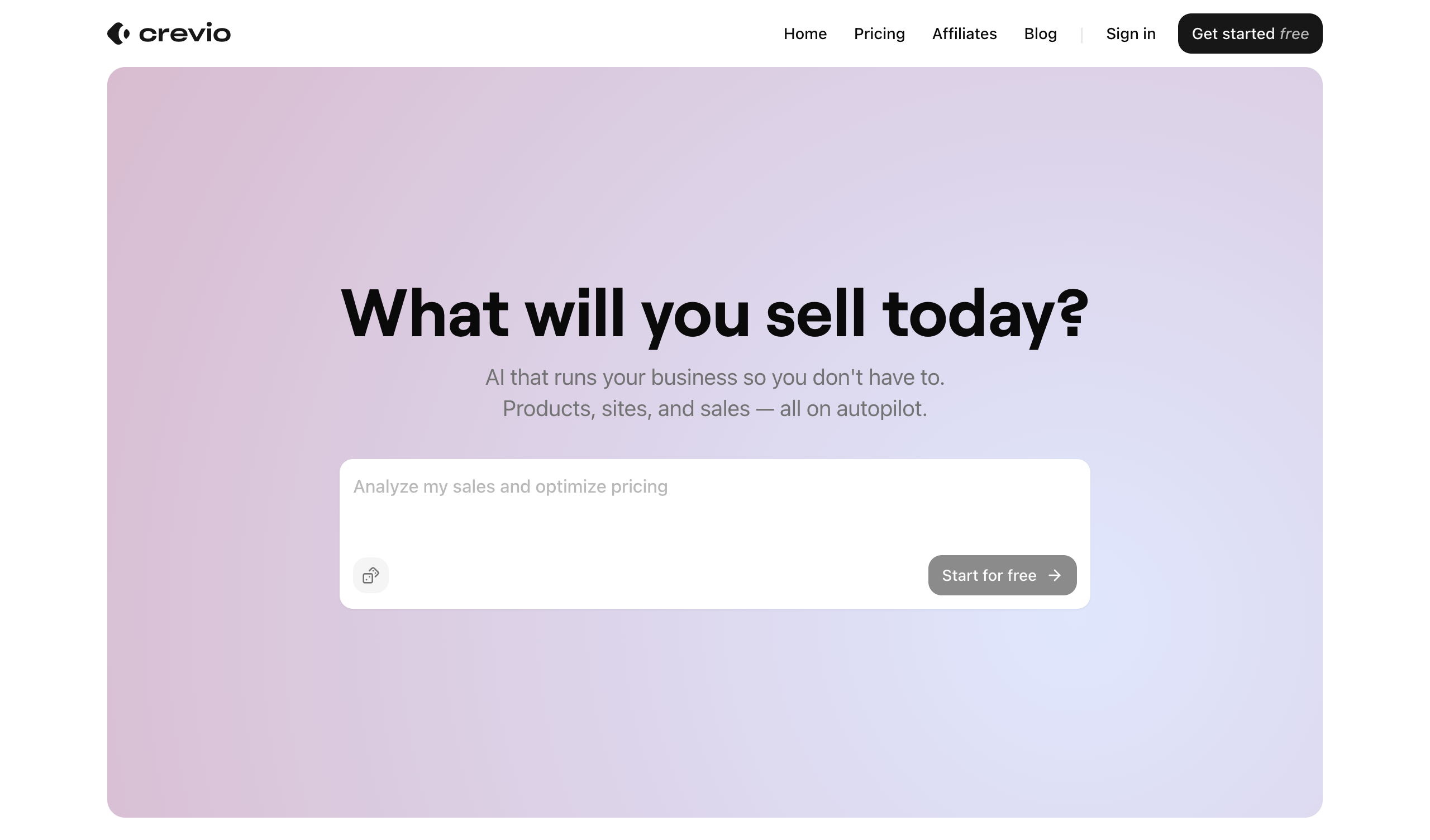
Crevio is the AI business builder for digital product businesses: courses, downloads, memberships, coaching, embeds. You describe what you want to sell. Crevio builds the storefront, sets up Stripe-powered checkout, drafts the product pages, generates marketing copy, and handles customer messaging.
What it costs:
| Plan | Price | Transaction fee | Best for |
|---|---|---|---|
| Starter | Free | 5% | Validating a product idea |
| Pro | $20/mo | 2.5% | Real launches, full storefront |
| Business | $50/mo | 1% | Scale, custom domain, no Crevio branding |
What Crevio does not do: physical product shipping, inventory, fulfillment, or anything that requires a warehouse. If you are selling t-shirts or running a consultancy with a 12-person sales team, this is not for you. If you are selling digital things and would otherwise be hiring 3-5 people to do it, it is the most leveraged $20-$50 you will spend this year.
The honest limit: Crevio is shipping today as a capable AI partner, not a fully autonomous CEO. The agents handle real work. The strategic calls are still yours. We think that is the right design for 2026, not a limitation we are hiding.
For the wider category landscape (Durable, Lindy, Polsia, B12, and others), see the AI business builder roundup.
Two Objections That Actually Matter
"My business will feel generic if AI does the work." Only if you outsource the 20% that matters: your voice, your examples, your point of view, your taste in customers. Founders making real money use AI for the commoditized 80% and spend their saved time on the 20% that differentiates. Generic is a choice.
"I cannot fire AI when something goes wrong." True, and this is the strongest argument for keeping at least one human specialist in your stack. AI does not get fired; it gets retrained, prompted, or swapped. That is a different management discipline than running a team, and it takes a few months to build the muscle.
When You Should Actually Hire a Team
To be fair to the other side: there are real cases where hiring beats AI, and pretending otherwise would be misleading.
- You are past $1M ARR with a clear playbook. At that point, hiring people to execute a known process is faster than re-prompting AI for it.
- You are in a regulated industry. Legal, medical, financial, insurance. You need licensed humans on payroll, not contractors.
- You are selling enterprise. B2B deals over $50K usually require a human salesperson. AI can support, not close.
- You are building a venture-scale company. Some categories require a team of 10+ in the first year because the moat is execution complexity, not insight. Most online businesses are not this.
If none of those apply to you, AI plus one specialist is almost certainly the right starting point. You can always hire later. You cannot un-spend a $400K runway on a team that built the wrong thing.
FAQ
Not for most online businesses in 2026. A small team typically costs $22K-$35K a month and takes 6-12 weeks to launch. An AI business builder gets you to a working business in days for $0-$50/mo. Hiring becomes the right answer once you have proven demand and need to execute a known playbook at scale, usually past $1M ARR.
A typical AI business builder replaces the working draft of a web designer, developer, copywriter, marketing manager, and Tier-1 customer support agent for digital product businesses. It does not replace strategic decisions, brand identity calls, regulated work, or high-stakes negotiations. Those remain human.
A realistic 2026 stack is $50-$200/month: an AI business builder ($0-$50/mo), one or two specialized AI tools ($20-$100/mo), and transaction fees on payments. If you add one part-time human specialist on retainer (recommended), budget another $1,500-$3,000/month. Total: under $4,000/mo for what would otherwise cost $25,000-$35,000 in headcount.
For Tier-1 questions (order status, refund policy, login help), yes. For disputes, complex edge cases, and high-value VIP customers, you still want a human reading the message. The right setup is a tiered queue: AI handles the common 80%, a human reviews the rest. Most solo founders handle the human tier themselves until volume justifies a hire.
The Bottom Line
The choice is not "AI or humans." It is "which 20% of work do you keep human, and what do you hand off on day one?" Founders who hire a five-person team before they have product-market fit usually run out of money. Founders who try to do everything themselves usually burn out. Founders who use an AI business builder for execution and one human specialist for taste are the ones quietly hitting numbers that would have required a Series A team in 2022.
Start with the AI builder. Add a specialist when you can name exactly what they will do. Hire a team only when you have a playbook worth scaling.
Pick the order wrong and you build the wrong thing with money you do not have. Pick it right and a $50/month tool replaces a $300,000 burn rate, which is the kind of math that turns a side project into a business this year.
Related Blog Posts
What will you sell today?
Describe what you want to sell — Crevio builds, launches, and grows it. Products, payments, and marketing, all on autopilot.
Start for free