Your business,
on autopilot.
One platform for creating, running and growing your business, powered by AI.
Can AI Run a Business? What's Actually Possible in 2026





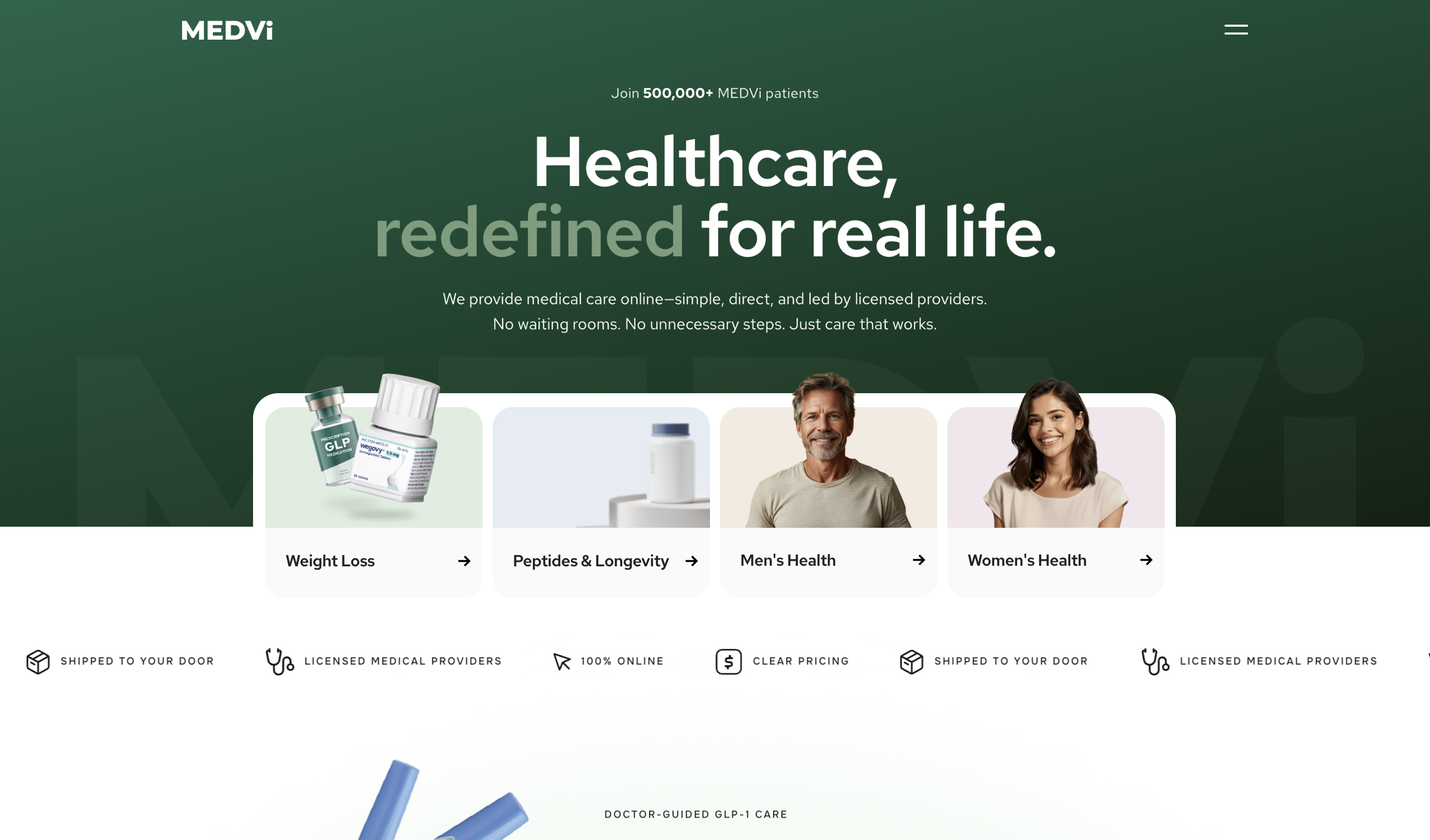
Can AI run a business in 2026? For most of it, yes, and someone already proved it. Matthew Gallagher launched Medvi from his living room with $20,000. Fourteen months later, the company hit $401 million in sales with a team of two. Year two is on a $1.8 billion run rate.
The tools Gallagher used (ChatGPT, Claude, Grok, ElevenLabs, Midjourney) are ones anyone can buy today. The advantage was not exotic technology. It was deciding which parts of a business a human still needs to touch, and handing off the rest.
Here is the honest breakdown of what AI handles today, what still needs a human, and how to actually run your own business this way.
- Short answer: Yes, AI can run most of the functions of a small online business today, including product building, storefront, marketing, customer messaging, and analytics.
- Honest limit: AI still cannot replace human judgment on strategy, taste, regulated relationships, and original positioning.
- What changed in 2026: Purpose-built "AI business builder" platforms consolidated what used to take 10 separate tools into one. Solo founders are seeing the results.
What AI Can and Can't Run (2026 Reality Check)
| Business function | Can AI run it today? | Human still needed for |
|---|---|---|
| Building a storefront or site | Yes | Final taste pass, brand fit |
| Writing marketing copy | Yes | Tone calibration, nuance |
| Running launch campaigns | Yes | Strategic timing, big bets |
| Customer messaging and support | Mostly | VIP, escalation, disputes |
| Pricing and packaging | Partially | Final call on positioning |
| Analytics and reporting | Yes | Interpretation and action |
| Payments and operations | Yes | Compliance, banking decisions |
| Strategy and vision | No | Must be human-led |
The Short Answer: Yes, and Someone Already Proved It
In early 2024, Sam Altman told Reddit co-founder Alexis Ohanian that he kept a betting pool with other tech CEOs for the year the first one-person billion-dollar company would arrive. Forecast window: 2026 to 2028. Medvi showed up early.

For context on scale: Hims and Hers, the closest competitor to Medvi, reported $2.4 billion in revenue with 2,442 employees and a 5.5% net margin. Medvi ran at 16.2% net margin with 0.08% of the headcount.
The pattern scales down. Indie hacker Pieter Levels generates millions per year across a portfolio of solo projects with zero employees. The playbook is the same at $3M as at $1.8B: define a narrow market, use AI to run the work, keep a human on the strategic decisions.
What "Running a Business" Actually Means
Most people who ask "can AI run a business?" are picturing a single magic button. That is not what is happening. Running a business is actually seven distinct jobs: product, storefront, marketing, sales, customer experience, analytics, and strategy. Six of them can be AI-led in 2026. The seventh cannot.
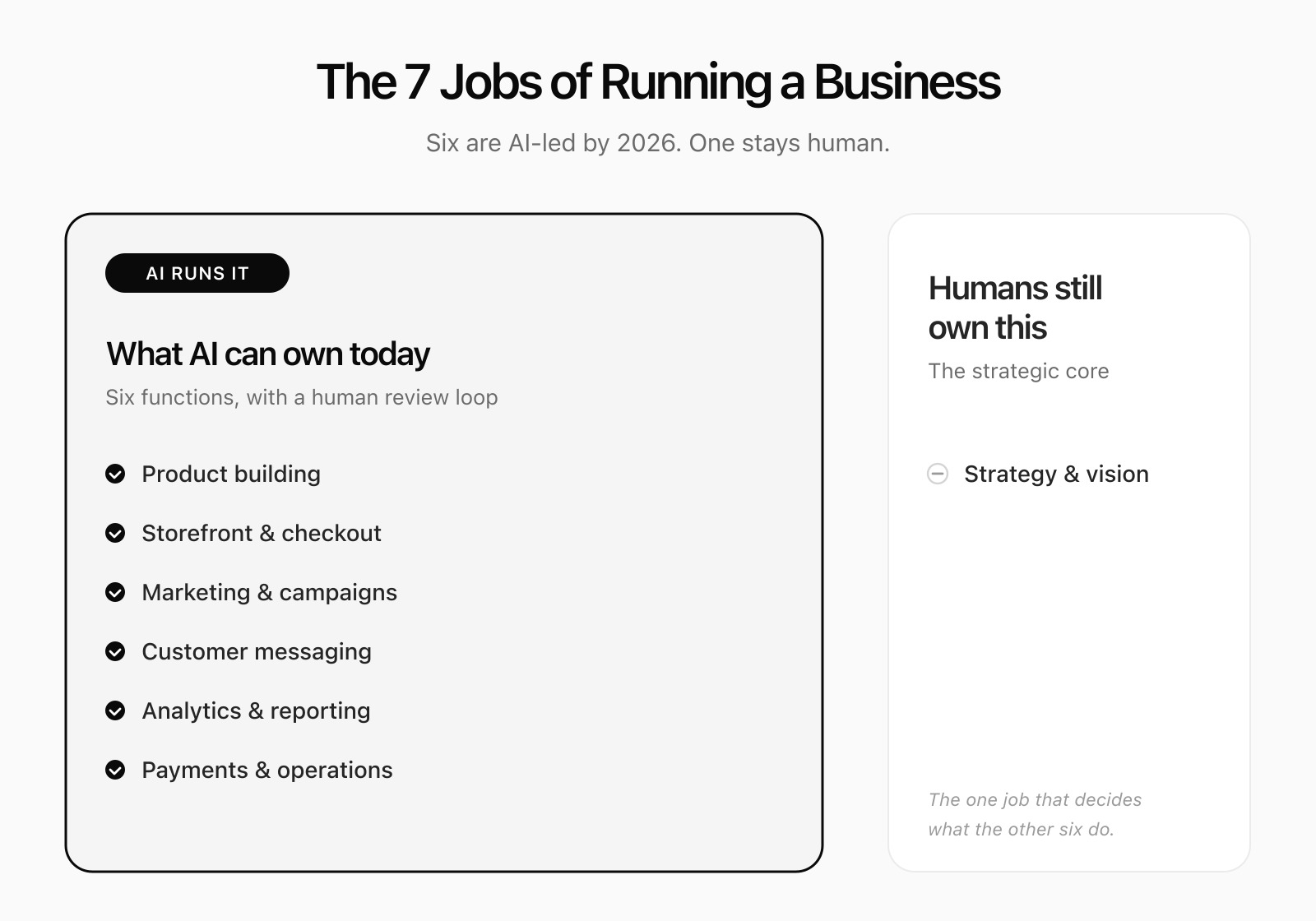
A business owner used to do all seven alone, or hire a team to do them — typically at $25K-$35K a month for a five-person launch crew. In 2026, AI can take on most of the work inside jobs 1 through 6. Job 7 stays human. The question is not whether AI can run a business. It is which pieces you hand off, and where you keep oversight.
What AI Can Actually Run Today
Here is an honest, function-by-function assessment of what works in production right now.
Product building
AI can build the first 80% of a digital product from a prompt. A course outline with module structure, a downloadable template with live data, a coaching program with a starter curriculum, a paid newsletter with a launch sequence. The last 20%, meaning your specific examples, your voice, your hot takes, still comes from you. That is the part that makes it sellable.
Storefront and checkout
This is the most underrated shift of 2026. Where a year ago you needed Webflow plus Gumroad plus Stripe plus Zapier plus a ConvertKit account glued together, now a single AI business builder assembles the whole stack. You describe what you sell. It builds the store, wires the checkout, and generates the product pages.
Marketing copy and campaigns
If your marketing copy in 2026 is not at least partly AI-drafted, you are wasting time on the least differentiated part of the work. The winners use AI for the first draft and humans for the final 20%, which is also the right split for AI agents in marketing. Drafts in 10 minutes, edits in one hour, launch the same day.
Customer messaging and support
AI handles the repetitive 80% of customer messages well: order status, refund windows, login problems, how-tos. The remaining 20% (disputes, edge cases, big-ticket VIPs) still benefits from a human. The right setup is a tiered queue, not a binary choice.
Analytics and reporting
Every major platform now has an AI layer that surfaces anomalies, writes weekly summaries, and flags what to act on. You no longer need a data analyst to tell you your Tuesday email underperformed.
Payments and operations
Stripe plus an AI layer handles payouts, tax, invoicing, subscription management, and dunning. Compliance still needs human review, but the manual work is mostly gone.
What AI Still Can't Run (Yet)
Being honest here matters. AI still falls short in four specific areas.
Original strategic bets
AI is excellent at optimization and pattern-matching. It is not good at deciding to enter a category nobody is in yet. Gallagher did not ask ChatGPT whether to start a GLP-1 telehealth company. He made that call as a human with a specific read on regulatory arbitrage and buyer intent. The biggest moves in any business are still human calls.
Taste and brand judgment
AI will happily ship 50 variations of a brand voice. Picking the one that actually works is still a human call. The best operators use AI as a drafting partner, not a decision-maker on identity.
Regulated relationships
Medvi works because Gallagher outsourced licensed physicians and compliance to CareValidate and OpenLoop. He did not try to get AI to practice medicine. For regulated work (legal, medical, financial), the pattern is to keep humans in the loop and use AI for everything around the regulated core.
High-stakes human-to-human work
Complex negotiations, closing an enterprise deal, firing someone, partnering with another founder. AI can prep you, script you, and rehearse with you. It should not be the one in the room.
The Part Nobody Writes About: Your Bottleneck Moves
Here is what nobody warns you about when AI takes over execution: your bottleneck does not disappear. It moves. It shifts from "I do not have enough time to build" to "I do not have enough conviction to decide fast enough."
Most founders are not mentally prepared for this. When AI was doing one task and you were building the rest, the job was effort. When AI runs most of the execution, the job becomes judgment. You are suddenly making five strategic calls a day that used to be one call a month, and each call has less context because you are no longer in the weeds of the work that produced it.
The old coping mechanism of "staying heads-down on the work" is gone. You cannot buy yourself time by disappearing into the code or the copy. The work is done in 20 minutes. The decision of what to do next is the job.
The fix is not a tool. It is building the habit of deciding fast on reversible calls and slow on irreversible ones, and journaling the difference so you can improve. The founders who get this earliest are the ones who turn an AI-run business into a scaling one.
The New Category: AI Business Builders
If you asked someone how to start a business online in 2021, the answer was to buy a domain, set up Shopify, install apps, and hire a designer. In 2026 there is a new answer: use an AI business builder. We walk through it step by step in how to start a business with AI.
An AI business builder is not a website builder with an AI feature bolted on. It is a platform where you describe what you want to sell, and AI builds the storefront, writes the product copy, drafts the launch campaign, handles payments, and handles customer messaging end to end. You focus on the 20% of decisions that matter. The AI does the rest.
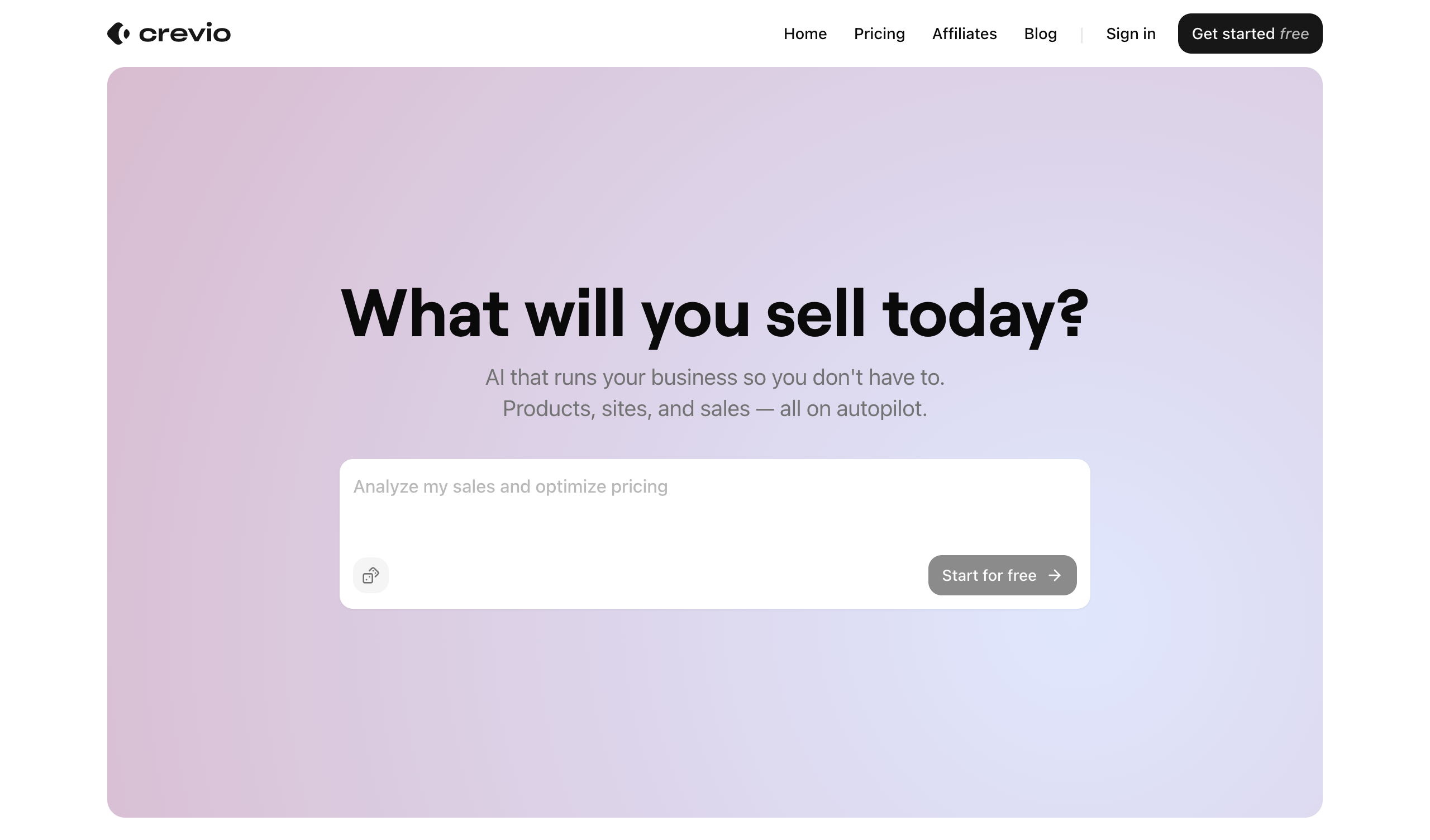
Crevio is an example of this new category. You tell it what you want to sell. It builds the site, launches the product, and runs your marketing. Crevio starts on a free plan, runs on Stripe, and replaces a stack that used to include Kajabi, Gumroad, Linktree, and a website builder. Today Crevio is a capable AI partner with agents that automate real work. The longer-term vision is for those agents to get more autonomous over time, driving product creation, marketing, and growth with less manual input.
This is different from point-solution AI tools like copy generators, image generators, or chatbots. Those help with one task. An AI that runs your business takes on the whole operation.
How to Actually Let AI Run Your Business
Tactical playbook, in the order most people should follow it.
1. Pick one specific thing to sell
Narrow wins. Medvi sells one category: GLP-1 telehealth. Pieter Levels runs niche micro-SaaS products. Pick a product you can describe in one sentence to a stranger. If you cannot, AI cannot either.
2. Let AI build the storefront and product
Do not start in Figma. Do not hire a designer for the first version. Use an AI business builder to describe what you want to sell, and let it generate the site, the product page, the checkout, and the first email sequence. You will be 2 to 4 weeks ahead of where you would have been building manually. For a full walkthrough, see how to sell digital products in 2026.
3. Launch small, learn fast
A soft launch to 100 people beats a big launch to nobody. Use AI to draft the launch sequence, but send it yourself and watch who replies. The signal is in the replies.
4. Set four human checkpoints
AI handles the day-to-day. You still decide on: pricing changes, brand positioning shifts, handling of VIP customers and complaints, and strategic pivots. Those four decisions stay manual.
5. Compound
Every week, look at what AI did, keep what worked, and tune what did not. This is the part most people miss. Treat your AI agents like a junior team: give feedback, iterate, and the output gets measurably better over time. See the full AI tools stack that solo founders are using in 2026.
The Two Objections That Actually Matter
"My product will feel generic if AI makes it." Only if you outsource the 20% that matters: your voice, your examples, your point of view. The solopreneurs making real money use AI for the commoditized 80% and spend their time on the differentiated 20%. Generic is a choice, not a consequence.
"I'll lose my moat." Your moat is not the code or the copy. Your moat is the specific audience you know, the product taste you have developed, and the trust you have built. AI amplifies those. It does not erase them. The founders losing their moat to AI are the ones whose moat was shallow to begin with.
FAQ
Not reliably, not in 2026. The closest case (Medvi) still runs with a two-person human team making every strategic call. The realistic setup for most businesses is AI handling day-to-day execution with a human making the four to six weekly strategic decisions that actually move the business.
For digital products, subscriptions, and one-person businesses, an AI business builder like Crevio bundles the stack into one. For point tasks (copy, images, voice), specialized tools like ChatGPT, Claude, Midjourney, and ElevenLabs are still the go-to references. The pattern most solo operators land on is one AI business builder as the hub plus two or three specialized tools as spokes.
A real-world 2026 stack for a solo founder is roughly $50 to $200 per month: an AI business builder on a free or starter plan, one or two specialized AI tools, and transaction fees on payments. Matthew Gallagher built Medvi for $20,000 total, most of it going to compliance and marketing, not to tools.
The Bottom Line
Can AI run a business? It already is, in roughly the time it takes a Fortune 500 company to schedule a digital transformation kickoff. The difference between the founders hitting $1 million solo and the ones still building slide decks is not access to better AI. Everyone has the same models. The difference is which 20% of decisions they kept for themselves, and what they were willing to hand off on day one.
Start small, hand off fast, and keep the strategic calls. That is the playbook.
Related Blog Posts
What will you sell today?
Describe what you want to sell — Crevio builds, launches, and grows it. Products, payments, and marketing, all on autopilot.
Start for free