Your business,
on autopilot.
One platform for creating, running and growing your business, powered by AI.
How to Start a Business With AI in 2026: A 6-Step Guide





Last updated: October 3, 2026
You can start a business with AI in a weekend, for less than a nice dinner a month. AI can now build the website, write the products, take payments, send the emails, and run the ads. What it can't do is decide what's worth selling, and that's the part that decides whether you make money. This guide shows exactly where AI does the work and where you still have to.
It's for first-time founders, side hustlers, and anyone with an idea who doesn't want to hire a team or learn five tools to test it. You'll get a six-step plan from idea to first customers, what each step looks like with AI, what it costs, and the mistakes that sink most AI-built businesses.
Key takeaways:
- AI handles execution, you handle direction. Research, building, copy, marketing, and support can all run on AI. Choosing the idea, the price, and what to approve stays with you.
- Validate before you build. Fully autonomous AI companies rarely earn: one platform's founder said about 10% of its companies had made a dollar. The difference is a human checking that someone will pay.
- One AI that runs the whole business beats a stack of tools. A single platform like Crevio builds the site, takes payments, and runs marketing from one place.
- You can start for $0. Free plans cover testing an idea. Expect $20 to $50 a month once it works.
What Starting a Business With AI Means in 2026
There are three ways people use AI to start a business, and they're very different:
| Approach | What you do | What AI does | Good for |
|---|---|---|---|
| AI as an assistant | Build and run everything yourself | Answers questions, drafts copy | Learning, planning |
| A stack of AI tools | Connect a website builder, email tool, scheduler, and more | Each tool automates one job | People who enjoy setting up tools |
| AI that runs the business | Decide, approve, and steer | Builds the business and runs the daily work | Getting to customers fastest |
A fourth option, fully autonomous "AI company builders," hands even the decisions to the AI. It's a fascinating experiment, but as you'll see below, the results so far are thin. We compare all of these in the best AI cofounder tools.
This guide follows the third approach: AI does the work, and you stay in charge.
How to Start a Business With AI, Step by Step
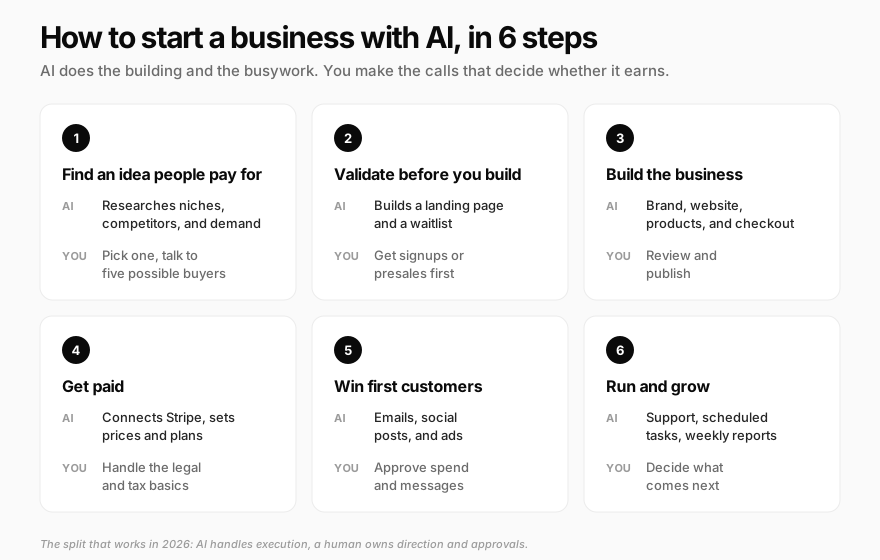
Step 1: Find an idea people will pay for
AI is a fast research partner. Ask it to list problems in a niche you know, summarize what people complain about in forums and reviews, and size up competitors and their prices. Good prompts are specific: "What do freelance photographers complain about most when invoicing clients, and what do current tools charge?"
The best ideas usually come from your own experience. A sous chef we spoke with built a site of cooking and unit-conversion calculators because he used them every day at work. You don't need a novel idea, just a problem you understand and people who'd pay to solve it.
Your job: pick one idea, then talk to five people who'd plausibly buy it. AI can find them and draft the message, but the conversation is yours.
Step 2: Validate before you build
This is the step most AI-built businesses skip, and it's the one that matters most. The fully autonomous platforms show why. Polsia's founder said about 10% of its companies had made at least a dollar, and NanoCorp's own dashboard shows $14.4K earned across nearly 33,000 businesses. AI is great at building things; it can't tell you whether anyone wants them.
The fix is cheap: put up a simple landing page that describes the offer, with a waitlist or a preorder button, and send people to it. If ten people sign up or two people pay, build it. If nobody does, change the idea before you spend a month on it.
With AI: you can have a landing page with signup and checkout live the same day. Crevio's free plan picks your niche and brand, then builds your website and first product from a description.
Step 3: Build the business
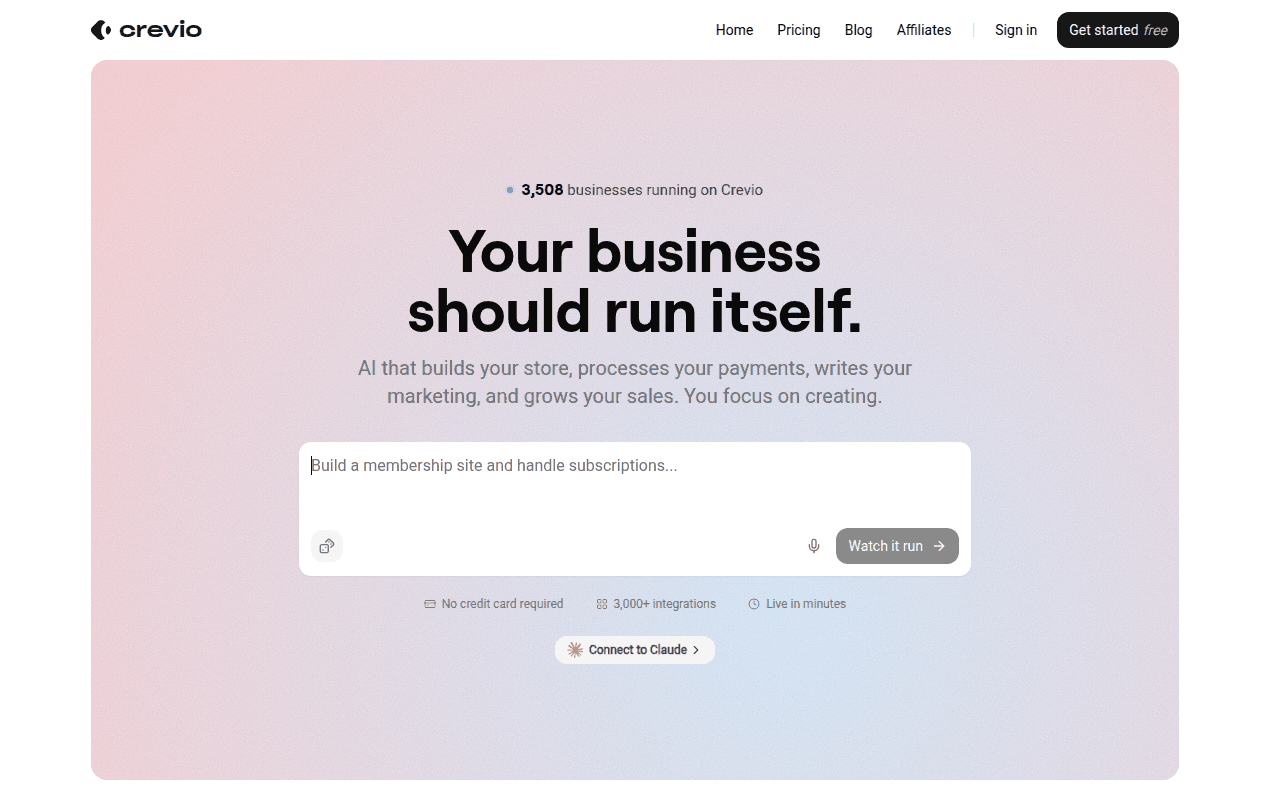
Once demand is real, build the full thing. With an AI business platform, you describe what you're selling and the AI creates:
- A brand and a website, on your own domain once you upgrade.
- Your products: digital downloads, courses, memberships, services, or a custom web app with its own database.
- Checkout, including one-time payments, subscriptions, payment plans, and discount codes.
- The copy: product pages, FAQs, and emails.
One founder we spoke with, building a site for a podiatry practice, had a full site up in about five minutes. The building is no longer the hard part.
Your job: review what the AI made, fix anything that doesn't sound like you, and publish.
Step 4: Get paid
Payments are where you want proven infrastructure. Connect a Stripe account so money goes straight to you, set your prices, and decide on one-time versus subscription pricing. Stripe's standard US rate is 2.9% plus 30 cents per card payment, and your platform may take a small percentage on top.
Your job: the legal and tax basics. Decide whether you need a business entity, register for sales tax where required, and keep records. AI can explain the options and draft documents, but a person, ideally with an accountant's help, is accountable for them.
Step 5: Win your first customers
This is where AI saves the most time. A good setup will:
- Build an email list from your waitlist and send launch emails and follow-ups.
- Post to social media on a schedule, in your voice.
- Run ads through your own ad accounts once you have something converting.
- Follow up with people who abandoned checkout or asked a question.
Your job: approve what matters. Choose which actions the AI can take on its own and which wait for you, especially anything that spends money or emails customers. We cover how to set that line in human-in-the-loop AI agents.
Step 6: Run and grow it
Once customers arrive, the daily work shifts to support, small fixes, and reporting. AI can answer routine customer questions, chase failed payments, publish new content, and send you a weekly report of what worked. Scheduled tasks keep running while you sleep.
Your job: read the reports and decide what's next: a new product, a price change, a new channel. That's the work no AI does well yet, and it's the most valuable thing you'll do.
What It Costs to Start a Business With AI
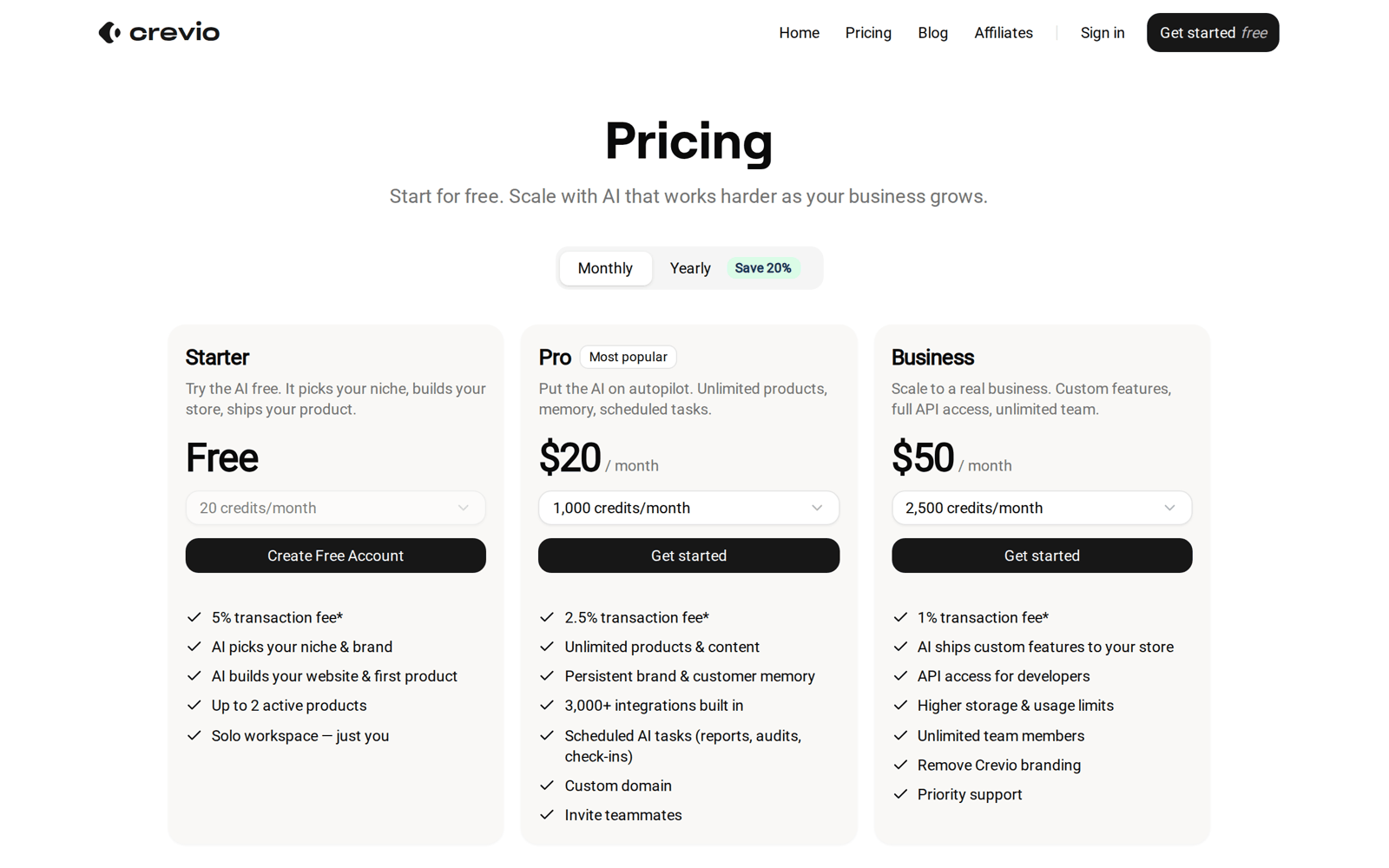
You can test an idea for nothing and run a real business for less than one part-time hire costs in a day:
| Cost | Testing an idea | Running a business |
|---|---|---|
| AI business platform | $0 (Crevio Starter) | $20 to $50/month (Crevio Pro or Business) |
| Platform fee on sales | 5% | 2.5% to 1% |
| Card processing | Stripe's standard rate | Stripe's standard rate |
| Domain | Optional | Around $10 to $20 a year |
| Ads | $0 | Whatever budget you approve |
The alternative, a stack of separate tools for the website, email, social scheduling, and automation, typically costs more each month and takes longer to set up. More importantly, the tools don't share context, so you end up doing the connecting yourself.
Why Crevio Is the Best Way to Start a Business With AI
Most AI tools handle one job: a website builder builds, an email tool emails, an assistant answers. Crevio is built to run the whole business, start to finish, from one place:
- It starts with you. On the free plan, the AI picks your niche and brand, and builds your website and first product.
- It builds real things. Websites and web apps with their own database, products, courses, memberships, and checkout.
- It takes payments the right way. Money goes into your own Stripe account on Stripe's normal payout schedule.
- It runs the marketing. Email lists and campaigns, social posts, and ads, plus follow-ups with customers.
- It keeps working. Scheduled tasks run on Crevio's own computer, even when your laptop is closed.
- You keep the veto. You choose which actions wait for your approval, and you can roll your site back to any earlier published version.
- It connects to everything else. 3,000+ integrations for the tools you already use.
Where it isn't the right fit: if you want to build a complex software product with full code control, a developer platform will suit you better, and if you only need a website for a local service business, a simple website builder is enough. Crevio is for people who want to sell online and have AI do the running.
Start free on Crevio, or see pricing.
What AI Still Can't Do When You Start a Business
Be clear-eyed about the limits:
- Pick a winning idea for you. AI can research and suggest, but it can't feel demand. The autonomous platforms' results prove it.
- Take legal responsibility. You sign the contracts, register the business, and own the tax obligations.
- Replace your judgment on money. Pricing, ad budgets, and refunds should go through you, at least until you trust the patterns.
- Make it distinctive. AI copy is competent by default. Your voice, story, and taste are what make people choose you.
For a deeper look at what AI can and can't run today, see Can AI Run a Business?
FAQ
AI can do most of the work of starting a business: research, branding, building the website and products, setting up checkout, and running marketing. It can't reliably choose an idea people will pay for or take legal responsibility, so you still decide what to sell and approve what matters.
Use a free plan to test the idea first. Crevio's free Starter plan builds your website and first product, and charges only a 5% fee when you make a sale. Validate demand with a landing page and waitlist before paying for anything.
If you want one tool that builds and runs the business, an AI business platform like Crevio. For research and planning, a general assistant like ChatGPT or Claude works well. For validating an idea before building, tools like Buildpad focus on research.
For many early-stage businesses, yes: AI can handle website building, copywriting, email, social posting, and routine support that would otherwise take several part-time hires. It can't replace the founder's judgment, so expect to spend time deciding, reviewing, and approving.
You can start for $0 on a free plan and pay only a percentage when you sell. Once the business works, expect roughly $20 to $50 a month for an AI business platform, plus card processing, a domain, and any ad budget.
The Bottom Line
Starting a business with AI in 2026 is less about finding the right tools and more about dividing the work correctly: let AI build and run, and keep the deciding for yourself. Validate before you build, approve what spends money or reaches customers, and use the time AI gives back on the choices that matter.
The fastest way to try it is to describe your idea and watch it come to life. Start free on Crevio.
Related Blog Posts
What will you sell today?
Describe what you want to sell — Crevio builds, launches, and grows it. Products, payments, and marketing, all on autopilot.
Start for free