Your business,
on autopilot.
One platform for creating, running and growing your business, powered by AI.
Best AI Cofounder Tools in 2026: 7 Options Compared Honestly





Last updated: October 2, 2026
An "AI cofounder" can mean four very different things: a tool that advises you, a kit for building your own agent team, an AI that runs your business while you approve what matters, or one that runs a company entirely on its own. Most comparison lists mix them up, which is why two "AI cofounders" can cost $0 and $120 a month and do completely different jobs.
This guide is for solo founders and small teams who want AI to carry real work, not just answer questions. It compares the seven best AI cofounder tools in 2026 on what they actually do, what they cost, how much they act without you, and what results their users are getting.
Key takeaways:
- Decide how much you want to steer first. The right AI cofounder depends far more on that than on features.
- Fully autonomous tools rarely earn yet. Polsia's founder said about 10% of its companies had made a dollar, and NanoCorp's live ticker showed $1,140 earned across its businesses in 30 days.
- The practical sweet spot is an AI that does the work on its own but lets you approve what spends money or reaches customers.
The Best AI Cofounder Tools at a Glance
| Tool | What it actually does | Starting price | How much it acts alone | Best for |
|---|---|---|---|---|
| Crevio | Builds and runs an online business | Free | Works on its own; you choose what needs approval | Running a business that sells |
| Cofounder | Agents by department: launch, grow, operate | 7-day trial, then from $120/mo | Asks before risky actions | Launching a startup with approval gates |
| Polsia | Runs a company end to end | Plan per company + 3% of sales | Acts without check-ins | Hands-off experiments |
| NanoCorp | Builds and runs a business from a one-line idea | 3-day trial, then $30/mo + 20% of withdrawals | Acts without check-ins | Cheap software experiments |
| Vybe | AI teammates in Slack for your company | Free ($10 credits), Team $50/mo | Works inside your team's workflows | Existing teams |
| Paperclip | Open-source orchestration for agent "companies" | Free (self-hosted) | As much as you configure | Developers |
| Buildpad | Plans and validates your idea | Free and paid plans | Advises only | Pre-launch validation |
What Is an AI Cofounder?
An AI cofounder is an AI tool that takes on part of the work a human cofounder would: strategy, building, marketing, sales, or operations. The term is loose, so the useful question is how much of that work the tool does by itself.
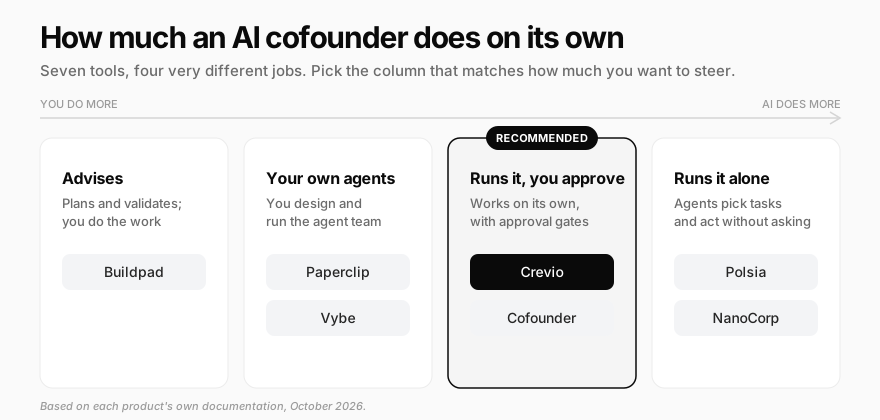
- Advisors help you think: research, validate, and plan. You still do the work.
- Agent kits give you the building blocks to run your own team of AI agents. Powerful, but you design it.
- Business runners with approvals do the work themselves and stop for you on the decisions that matter.
- Autonomous company builders pick their own tasks and act without asking, which is fast but risky with real customers.
We cover the levels in more depth in What Is an Autonomous AI Company?
The 7 Best AI Cofounder Tools in 2026
1. Crevio: Best AI Cofounder for Running a Real Business
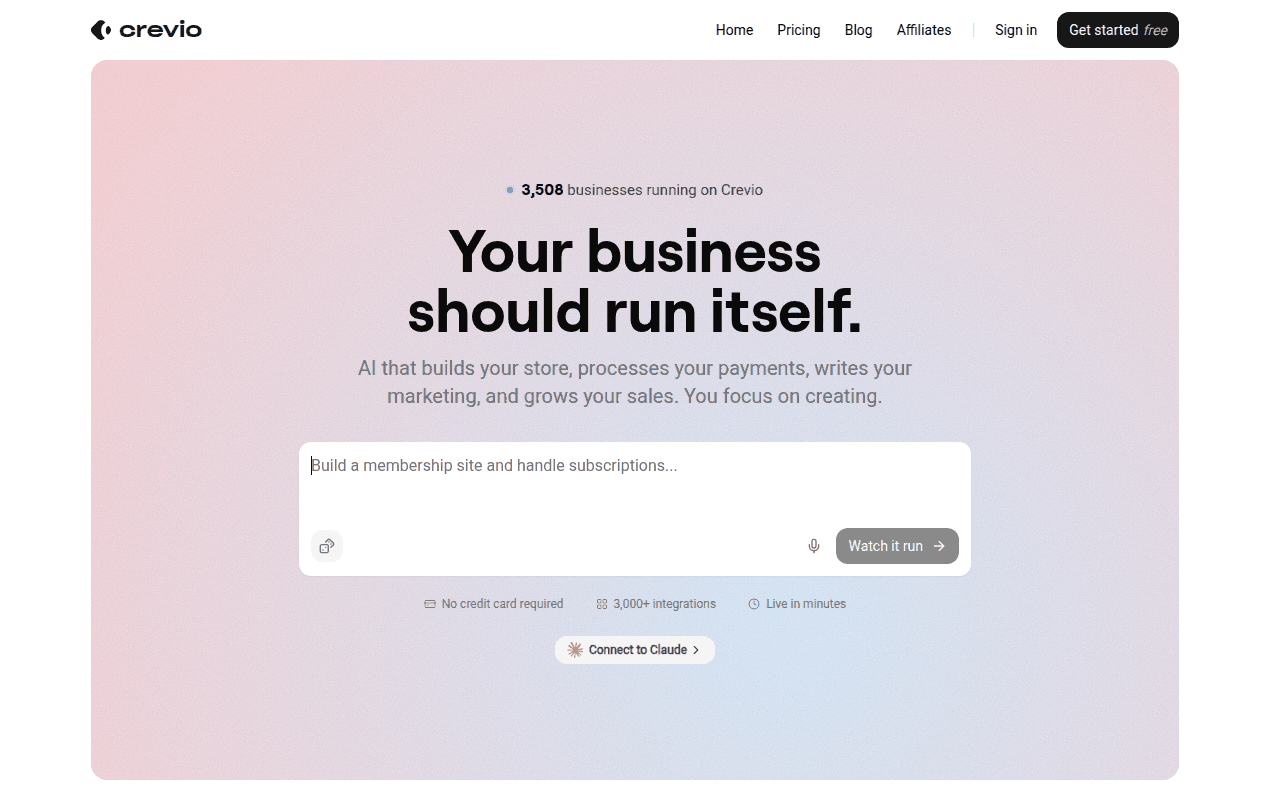
Crevio is AI that runs your business. You describe what you want to sell, and it builds the website, lists the products, takes payments through your own Stripe account, answers email, posts to social, runs ads, and reports on what worked. Its agent has its own computer, so scheduled work keeps running when your laptop is closed.
How much it acts alone: It works on its own, and you choose which actions wait for your approval, such as refunds, customer emails, or ad changes. You can also run a task supervised so every change arrives as a draft, and roll your site back to any earlier published version.
Pricing: Free plan with 20 AI credits a month and a 5% fee on sales. Pro is $20/month (1,000 credits, 2.5% fee, custom domain); Business is $50/month (2,500 credits, 1% fee, custom features and API access). See pricing.
Limitations: It's built around selling and operating a business, not autonomous software experiments. The free plan's credits are enough to try it, not to run a business on.
Best for: Founders, creators, and small businesses selling products, courses, memberships, or services who want AI doing the work without handing over the keys.
2. Cofounder: Best for Launching a Startup With Approval Gates

Cofounder, from The General Intelligence Company of New York, organizes its agents like departments: engineering, sales, marketing, design, finance, and ops. It helps you launch (positioning, brand, website), grow (market research, prospects, outreach), and operate (LLC incorporation, analytics, support).
How much it acts alone: Agents work alongside you and require approval "when potentially dangerous actions are taken."
Pricing: A 7-day free trial, then Cofounder Pro from $120/month. LLC incorporation is an add-on, and a team plan at $100/seat is on a waitlist (pricing). You can claim ownership of the GitHub, Supabase, and Vercel projects it creates.
Limitations: The highest entry price in this list. It's oriented toward software startups rather than selling products or courses.
Best for: Founders launching a software startup who want an AI team with built-in checkpoints. The company says over 10,650 companies run on it.
3. Polsia: Best for Hands-Off Experiments

Polsia is the best-known autonomous company builder. Give it an idea, or none, and its agents plan, code, market, and run the company in nightly cycles with little input from you. It raised $30 million at a $250 million valuation in May 2026.
How much it acts alone: Almost entirely. That's the product.
Pricing: A plan per company plus task credits, a 3% fee on every customer payment, a 31-day hold before payouts, and a 20% platform fee on ad budgets it runs.
Results so far: Its founder said in a May 2026 interview that about 10% of companies on the platform had made at least a dollar. We break down the numbers in Is Polsia Legit?
Best for: Seeing what an AI does with an idea, as a low-stakes experiment. See our Polsia alternatives if you want more control.
4. NanoCorp: Best for Cheap Software Experiments
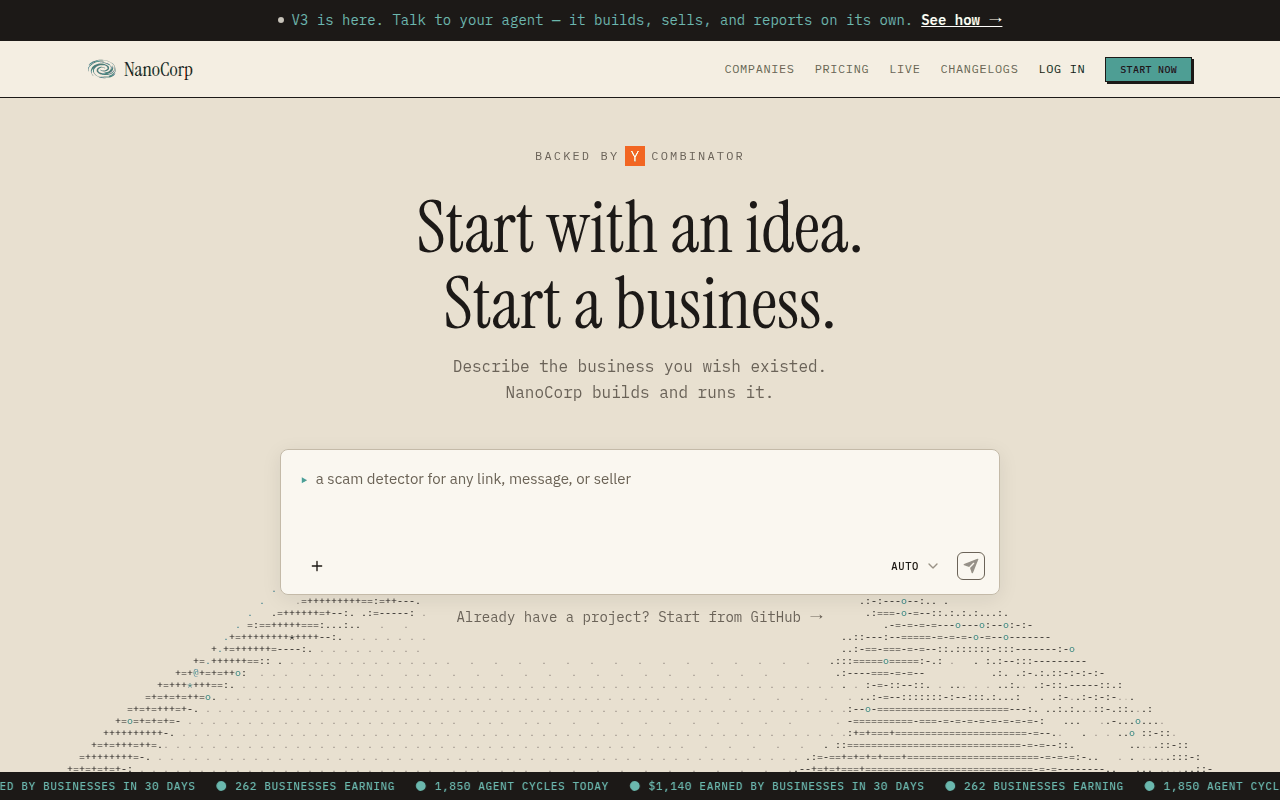
NanoCorp, backed by Y Combinator, turns a one-sentence idea into a live product with a site, email, and checkout, then keeps running it. It's unusually transparent: a live ticker shows how its businesses are doing.
How much it acts alone: Like Polsia, it's built to run without check-ins, within a budget cap.
Pricing: A 3-day free trial with 15 credits, then the Founder plan at $30/month for 30 rollover credits and unlimited businesses. NanoCorp keeps 20% of every withdrawal (pricing).
Results so far: On October 2, 2026, NanoCorp's homepage ticker showed 262 businesses earning and $1,140 earned by its businesses in the last 30 days, with the top two having each earned over $1,000 in total.
Best for: Cheap, fast software experiments, if you accept a 20% cut once money comes in. We dig into its live numbers in Is NanoCorp legit?, and compare options in NanoCorp alternatives.
5. Vybe: Best for Existing Teams
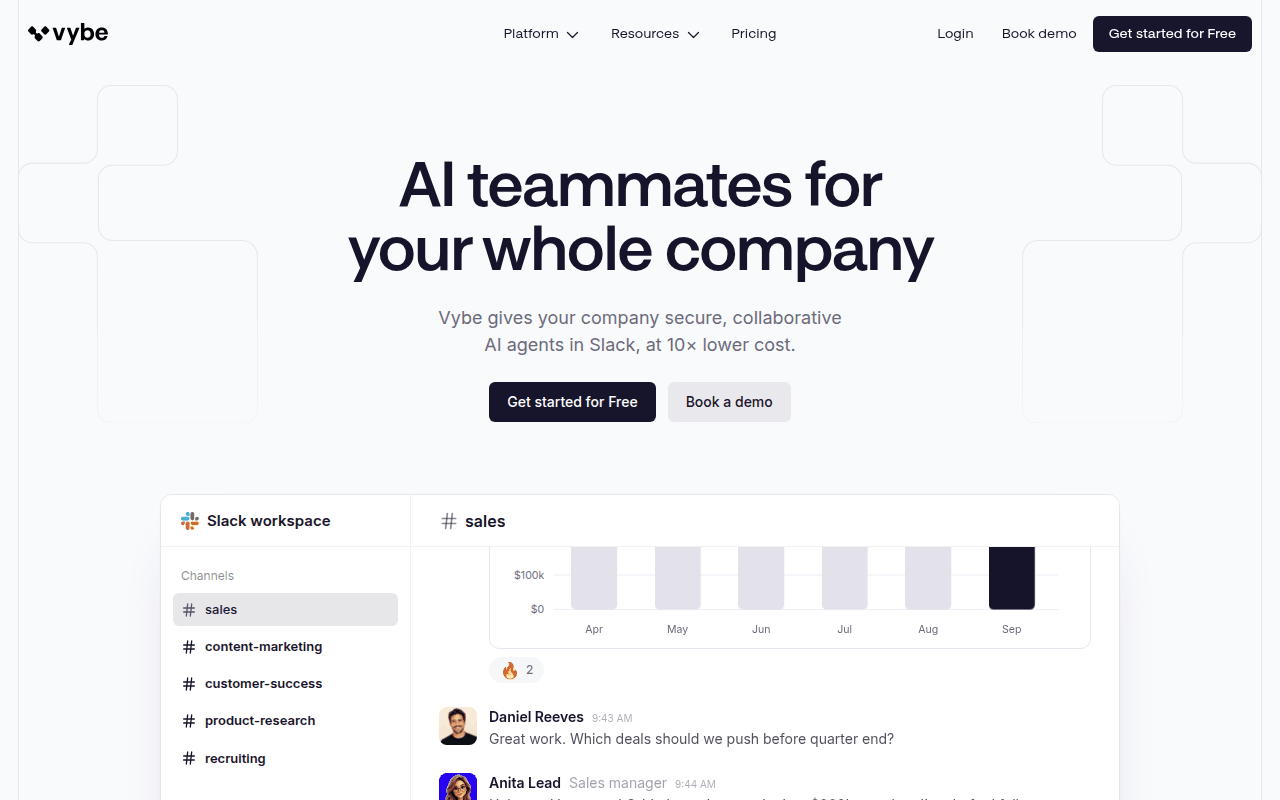
Vybe puts AI teammates into your company's Slack. Agents work across 3,000+ integrations and can build internal apps, with enterprise security on higher plans.
How much it acts alone: It runs the workflows your team sets up, inside the tools you already use.
Pricing: A free plan with $10 of credits a month, Team at $50/month for 5,000 credits, and custom Enterprise plans with SSO and SOC 2 (pricing).
Limitations: It helps a company that already exists. It won't build and launch a business for you from scratch.
Best for: Small and mid-size teams that want AI agents working inside Slack.
6. Paperclip: Best for Developers
Paperclip is an open-source platform for running "zero-human companies": you give AI agents an org chart, budgets, goals, and schedules, and it coordinates their work from one dashboard. It launched in March 2026 and became one of the fastest-growing open-source projects of the year, with over 71,000 GitHub stars by June (review).
How much it acts alone: As much as you configure. It orchestrates agents you bring.
Pricing: Free under the MIT license. You pay for hosting and the AI models your agents use.
Limitations: You host it, secure it, and wire up the agents yourself. It's infrastructure, not a finished product.
Best for: Developers who want full control over an agent team.
7. Buildpad: Best for Validating an Idea First
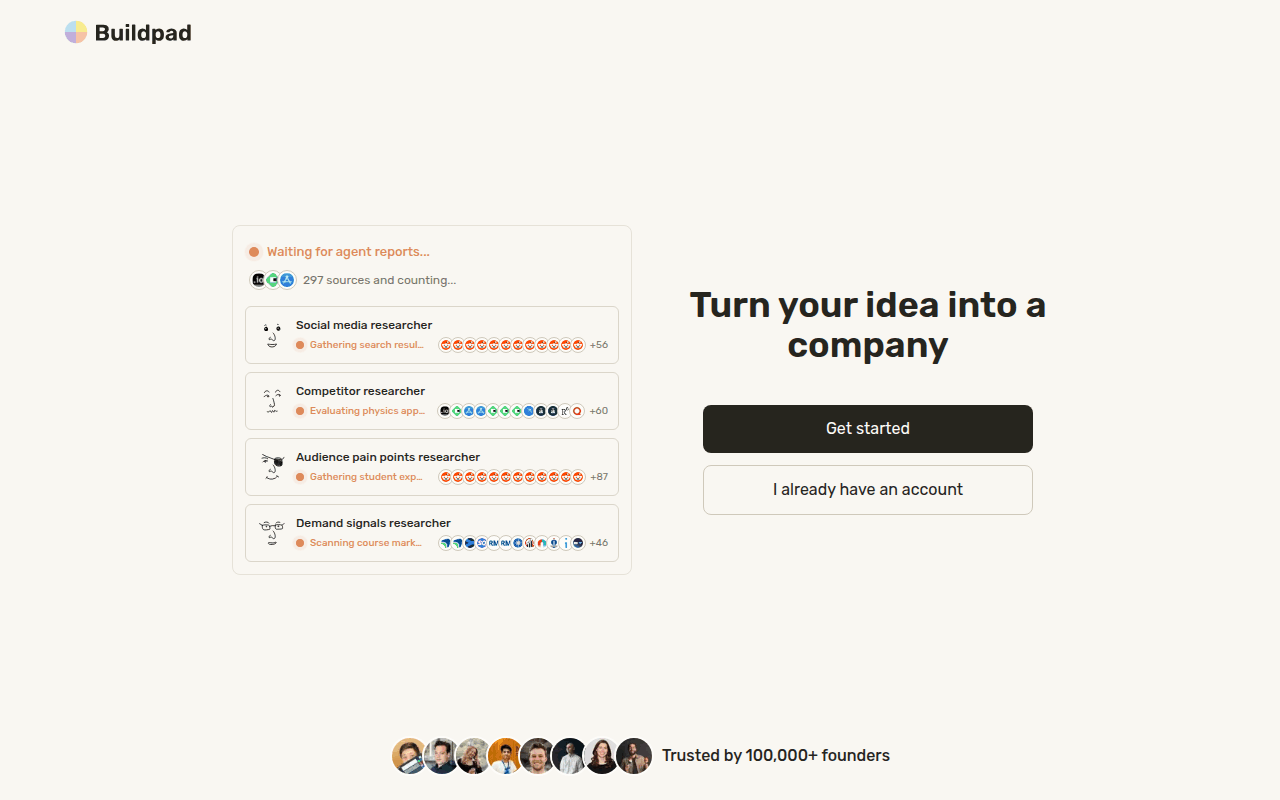
Buildpad, formerly AICofounder, is an AI advisor. It guides you from idea to launch in phases, sends research agents through social media and online communities to check whether people actually want what you're building, and pushes back on weak ideas.
How much it acts alone: It advises; you do the building.
Pricing: Free and paid plans.
Best for: Founders who want to validate demand before building anything. Pair it with a tool that does the work once you've decided.
Do AI Cofounders Actually Make Money?
The honest answer in 2026: the fully autonomous ones rarely do yet. Polsia reported that about 10% of its roughly 8,791 companies had made at least a dollar, and NanoCorp's own ticker showed $1,140 earned across its businesses in a month. Both are real products doing real work, but agents are better at producing activity, such as sites, posts, and outreach, than at the judgment that turns activity into revenue.
The businesses earning with AI in 2026 tend to keep a human choosing the direction and approving what matters, while the AI does the volume of work. That's why the "runs it, you approve" column is the practical choice for most founders.
How to Choose an AI Cofounder
| If you want to… | Choose |
|---|---|
| Run a business that sells, with AI doing the work and you approving what matters | Crevio |
| Launch a software startup with an AI team and approval gates | Cofounder |
| Experiment hands-off and see what AI builds | Polsia or NanoCorp |
| Add AI teammates to an existing company in Slack | Vybe |
| Build your own agent team in code | Paperclip |
| Validate an idea before building anything | Buildpad |
If you mainly want drafts of posts and emails rather than a cofounder, an AI employee tool may be enough. See our Sintra AI review and Marblism review for the trade-offs.
FAQ
It depends on how much you want to steer. For running a business that sells, Crevio does the work while you approve what matters. For launching a software startup with checkpoints, Cofounder. For hands-off experiments, Polsia or NanoCorp. For validating an idea first, Buildpad.
Yes. Crevio has a free plan with 20 AI credits a month, Vybe has a free plan with $10 of credits, Paperclip is free and open source, and Buildpad has a free tier. Cofounder and NanoCorp offer short free trials.
Not fully. AI cofounders handle a lot of execution, from building a site to outreach and support, but they're weak at strategy, judgment, and accountability. Treat one as a very fast team, with you as the founder who decides.
Some do. Polsia takes 3% of every customer payment and holds payouts for 31 days, and NanoCorp keeps 20% of every withdrawal. Crevio charges 1% to 5% of sales depending on the plan, paid into your own Stripe account.
Related Blog Posts
What will you sell today?
Describe what you want to sell — Crevio builds, launches, and grows it. Products, payments, and marketing, all on autopilot.
Start for free