Your business,
on autopilot.
One platform for creating, running and growing your business, powered by AI.
8 Best Muse AI Alternatives in 2026 (Honest Comparison)





Meta shipped Muse in September 2026 and downloads surged hard enough to move the company's stock. Most people now searching for Muse AI alternatives are not looking for a different chatbot. They are looking for a different answer to the question "what am I actually trying to hand off?" Muse books your dinner, tracks your calories, and argues with your phone company. That is genuinely useful. It is also not the same job as producing a finished deliverable, and it is nowhere near the same job as running the business you make money from.
This article is for people who tried Muse, or read about it, and want to know what else is out there. Here is the short version:
- Crevio if the thing eating your week is a business (products, payments, customers, marketing), not errands
- ChatGPT if you want the closest like-for-like swap with a longer track record ($20/mo Plus)
- Google Gemini if your life already lives in Gmail, Calendar, and Android ($19.99/mo AI Pro)
- Manus if you want finished deliverables rather than errands (independent again since September 2026, after a $2B Meta deal collapsed)
- Instinct if you want a text-message agent with full credential delegation and you are comfortable with that
- Poke if you want the same texting experience for $19/mo instead of $20
- Carly if the work eating your week arrives at a work email address (free tier, $35/mo Personal)
- OpenClaw if you want to self-host and own the whole stack, and you can read a CVE advisory
One honesty note before the comparison. I build software for business owners for a living, so I have an obvious bias, and I flag it in the Crevio section rather than burying it. Every price below was checked against the vendor's own pricing page or a linked news report at the time of writing. Where I am relying on reporting rather than a published page, I say so in that entry.
Quick Comparison (Verified Pricing)
| Platform | Starting Price | Free Tier? | Best For |
|---|---|---|---|
| Crevio | Free Starter, $20/mo Pro | Yes (2 products, 20 AI credits/mo) | Running an online business with AI |
| ChatGPT | $20/mo Plus | Yes (limited) | General-purpose agent work |
| Google Gemini | $19.99/mo AI Pro | Yes | Google-native actions and research |
| Manus | $20/mo Pro | Yes (300 daily credits) | Finished decks, docs, and research |
| Instinct | Free in private access | Invite-only | Text-message errands with credentials |
| Poke | $19/mo Pro | Yes | Texting-first personal assistant |
| Carly | $35/mo Personal | Yes (limited) | Email-driven agent work |
| OpenClaw | Free (self-hosted) | Yes (open source) | Full control, technical users |
| Meta Muse | Free, then $20/mo | Yes (100M tokens/week) | Personal errands and life admin |
What Is Muse AI?

Muse is Meta's personal AI agent, announced in September 2026 and described by the company as "a secure, private personal AI agent that proactively helps people meet their goals and suggests ideas." It runs on Muse Spark, which Meta calls its most capable model built for agentic work, and it executes inside a dedicated environment Meta calls the Muse Secure VM, with its own browser.
Worth noting what the product itself leads with. The headline on muse.ai is not "AI that runs your life" or "AI that works for you." It is "Muse, AI that shops for you." That is a narrower and more honest pitch than the launch blog post, and it tells you a lot about which problems Muse is actually tuned for.
In practice it does things like open a website, fill in a form, book an appointment, turn a saved recipe into a shopping list, track a budget, and keep working after you close the app. It is available in the US on iOS, Android, WhatsApp, and at muse.ai, with AI glasses support announced as coming.
Muse pricing, as reported: Meta did not publish tier names or prices on its own launch pages. TechCrunch reported a free tier plus Power at $20/month and Maximum at $100/month. The free tier is metered in tokens rather than messages, at roughly 100 million tokens per week, with an in-app usage meter that warns you before it runs out.
Where Muse genuinely works well:
- Errands with a clear end state: booking, forms, comparison shopping, cancelling things
- Proactive suggestions, because it has context on your saved content and conversations
- Reach, since it works in WhatsApp and on a phone rather than only in a browser tab
- Price, if you stay under the free meter, which Meta says most people will
Why people go looking for alternatives:
- Trust. This is the dominant reason, and it is not abstract. Meta paid a $5 billion FTC settlement in 2019 over privacy violations, following a 2011 settlement over deceiving consumers about privacy. Meta says Muse conversations do not feed its ad systems. Security researchers have not yet verified that independently.
- It is a consumer product. Muse is built for a person, not a business. There is no team seat, no audit trail your accountant would accept, and no product catalog.
- US only, for now. If you are outside the US, the decision is already made for you.
- Credential access. Muse needs to act as you across services. That is the whole point, and also the whole risk.
The Three Things People Mean by "Muse AI Alternative"
Almost every roundup on this keyword hands you the same list of chatbots. That is a category error. When people say they want a Muse alternative, they mean one of three different things, and the right answer is completely different for each.
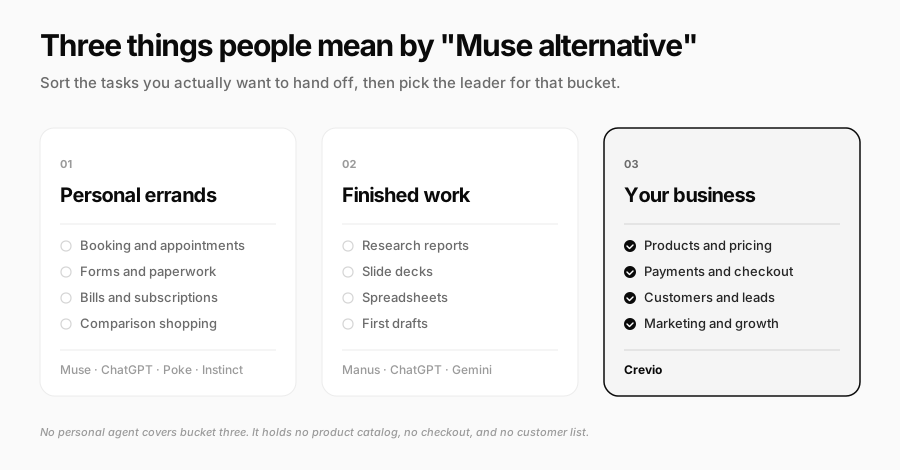
If you are in bucket one, the swap is easy and the rest of this article is a price comparison. If you are in bucket three, no personal agent on this list will help you, because none of them hold your products, your payments, or your customers. That is worth knowing before you spend a month evaluating the wrong category.
1. Crevio: For When the Thing You Want Automated Is a Business
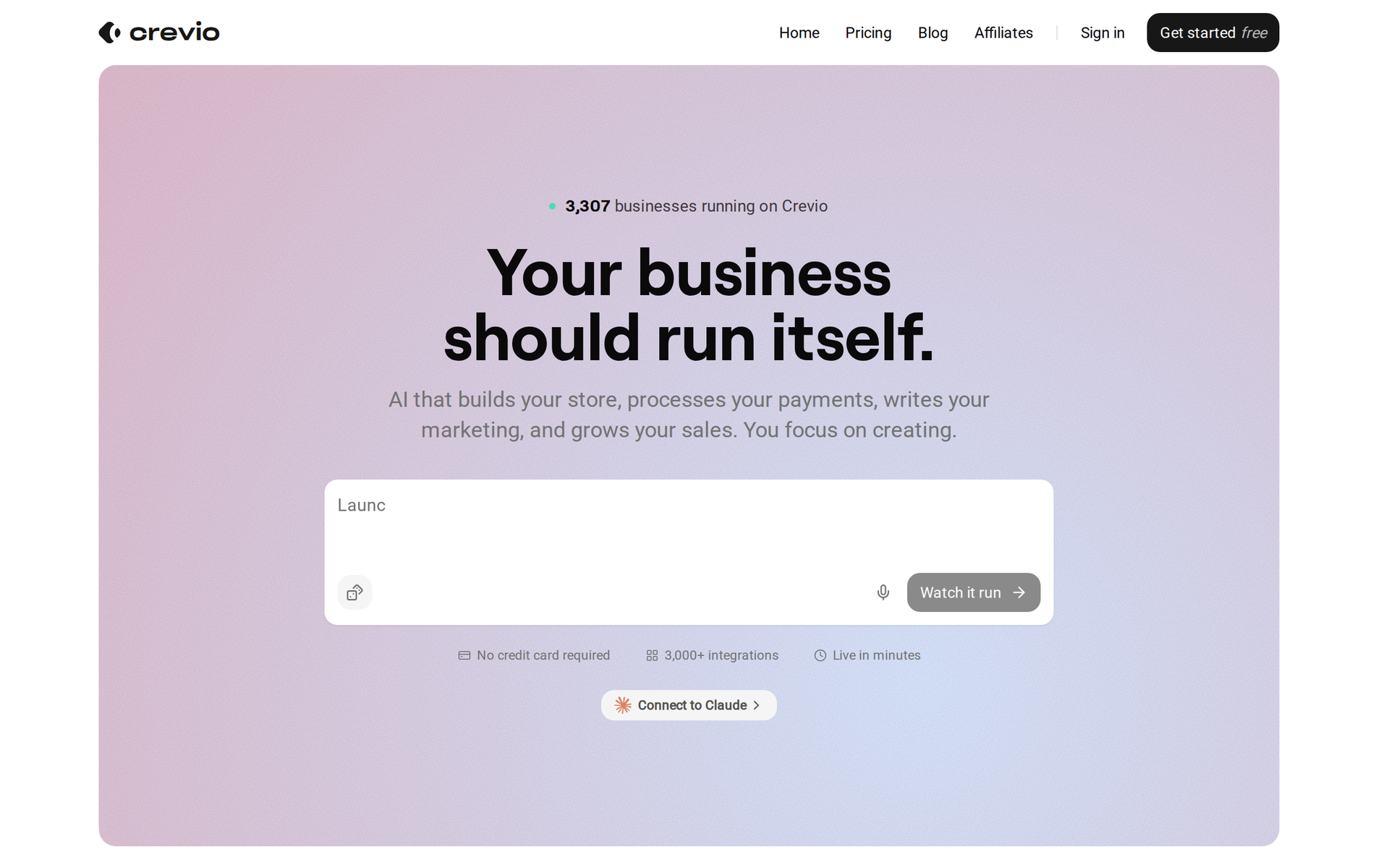
Crevio is an AI business builder. You describe what you want to sell, and AI agents build the storefront, set up the products and pricing, wire up Stripe, and keep working on marketing and growth afterwards. It is a different category from Muse: Muse acts on your personal life, Crevio acts on your business.
The practical difference shows up in what the agent is allowed to touch. A personal agent can browse to your Stripe dashboard and read a number to you. A business agent owns the product catalog, the checkout, the customer list, and the emails that go out. That is why the useful comparison is not "Crevio versus Muse" but "Crevio plus Muse", if you want both.
What Crevio handles:
- Digital products: courses, downloads, memberships, and embeds
- Storefronts, websites, and lead capture forms
- Stripe payments, one-time and subscription
- Customer and lead management, plus analytics
- A full REST API and webhooks, so your data is portable
- 3,000+ integrations, with Crevio as the hub
- Nine languages, including German, French, Spanish, Portuguese, and Polish
Pricing: Starter is free with 2 published products, 1 admin seat, 20 AI credits per month, and a 5% transaction fee. Pro is $20/month with unlimited products, 2 seats, 1,000 credits, and 2.5% fees. Business is $50/month with unlimited seats, 2,500 credits, a custom domain, and 1% fees.
Where Crevio is honestly weaker than Muse: it will not book your dentist, plan your meals, or argue with your internet provider. It has no consumer app and no WhatsApp presence. And it does not handle physical products: no shipping, no inventory, no fulfillment. If you sell t-shirts, this is the wrong tool, and Shopify is the right one.
The bias disclosure: I work on Crevio. Read the section with that in mind. The reason it is first is that it is the only entry on this list in bucket three, not because it beats ChatGPT at answering questions.
2. ChatGPT: The Closest Like-for-Like Swap
If you want what Muse does, minus Meta, ChatGPT is the default. Agent mode browses, fills forms, and completes multi-step tasks, and the ecosystem around it is the largest in the category by a wide margin.
Pricing: Free tier with limits, Plus at $20/month, Pro at $200/month. That is the same price as Muse Power, so cost is not the deciding factor between them.
Strengths: the longest public track record of any consumer agent, the widest third-party integration surface, and a memory system that has been iterated on for years rather than weeks.
Trade-offs: it is less proactive than Muse by design. Muse's pitch is that it comes back to you unprompted; ChatGPT mostly waits to be asked. And it does not live in WhatsApp, so the "text it like a person" experience is weaker.
3. Google Gemini: Strongest If Your Life Is Already in Google
Gemini has a structural advantage that no other entry here can match: it is already inside Gmail, Google Calendar, Google Drive, and Android. For an agent whose usefulness depends on context, starting with your entire inbox is a meaningful head start.
Pricing: free tier, AI Plus at roughly $7.99/month, Google AI Pro at $19.99/month, and AI Ultra at $99.99/month and up. The AI Plus tier makes Gemini the cheapest serious paid option on this list.
Strengths: deep research, Google-native actions, and a price floor below everyone else.
Trade-offs: if you are leaving Muse because you do not want one very large advertising company holding your life context, Gemini is a lateral move, not an escape. Be honest with yourself about which concern you actually have. If your worry is Meta's specific record, Gemini is fine. If your worry is ad-funded platforms in general, look at OpenClaw or a paid, non-ad-funded tool instead.
4. Manus: Finished Deliverables, and a Cautionary Tale
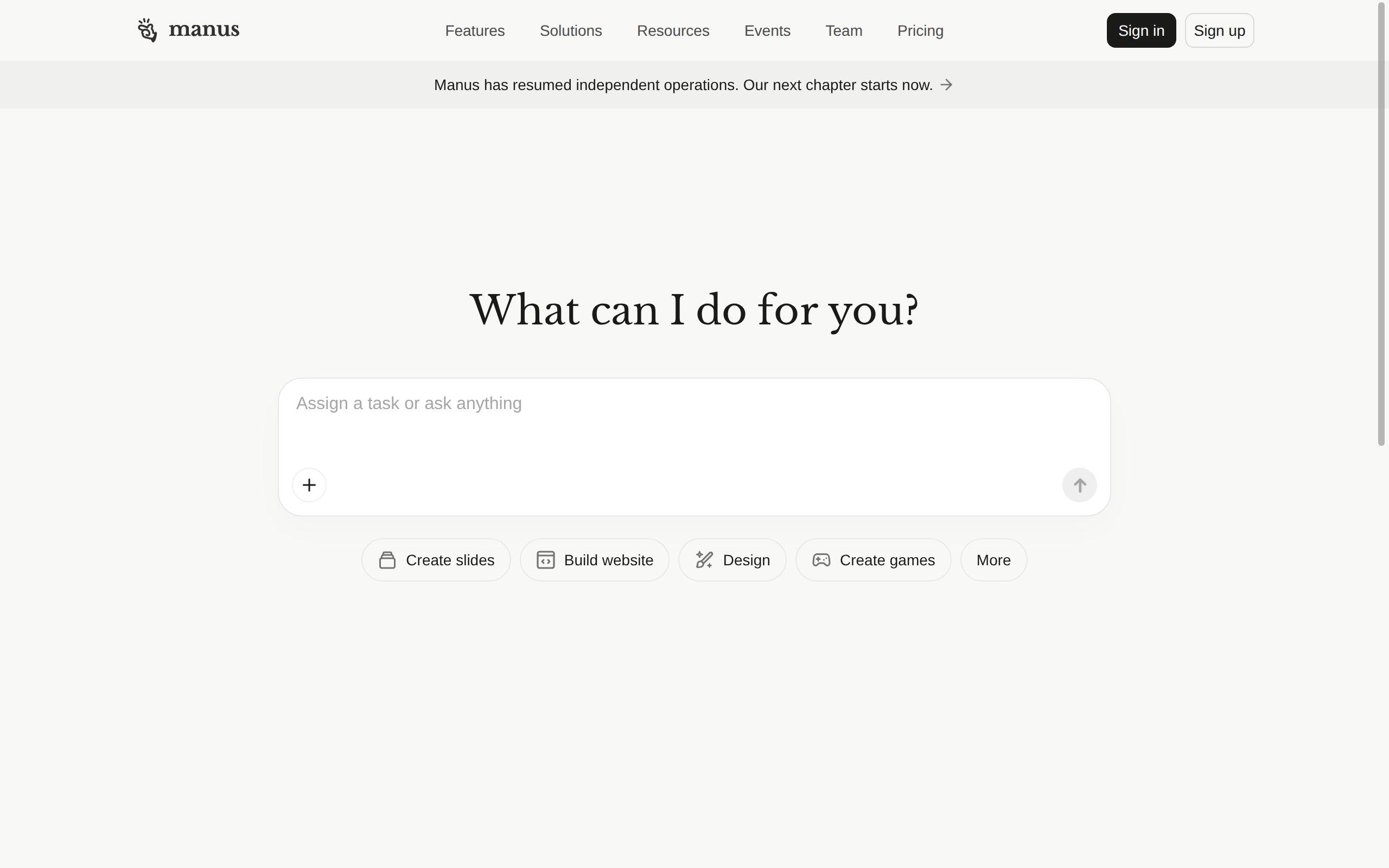
Manus is the strongest entry in bucket two. Where Muse runs errands, Manus produces artifacts: a research report, a slide deck, a spreadsheet, a working web page. You give it a brief and come back to a file.
Pricing: free tier with 300 daily credits that reset every 24 hours, 1 concurrent task, and 2 scheduled tasks. Pro starts at $20/month for 4,000 monthly credits, with $40 and $200 tiers above it. Team starts at $20 per seat with a 2-seat minimum.
Strengths: the output is a thing you can send to someone. That is rarer than it sounds. For research, competitive analysis, and first drafts of documents, it is the best tool here.
The part most roundups still have wrong: Manus and Meta have a history, and it did not end the way the headlines from last year suggested. Meta acquired Manus in a deal reported at around $2 billion and announced on December 29, 2025. China's National Development and Reform Commission blocked the transaction in April 2026 and ordered it unwound. Meta began cutting Manus off from its internal systems in June, and Manus resumed independent operations on September 1, 2026 with its founding team intact. Its homepage still carries the banner.
So the answer to "is Manus owned by Meta?" is: it was, for about eight months, and it is not now. Lists that tell you otherwise were written during the window and never updated. What happened to Manus users during that unwind is the most useful cautionary detail on this page, and it gets its own section below.
Trade-offs: it is a credit system, and complex tasks burn credits fast, so the free tier is a trial rather than a way to live. It also has a more volatile corporate history than anything else on this list, which is worth weighing if you plan to build a habit around it.
5. Instinct: The Text-Message Agent With the Keys
Instinct, built by Spear Street Technology, is the closest thing to Muse in spirit. You text it, or call it, and it handles the thing. It runs a persistent cloud desktop with a browser and cached credentials, so it keeps working between your messages: booking travel, negotiating bills, cancelling subscriptions, filling out paperwork.
Pricing: Instinct is invite-only and free during private access, with no published pricing. Because it runs a persistent cloud desktop per user, its costs are structurally higher than a chat-only agent, so expect it to land above the $20 consumer band. Treat any specific figure you see quoted elsewhere as unconfirmed until Instinct publishes one. Forbes reported a $2.5 billion valuation in August 2026.
Strengths: the most aggressive credential delegation of anything on this list. It signs into your real accounts and acts as you, which is exactly what makes it effective.
Trade-offs: that same delegation is the risk, and Instinct is a much younger company than Meta or OpenAI with a much shorter security track record. Invite-only also means you may not be able to try it at all.
6. Poke: The Same Idea, One Dollar Cheaper
Poke, from The Interaction Company, is a texting-first assistant that predates Muse and does a narrower version of the same job well. It lives in iMessage and WhatsApp and handles scheduling, reminders, email triage, and follow-ups.
Pricing: as of August 2026, Free at $0, Pro at $19/month, and Ultra at $199/month.
Strengths: the texting experience is polished, and the free tier is genuinely usable rather than a demo.
Trade-offs: The Interaction Company joined Cognition in July 2026. Both companies said Poke would keep operating as before while Cognition's models and infrastructure are integrated. That is a reasonable outcome, but it is the second consolidation on this page, which is a pattern worth noticing.
7. Carly: When the Work Arrives at a Work Address
Carly makes a specific bet: most of the work you want to hand off arrives as an email thread, so the agent should have its own email address and live in the thread with you.
Pricing: there is a free tier that includes MCP access, so you can drive Carly from ChatGPT or Claude at no cost. Personal is $35/month with 200 AI credits, Organization is $35 per seat with pooled credits, and credit add-ons run from +$30/month for 400 credits upward.
Strengths: the only tool here designed around the idea that a thread, not a chat window, is the unit of work. Enterprise plans can run agents on your own company domain.
Trade-offs: $35/month is the highest entry price among the personal agents, and the 200-credit base allowance goes quickly if your threads are complex. If your work does not arrive by email, this is the wrong shape.
8. OpenClaw: Full Control, Full Responsibility

OpenClaw is the answer for people whose objection to Muse is architectural rather than brand-specific. It is free, open source, model-agnostic, and runs on your own machine. At the time of writing the repository has 390,000 stars and 82,000 forks, which makes it the largest community project in this category by a wide margin. It connects to Signal, Telegram, Discord, and WhatsApp, so you get the "text your agent" experience without a vendor in the middle.
Pricing: free. You pay for model tokens from whichever provider you point it at.
Strengths: nothing leaves your control unless you send it. You can swap models, read every line of the code, and run it offline against local weights if you want to.
Trade-offs: you are the security team. OpenClaw had multiple CVEs disclosed in February 2026, including CVE-2026-25253 at CVSS 8.8, and it runs with broad permissions on your machine by design. One maintainer put it plainly: if you cannot comfortably use a command line, this project is too dangerous to run. We covered this in more depth in our OpenClaw alternatives roundup.
What Nobody Tells You About Switching Away From Muse
Four things that only become obvious a few months in.
Your data can be deleted by a deal you had nothing to do with. This is not hypothetical. When the Meta acquisition of Manus was unwound, the separation required deleting data generated by certain users on or after December 29, 2025. Affected users had until August 23, 2026 to back it up, and could restore from August 25. If you were not reading Singaporean tech press that month, you found out when it was gone. Nobody signs up for an AI agent thinking about outbound investment rules at China's NDRC, and yet that is what determined whether some people kept their work.
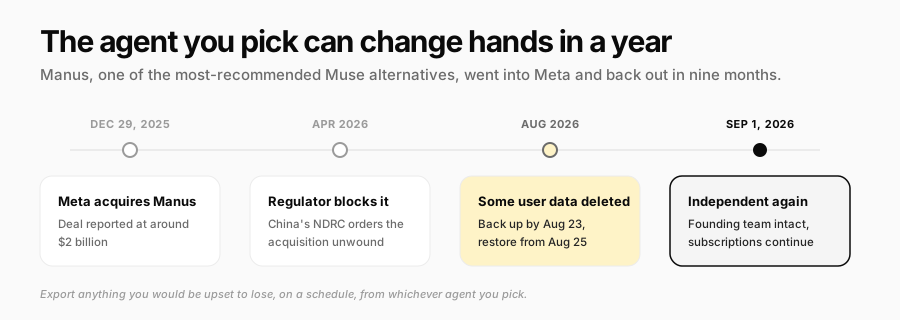
The practical lesson is small and boring: export anything you would be upset to lose, on a schedule, from whichever agent you pick. Every tool on this list is owned by a company that could be acquired, blocked, or shut down within a year. The ones that make export easy, through a real API or a plain download, are meaningfully safer to build a habit on than the ones that do not.
The category is consolidating faster than the roundups update. The Interaction Company, which builds Poke, joined Cognition in July 2026. Manus went in and back out of Meta inside a year. Most "Muse alternatives" lists still describe the landscape as it was when they were published. Before you hand over credentials, check who owns the thing this quarter, not who founded it.
Token meters are not message limits, and they fail differently. Muse's free tier is measured in tokens per week, not tasks per week. A long agentic run with a lot of browsing can consume a startling share of that allowance in one sitting, and you will not feel it coming the way you feel a "you have 3 messages left" counter. Check the usage meter before you start something big, not after.
Credential delegation has no undo. Every agent here that is genuinely useful works by holding, or acting through, your logins. When you stop using one, revoking access is a manual job across every service you connected, and most people never do it. Keep a list of what you connected as you connect it. Future you will not remember.
How to Choose
The decision is simpler than the field makes it look.
- Write down the three tasks you actually want to hand off this month. Not the impressive ones from the demo video, the boring ones that recur.
- Sort them into the three buckets. Errands, deliverables, or business operations.
- If they land in one bucket, pick the leader for that bucket and stop. Muse or ChatGPT for errands, Manus for deliverables, Crevio for business operations.
- If they land in two buckets, use two tools. They cost $20/month each and they do not conflict. Trying to find one agent that covers all three is how people spend three months evaluating and zero months automating.
- If privacy is your actual constraint, go to OpenClaw and accept the operational cost. Every hosted option on this list involves trusting someone. Only self-hosting removes that.
If the answer turns out to be bucket three, our guide on AI agents for small business covers what to automate first, and can AI run a business? is a more skeptical look at how far the current generation actually goes.
Muse is a good answer to "who handles my errands." It was never trying to answer "who runs my business." Most of the disappointment people report with AI agents comes from asking one the other one's question.
FAQ
Yes, with a meter. Muse has a free tier reported at roughly 100 million tokens per week, which Meta expects will cover most people. Above that, reporting puts paid plans at $20/month for Power and $100/month for Maximum. Meta did not publish tier names or prices on its own launch pages.
Not anymore. Meta acquired Manus in a deal reported at around $2 billion, announced on December 29, 2025. China's National Development and Reform Commission blocked the transaction in April 2026 and ordered it unwound, and Manus resumed independent operations on September 1, 2026 with its founding team. Many alternatives lists were written during that window and still describe Manus as a Meta property.
Not really. Muse is a personal agent: it acts on your accounts, your calendar, and your errands. It does not hold a product catalog, process payments, or manage customers. For that you need a business platform such as Crevio, which builds and runs the storefront, checkout, and customer side directly.
Related Blog Posts
What will you sell today?
Describe what you want to sell — Crevio builds, launches, and grows it. Products, payments, and marketing, all on autopilot.
Start for free