Your business,
on autopilot.
One platform for creating, running and growing your business, powered by AI.
Monthly Recurring Revenue (MRR): Formula, Types & 2026 Benchmarks





Monthly recurring revenue is the one number that tells you whether a subscription business is actually working. Not total revenue, not signups, not app downloads: the amount of revenue you can reliably count on next month, and the month after that, without selling anything new. This guide covers the MRR formula, the five types of MRR movement that explain why it went up or down, how MRR differs from ARR, what counts as good growth in 2026, and where the number quietly breaks.
- MRR is a snapshot, not a total. It only counts revenue from active subscriptions this month, normalized to a monthly figure, which is what makes it comparable month over month
- Growth and churn are two different numbers wearing one trend line. A flat MRR chart can hide a business adding customers as fast as it's losing them
- SaaS Capital's 2026 survey of over 1,000 private B2B SaaS companies puts median growth at 22%, down from 25% in 2024, so "we're growing" and "we're growing well" are not the same claim
- Net revenue retention predicts growth better than new sales do. The same survey found that companies moving from 90-100% NRR into the 100-110% band grow roughly 5 percentage points faster, before a single new customer is added
What Is Monthly Recurring Revenue (MRR)?
Monthly recurring revenue is the predictable revenue a subscription business collects every month from customers on a recurring plan. Stripe's definition frames it well: MRR is the total amount of monthly revenue you can reliably expect to receive on a recurring basis, which is what separates it from total revenue. A $5,000 one-time consulting invoice doesn't touch MRR. A $50/month subscription does, every month it stays active.
That distinction is why MRR exists as its own metric instead of just using revenue. Total revenue answers "how much did we make." MRR answers "how much are we guaranteed to make again next month if nothing changes," which is the number investors, lenders, and your own cash-flow planning actually care about. It's also the metric that makes choosing a membership or subscription model over one-time sales worth the tradeoff: a lower month-one payment that compounds beats a bigger one-time payment that resets to zero the day after it lands.
MRR isn't exclusive to SaaS, either. It applies to any business with recurring billing: a paid Discord community, a coaching membership, a software subscription, a box subscription. If a customer is charged on a repeating schedule, that charge belongs in MRR.
The MRR Formula (How to Calculate It)
The basic formula is simple:
MRR = Number of paying customers × Average Revenue Per User (ARPU)
If you have 200 subscribers paying an average of $35/month, your MRR is $7,000.
Most real businesses have more than one plan, so the more accurate version sums each plan separately. Getting ARPU right starts with pricing each plan deliberately rather than guessing, since every plan you add or reprice moves this formula's second input directly:
MRR = Σ (customers on Plan A × Plan A price) + (customers on Plan B × Plan B price) + ...
For example: 100 customers on a $10/month plan, 50 on a $20/month plan, and 30 on a $30/month plan gives you (100 × $10) + (50 × $20) + (30 × $30) = $2,900 MRR.

One detail trips people up constantly: annual plans. Stripe's guidance is explicit that you normalize them to a monthly figure rather than counting the full charge in the month it lands. A $1,200 annual subscription contributes $100 to MRR, not $1,200, spread evenly across the year it covers. Counting the whole annual charge in one month makes that month's MRR meaningless and the next eleven months look like a cliff.
The 5 Types of MRR Movement
A single MRR number tells you where you landed. It doesn't tell you how you got there, and two businesses can post the identical MRR figure for completely different reasons: one adding customers steadily, one losing as many as it gains. ChartMogul's breakdown of revenue churn splits the movement into five categories that explain the difference:
- New MRR: revenue added from brand-new customers this period
- Expansion MRR: revenue gained from existing customers upgrading, adding seats, or buying add-ons
- Contraction MRR: revenue lost from existing customers downgrading, but not fully canceling
- Churned MRR: revenue lost from customers who canceled entirely
- Reactivation MRR: revenue gained from customers who canceled previously and came back
Add New and Expansion, subtract Contraction and Churn, and you get Net New MRR, the actual change in your total for the period. Reactivation typically gets folded into that same net figure.
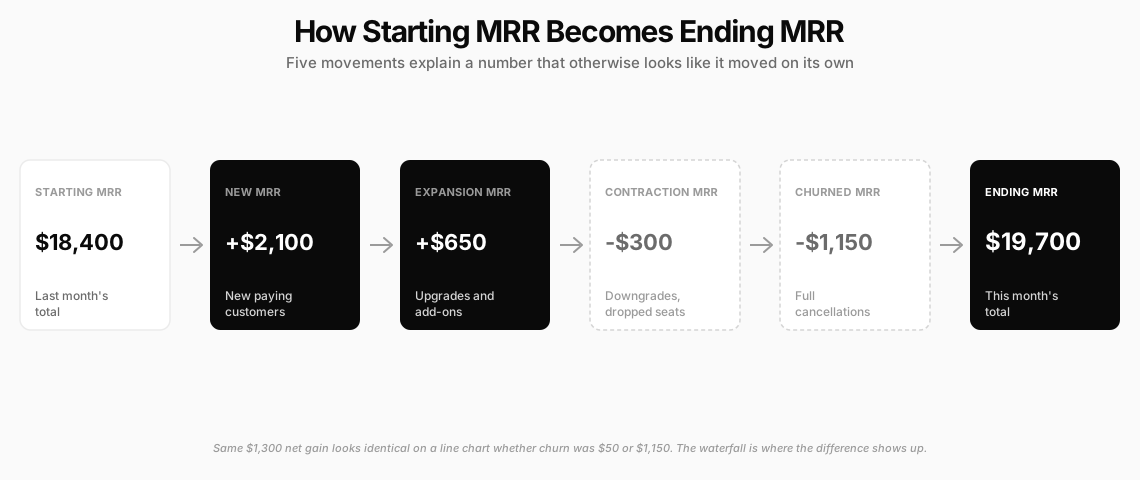
This breakdown matters because "MRR is flat" is not a diagnosis. Flat MRR with high New and high Churn is a leaky bucket you're refilling every month. Flat MRR with low New and low Churn is a stable, mature base with nowhere near the growth potential you might assume. Same top-line number, opposite businesses.
ChartMogul also notes that the healthiest version of this is negative net churn: when Expansion and Reactivation MRR outweigh Contraction and Churned MRR, your existing customer base is growing revenue on its own, even before a single new customer signs up.
MRR vs. ARR: What's the Difference?
Annual Recurring Revenue (ARR) is MRR expressed on a yearly basis: ARR = MRR × 12. Neither number is "more correct." They're the same underlying business viewed at a different resolution.
| Dimension | MRR | ARR |
|---|---|---|
| Time horizon | Monthly | Annual |
| Best for | Month-to-month trend tracking, operational decisions | Investor conversations, annual planning, valuation multiples |
| Reacts to change | Fast: a bad month shows up immediately | Slow: smooths out monthly noise |
| Typical users | Early-stage or fast-moving subscription businesses | Later-stage SaaS, enterprise sales cycles |
Use MRR when you need to catch a problem while it's still small. Use ARR when you're reporting to someone who thinks in yearly terms, like an investor or a lender, and monthly noise would just be a distraction.
What's a Good MRR Growth Rate in 2026?
This is the question most MRR explainers skip, and it's the one that actually matters: is your number good?
SaaS Capital's 2026 annual survey, based on more than 1,000 private B2B SaaS companies, puts the median growth rate at 22% for the year, down from a population median of 25% in 2024. Split by funding type, bootstrapped companies posted a median of 20% (down from 23%), while equity-backed companies held at 25%, unchanged year over year.
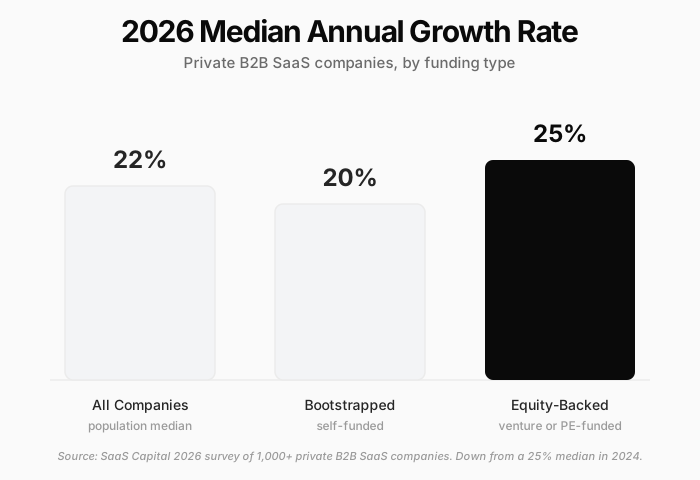
The more useful finding in that same survey isn't the median, it's what predicts it. Net revenue retention (NRR) correlates with growth rate almost exponentially: companies moving from the 90-100% NRR band into the 100-110% band saw roughly 5 percentage points of additional growth, and the highest-NRR companies in the survey grew at a median rate 173% higher than the population median. In plain terms: keeping and expanding the customers you already have predicts growth better than how aggressively you're selling to new ones.
There's no single "good" number that applies to every business regardless of stage. A pre-revenue product finding its first 50 customers should grow far faster, in percentage terms, than a $10M ARR company with an established base. The number that matters most is your own trend, quarter over quarter, not a single external benchmark you're chasing in isolation.
Why MRR Drops (and What to Do About It)
MRR going down is rarely one clean cause. The usual suspects, in roughly the order worth checking first:
- Voluntary churn: a customer decided the product isn't worth the price anymore and canceled outright
- Involuntary churn: a card expired or a charge failed, and the subscription lapsed with no active decision behind it at all
- Downgrades (contraction): customers stayed, but moved to a cheaper plan or dropped a paid seat
- Discounting that outlives its purpose: a promotional rate that was supposed to be temporary quietly became permanent revenue leakage
- Seasonality: some businesses genuinely lose and regain subscribers on a predictable calendar, and treating a seasonal dip as a crisis wastes effort fixing something that wasn't broken
Involuntary churn is worth checking first because it's the cheapest fix on the list: it isn't a product problem or a pricing problem, it's a billing problem. Automatic payment retries and a dunning email sequence before access is revoked recover subscribers who never actually decided to leave. Everything else on that list requires an actual product, pricing, or communication fix; this one just requires the billing tool to retry a failed charge instead of giving up on the first attempt. If voluntary churn is the bigger share of your losses, our retention playbook goes deeper on the tactics, though it's written for community businesses specifically; the activation, engagement, and win-back logic carries over to any subscription product.
How to Track MRR Without a Spreadsheet Nightmare
The manual version of MRR tracking is a spreadsheet that recalculates every active subscription, every plan change, and every cancellation by hand each month. It works until you have more than a handful of customers, and then it quietly goes stale.
- Your payment processor's own reporting. Stripe Billing calculates MRR directly from active subscriptions if that's where your billing already lives
- Dedicated subscription analytics tools like ChartMogul or Baremetrics connect to your billing data and break MRR down into the New/Expansion/Contraction/Churn view automatically, which is worth it once manual tracking stops scaling
- A storefront platform with subscriptions and analytics built in, so the number is already sitting in your dashboard instead of a separate tool you have to reconcile against your actual sales

How Crevio Fits Into Recurring Revenue
Crevio is an AI business builder: you describe the subscription, membership, or digital product you want to sell, and Crevio's AI builds the storefront, sets up Stripe-powered billing, and gets it live. For anything sold on a recurring basis, that billing layer is directly where MRR lives: active subscriptions, renewal dates, and the customer records that let you see who's paying and who just churned, all in one account instead of split across a page builder, a separate payment processor, and a spreadsheet.
Crevio starts on a free Starter plan (5% transaction fee, 20 AI credits/month, 2 published products), with Pro at $20/month (2.5% fee, unlimited products) and Business at $50/month (1% fee, unlimited admin seats, custom domain) for businesses further along. None of Crevio's plans run a 0% transaction fee; the honest comparison point against any platform promising that is what else you're giving up to get there.
It's a reasonable fit if you're setting up a subscription or membership business from scratch and want the storefront, the billing, and the customer data in the same place from day one, rather than assembling MRR tracking as an afterthought once the spreadsheet stops working. It's not a fit if you already run a large SaaS product with an established billing stack; ripping that out to chase a lower fee isn't what the tradeoff is for.
What Nobody Tells You About MRR
- A rising MRR chart can still be a dying business. If New MRR is propping up a chart while Churned MRR quietly climbs alongside it, the trend line looks fine right up until New MRR can't outrun churn anymore, and then it looks fine no more
- Discount codes distort MRR in both directions. A launch discount inflates New MRR with customers who churn the moment the price reverts, and forgetting to expire it turns a promotion into permanent revenue leakage nobody budgeted for
- MRR says nothing about margin. A high-MRR business with expensive support, high infrastructure costs, or a generous free tier subsidizing paid users can be less healthy than a smaller MRR number with a leaner cost base
- Founders round MRR up more than they round it down. It's an easy number to be optimistic about because it's forward-looking by definition; cross-check it against actual cash collected, not just active subscriptions, every few months
FAQ
Total revenue includes everything collected in a period, including one-time sales, refunds netted out, and non-recurring charges. MRR only counts revenue from active recurring subscriptions, normalized to a monthly figure. A business can have high total revenue and low MRR if most of its sales are one-time, or the reverse if it's subscription-heavy with few one-off purchases.
Divide the annual charge by 12 and count that monthly-normalized amount, not the full payment in the month it was charged. Stripe's guidance confirms this is the standard approach: a $1,200 annual plan contributes $100 to MRR every month it's active, keeping the metric comparable across months regardless of billing frequency.
Not automatically. Flat MRR with low churn and low new sales is a stable, mature business that isn't actively growing, which is a legitimate state to be in. Flat MRR with high churn offset by equally high new sales is a warning sign: you're replacing customers as fast as you lose them, and any slowdown in acquisition will immediately show up as a decline instead of a plateau.
MRR is only useful once you stop treating it as one number and start asking which of the five movements produced it. A business with growing New MRR and shrinking Churned MRR is compounding. A business with the same top-line trend but the inputs reversed is running in place, and the chart won't tell you which one you are until you break it apart.
Related Blog Posts
What will you sell today?
Describe what you want to sell — Crevio builds, launches, and grows it. Products, payments, and marketing, all on autopilot.
Start for free