Your business,
on autopilot.
One platform for creating, running and growing your business, powered by AI.
Free Trial vs. Freemium: Which Pricing Model Wins in 2026?





A 2026 study of 200 B2B software products found something most pricing advice gets wrong: free trials barely out-convert freemium, and the gap disappears once you count how many people actually sign up. If you've been agonizing over free trial vs freemium as the "right" choice for your business, the honest answer is that neither model is universally better. Each wins under specific conditions, and picking the wrong one quietly caps your growth for years.
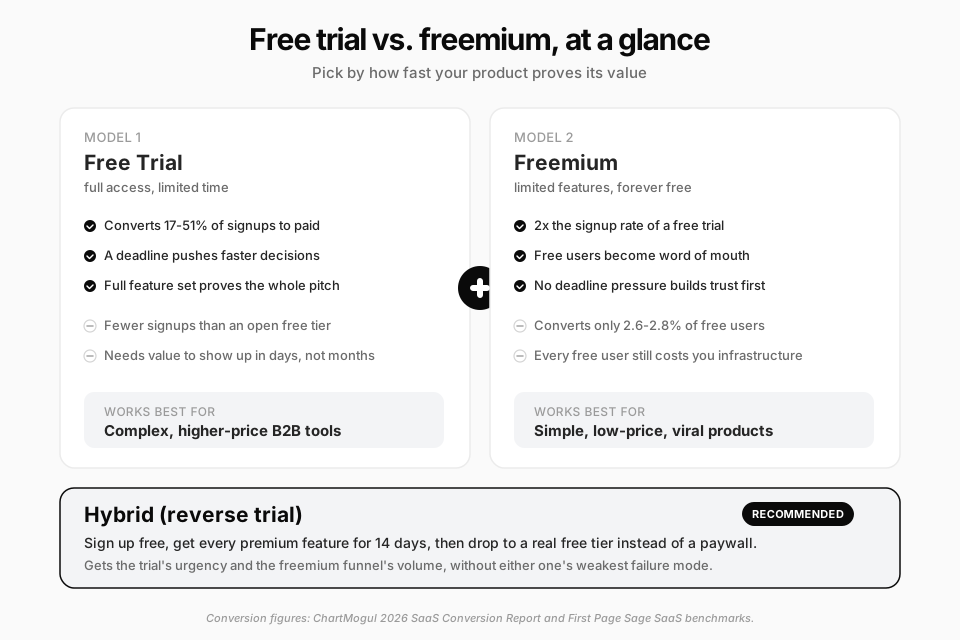
- Free trials convert higher per signup (roughly 17-51% depending on whether a card is required), but freemium brings in far more signups to convert from.
- Freemium wins on volume, not rate. A 2.6-2.8% freemium conversion rate against a much bigger funnel can out-earn a 20% trial conversion rate against a small one.
- The model has to match the product. Fast time-to-value products lean freemium; complex, higher-price products lean free trial.
- Hybrid ("reverse trial") is the fastest-growing option in 2026, giving you a taste of the full product before settling into a real free tier.
Quick Comparison
| Free Trial | Freemium | Hybrid (Reverse Trial) | |
|---|---|---|---|
| How it works | Full access, limited days | Limited features, forever free | Full access briefly, then drops to a free tier |
| Signup friction | Higher (especially with a card) | Lowest | Low |
| Free-to-paid conversion | 17-51% | 2.6-2.8% | Often 15%+ |
| Best for | Complex, higher-ACV B2B tools | Simple, viral, fast time-to-value products | Most self-serve SaaS in 2026 |
| Biggest risk | Small top of funnel | Free users who never convert | More product complexity to build |
What Is a Free Trial?
A free trial gives new users full (or near-full) access to your product for a fixed window, usually 7 to 14 days, after which they either pay or lose access. The whole mechanic runs on urgency: because the clock is ticking, a user who gets real value has a reason to decide now instead of "maybe later."
 Free trials split into two flavors that behave very differently:
- Opt-in trials (no credit card required): lower friction, more signups, but a softer conversion moment since nothing happens automatically when the trial ends.
- Opt-out trials (credit card required upfront): far fewer people start one, but conversion at the end is dramatically higher, because non-conversion requires an active cancellation instead of an active purchase.
That difference alone explains a lot of the "which is better" debate you'll see online: two companies can both run "free trials" and see wildly different numbers because one requires a card and the other doesn't.
What Is Freemium?
Freemium gives users a genuinely free, permanent tier with real (if limited) functionality, and reserves the best features, higher usage limits, or team functionality for paid plans. There's no clock. A freemium user can stay on the free tier forever, which is either the model's biggest strength or its biggest cost problem, depending on how well you've drawn the line between free and paid.
Freemium works by removing the one thing that kills most signups: risk. Nobody has to commit, guess whether they'll remember to cancel, or hand over a card to a product they haven't tried. That's why freemium products consistently see meaningfully higher visitor-to-signup rates than trial products. The tradeoff shows up later: without a deadline, a large share of free users simply never feel enough pressure to upgrade.
Free Trial vs Freemium: The Real Conversion Numbers
This is where most articles on free trial vs freemium either cite a stat with no source or repeat the same rounded "2-5% vs 15-25%" numbers without saying where they came from. Here's what two separate, dated studies actually found.
 ChartMogul's 2026 SaaS Conversion Report, a January 2026 survey of 200 B2B software products run with the ProductLed and Growth Unhinged teams, found a median free-to-paid conversion rate of 8% across all models, with a distribution that's sharply bimodal: 20% of products convert below 2.5%, while 23% convert above 25%. Its most important line, though, isn't about the rate at all: "free trials convert at slightly higher rates than freemium; however, this difference gets wiped out upon accounting for signup rates." In other words, freemium's bigger top of funnel roughly cancels out its lower conversion rate.
First Page Sage's benchmark study, covering 86 SaaS companies from Q1 2022 through Q3 2025, breaks the numbers down further:
| Model | Visitor → Signup | Signup → Paid |
|---|---|---|
| Opt-in free trial (no card) | 7.1-8.5% | 17.4-18.2% |
| Opt-out free trial (card required) | 2.2-2.5% | 48.8-51% |
| Freemium | 13.3-15.9% | 2.6-2.8% |
Run the math on 10,000 visitors and the two models land in a similar place: an opt-in trial gets you roughly 750 signups and 135 paying customers; freemium gets you roughly 1,450 signups and 39 paying customers today, plus a much larger pool of free users who may still convert later, refer someone who pays, or never convert at all. Neither number is "wrong." They measure different bets: freemium bets on volume and long-tail conversion, trials bet on a smaller, higher-intent group converting fast.
Public examples show the same range in practice. Slack built its freemium paywall around a usage limit (a message history cap) rather than a calendar, and widely reported figures on its free-to-paid conversion vary enough between sources that they're not worth repeating as a single number here, a good reminder to check a stat's primary source before you build a strategy on it. Dropbox, running freemium since its earliest days, has talked publicly about converting closer to the freemium norm and leaning on referral mechanics to make the economics work regardless. Same model, different execution, different results. That's really the whole lesson here: the model sets the ceiling, execution decides how close you get to it.
When a Free Trial Wins
A free trial is the better default when most of these are true:
- Your product is complex. If it takes real setup, configuration, or onboarding to see value, a limited free tier will frustrate users before they get there. A trial gives them full access long enough to actually experience it.
- Your price point is higher. Products priced above roughly $50/month tend to convert better through trials, because the buyer is making a more deliberate decision that benefits from full access and urgency.
- You sell to a defined buyer, not a crowd. B2B tools with a clear ideal customer profile don't need freemium's mass top-of-funnel; they need qualified people to experience the real product.
- You can support a trial well. Trials work best with active onboarding (emails, in-app nudges, sometimes a sales touch) that pushes users toward the "aha moment" before the clock runs out.
When Freemium Wins
Freemium is the better default when most of these are true:
- Time-to-value is fast. If someone can feel the payoff in minutes, freemium works because they don't need an evaluation runway: they need permission to start with zero friction.
- The product has viral or network mechanics. Tools that get better with more users invited (think collaborative docs, communication tools, scheduling links) turn free users into a distribution channel, not just a cost center.
- Your price point is lower. Sub-$20/month products often see better economics from a large, low-friction funnel than from gatekeeping access behind a trial.
- You can genuinely afford the free tier. Freemium only works if free users cost you little enough, in infrastructure and support, that a low single-digit conversion rate still pencils out. This has gotten harder in 2026: AI-native products carry real inference costs per free user, so "free" users aren't nearly as cheap to host as a free tier on a traditional web app.
The Hybrid Model: Reverse Trials
The fastest-growing option in 2026 isn't really new: it's a combination. Give every new signup full access to premium features for a limited window (the trial's urgency and completeness), then drop them into a real, permanently free tier instead of a hard paywall (freemium's low-risk, no-deadline funnel).
This is sometimes called a "reverse trial," and it's popular for a good reason: it removes the worst failure mode of each pure model. A pure trial's worst outcome is someone who needed more than 14 days to feel the value and simply never came back. A pure freemium's worst outcome is someone who's perfectly happy on the free tier forever and never feels a reason to upgrade. A reverse trial gives users the full picture early (so they know what they'd be giving up) and then still keeps them in the funnel with a genuine free tier instead of locking them out completely.
The tradeoff is real, though: a reverse trial means building and maintaining three states instead of two (trial, free, paid), which is more product and billing complexity than either pure model. It's worth that complexity for most self-serve SaaS businesses in 2026, but it's not free to build.
How Crevio Fits Into This
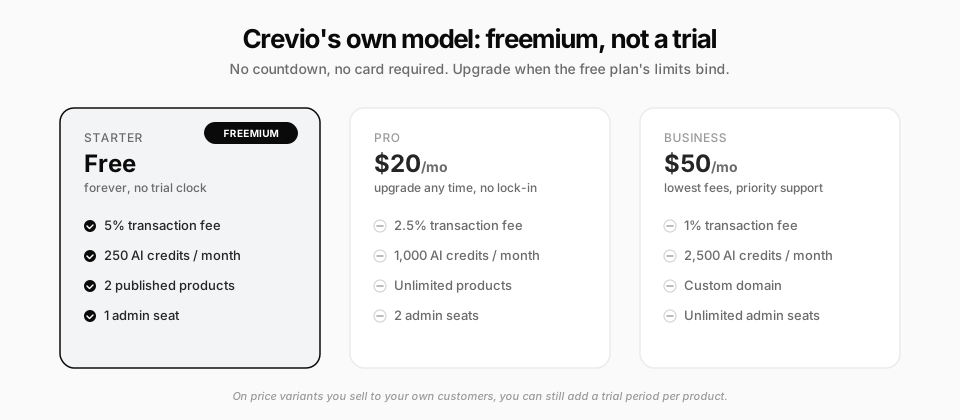
Worth being transparent about where Crevio itself lands on this spectrum, since it's exactly the kind of decision this article is about. Crevio runs a straightforward freemium model, not a free trial: the Starter plan is free forever, with a 5% transaction fee, 20 AI credits a month, and room for 2 published products and 1 admin seat. There's no countdown and no card required to start. Upgrading to Pro ($20/month) or Business ($50/month) drops the transaction fee to 2.5% or 1% and lifts the product and seat limits, but that's a decision you make when the free tier's limits start to bind, not on a deadline.
That choice fits the framework above: Crevio's time-to-value is fast (you describe the business you want and the AI starts building it in the same session), and the audience is broad, business owners and solopreneurs rather than a narrow enterprise buyer, which is exactly the profile that tends to do better with freemium than with a trial.
If you're building a subscription product of your own on Crevio, though, you're not locked into freemium just because the platform is. Price variants support their own trial_period_days, so you can offer your own customers a free trial, a discounted intro period, or no trial at all, independent of how Crevio prices itself. That's the same decision this whole article walks through, just one level down, for whatever you're selling through your own storefront.
Common Mistakes With Each Model
Free trial mistakes:
- Making the trial too short for the product's real time-to-value. If your onboarding alone takes a week, a 7-day trial guarantees most users never get there.
- No urgency inside the trial itself. A countdown that never appears in the product doesn't create urgency; it just quietly expires.
- Requiring a card for a product nobody's heard of yet. High-friction opt-out trials work when your brand already carries trust; for a new product, they can crush signups before anyone's had the chance to see the value.
Freemium mistakes:
- Gating the wrong feature. Cut off something core and free users churn before they experience the product. Leave in too much and nobody ever needs to pay.
- Treating the free tier as marketing-only, not a real cost center. Every free user consumes support, infrastructure, and (increasingly) AI compute. Underestimating that cost is how freemium quietly loses money on volume.
- No upgrade trigger. If nothing in the product ever nudges a free user toward a limit, they'll happily stay free indefinitely, and freemium's low conversion rate gets worse, not better.
How to Decide: A 4-Question Framework
Answer these honestly and the right model is usually obvious:
- How fast is time-to-value? Minutes, lean freemium. Days or more, lean trial.
- What's your price point? Under ~$20/month, freemium tends to win on economics. Above ~$50/month, trials tend to convert better.
- Does your product get better with more (free) users in it? If yes, freemium's distribution effect is worth more than a higher conversion percentage.
- Can you actually afford free users? If cost-to-serve a free user is near zero, freemium is low-risk. If it's meaningful (AI inference, storage, support), a trial or a much stingier free tier protects your margins.
If your answers split between models, that's usually the signal to build a reverse trial instead of forcing a pure version of either one. For a broader look at building the business around a subscription product, our guide on how to start a SaaS business covers the steps before pricing even comes into play, and our pricing framework for digital products walks through setting the price itself once you've picked the model.
Free trial vs freemium was never really a branding decision. It's a bet on how fast your specific product earns trust, so bet on the model that matches how fast yours actually proves it, not the one your last three competitors happened to pick.
FAQ
Neither is better in the abstract. Free trials convert a higher percentage of signups but attract fewer of them; freemium attracts more signups but converts a much smaller share. For most new, low-price, fast-time-to-value products, freemium or a hybrid reverse trial tends to be the safer starting point. For complex or higher-priced B2B tools, a free trial usually outperforms.
Based on First Page Sage's 2022-2025 benchmark data, 2.6-2.8% free-to-paid is the norm for freemium. ChartMogul's 2026 report found roughly a quarter of products converting below 2.5% and a similar share above 10%, so double-digit territory is achievable but not typical. Treat single-digit conversion as normal, not a sign something's broken.
Yes, and plenty of companies do, though it's disruptive to existing free users either way. Switching from freemium to a trial usually means grandfathering existing free accounts while gating new signups differently. Switching from trial to freemium (or adding a reverse trial) is generally the smoother direction, since you're removing friction rather than adding it.
It depends more on your product than the model. A free trial's cost is bounded by its time window; a freemium free tier's cost runs indefinitely for every free user who sticks around, which is why unclear feature gating is riskier under freemium. For AI-heavy products specifically, free-tier compute cost has become a real line item in 2026, worth modeling before you commit to an unlimited free plan.
Related Blog Posts
What will you sell today?
Describe what you want to sell — Crevio builds, launches, and grows it. Products, payments, and marketing, all on autopilot.
Start for free