Your business,
on autopilot.
One platform for creating, running and growing your business, powered by AI.
7 Best Durable Alternatives in 2026: AI Business Builders Compared




Last updated: April 2026
Durable built the "AI business builder" category, then filled it with service businesses: landscapers, handymen, wellness studios, pet groomers. If you're not one of those, or if you've outgrown Durable's $25/month website and CRM combo, the right alternative depends on one question most roundups skip: do you need an AI business builder or just an AI website builder? They are not the same thing, and mixing them up is why so many creators and online sellers end up paying for the wrong tool.
This comparison splits them honestly.
- Crevio is the AI business builder for online businesses: digital products, courses, memberships, online services. Think Durable, but pointed at creators and digital sellers instead of local service businesses.
- Naïve goes furthest on autonomy: a Y Combinator-backed "company runtime" that hires autonomous AI employees, forms an LLC, and runs the operation end-to-end.
- 10Web, Wix, Framer, Hostinger, and Dorik are AI website builders, not business builders. They generate a site. You run everything else.
Quick Comparison
| Platform | Starting Price | Category | Best For |
|---|---|---|---|
| Crevio | Free (5% tx fee) | AI business builder | Digital products, courses, online businesses |
| Durable | $25/mo (after free tier) | AI business builder | Local service businesses |
| Naïve | Free trial, then $49/mo | Autonomous AI company runtime | Aggressive autonomy, new ventures, YC-backed bet |
| 10Web | $10/mo (billed yearly) | AI website + WordPress | Teams wanting WordPress on rails |
| Framer | Free (from $5/mo) | AI website + design tool | Designers and brand-first teams |
| Wix | Free (from $17/mo) | General AI website builder | Broad SMB use cases |
| Hostinger | $2.99/mo (billed yearly) | Budget AI website + hosting | Cheapest path to a live site |
| Dorik | Free (from $7/mo) | Simple AI website builder | One-pagers and portfolios |
Prices verified April 2026 and may shift; check each provider for current terms.
Why People Look for Durable Alternatives
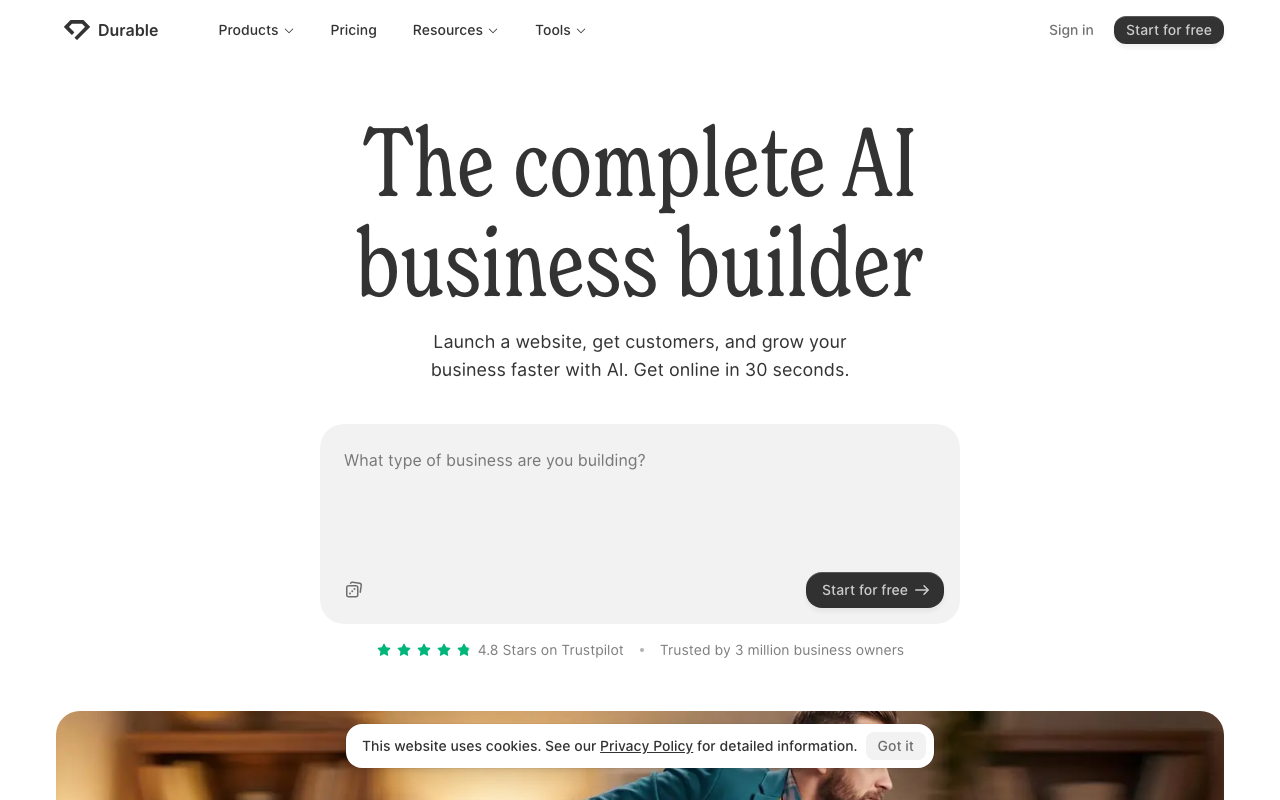
Durable is a legitimate product. Over 10 million sites generated and a 4.8-star Trustpilot rating don't happen by accident. But the reasons people end up searching for alternatives cluster into a predictable list:
- It's built for local service businesses. Durable's templates, copy, and CRM assume you're a cleaner, plumber, trainer, or accountant. If you sell courses, ebooks, memberships, or any digital product, the templates fight you.
- No proper e-commerce or digital product delivery. You can take invoices and payments, but there's no course player, no gated downloads, no membership gating, no digital product vault.
- Design flexibility is limited. Reviews consistently flag rigid layouts and cookie-cutter results. Fine if you just need a site up. Frustrating if brand matters, and worth comparing against what the best ecommerce websites actually do differently.
- Marketing features are basic. The AI assistant helps with blogs and SEO basics. It does not run real email sequences, lead nurturing, or launch campaigns.
- Price creep on upgrades. The entry plan is $25/month, but add-ons and higher tiers add up fast once you need custom domains, better SEO, or more AI credits.
None of these are deal-breakers for a house painter. All of them matter if you're building an online business selling digital goods or services.
What nobody tells you: the real cost of Durable usually isn't the subscription. It's the year you spend building a business inside a CRM that wasn't designed for your business model, then migrating off when you finally admit the templates are fighting you. That migration is the most expensive part.
AI Business Builders vs AI Website Builders: The Category Split
Most "Durable alternatives" articles treat Durable like just another website builder. It isn't. Durable sits in a newer category called the AI business builder. Getting this distinction right is the most important decision in this whole list.
| You Describe | It Produces | Category | Examples |
|---|---|---|---|
| A task ("write an email") | A task output | AI tool | ChatGPT, Claude |
| A workflow ("when X, do Y") | An automation | AI automation | Zapier, Make |
| A website ("landscaping company in Austin") | A working site | AI website builder | Wix, Framer, 10Web |
| A business ("I sell fitness courses") | Working business infrastructure | AI business builder | Crevio, Durable, Naïve |
If you want the long version of this framework, we covered it in AI business builder: 8 platforms that actually build and run your business and can AI run a business in 2026.
The short version:
- An AI website builder produces pages. It stops at the site.
- An AI business builder produces the things the business actually needs to operate: storefront, payments, products, leads, customers, marketing. It keeps going after the site is live.
Durable, Crevio, and Naïve are business builders. Everyone else in this list is a website builder with AI baked in. Both are legitimate choices. Picking the wrong category is how you end up rebuilding your stack twice.
How We Picked These Alternatives
Every platform in this list hits at least three of these criteria:
- AI does meaningful setup work. Not just template picking. Actual generation of copy, structure, or imagery from a short description.
- A real free tier or low starting price. Paying $49+/month before you've validated anything is a bad idea.
- A clear use case where it beats Durable. Either a different audience (creators, agencies, designers) or a different trade-off (more control, lower price, better CMS).
- Live in 2026 and actively maintained. No abandonware.
We've ordered them by how well they fit readers leaving Durable, not by affiliate payout.
1. Crevio: Best AI Business Builder for Online Businesses
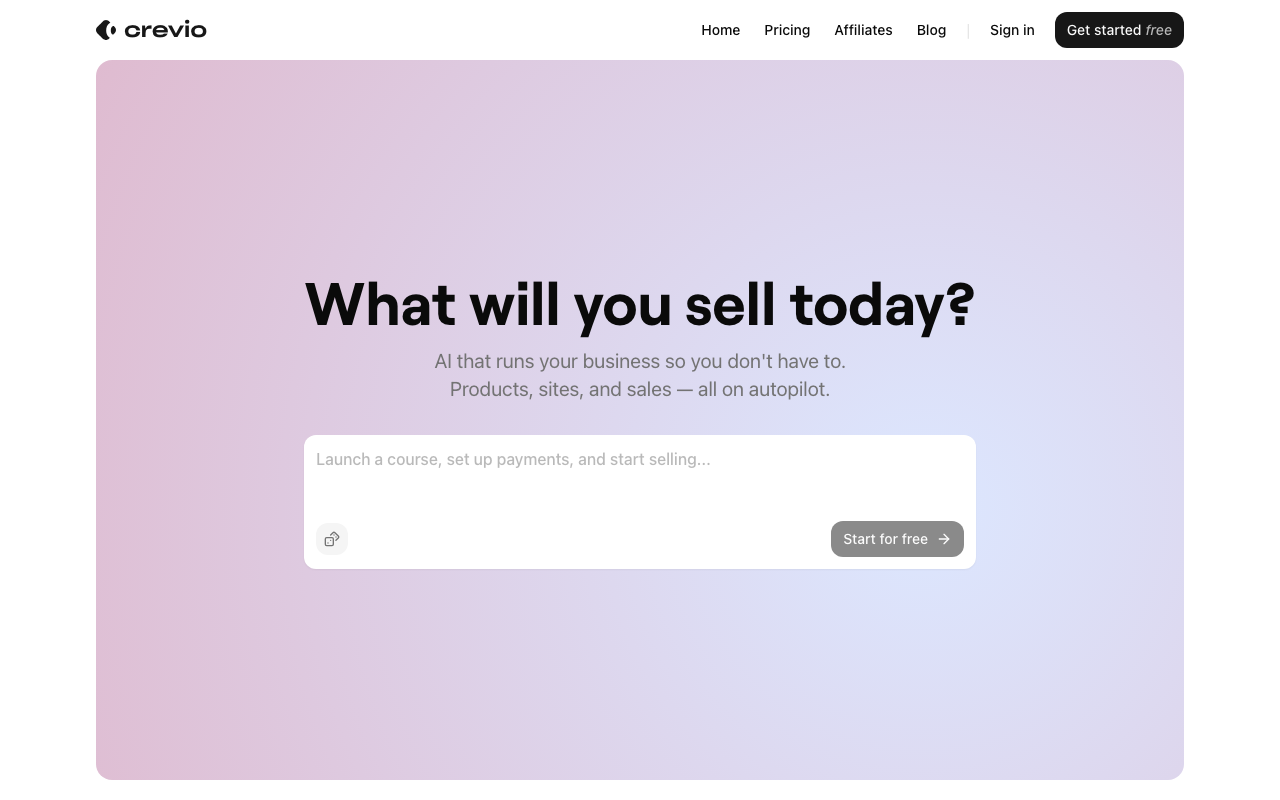
Crevio is the Durable of online businesses. Where Durable points AI at local service businesses, Crevio points it at digital products, courses, memberships, and online services. Same category, different audience.
You describe what you want to sell, whether that's "a $49 Notion template for freelance designers", "a three-module course on cold outreach", or "a paid Discord community for solopreneurs", and Crevio's AI agents build the storefront, write the product copy, set up checkout, draft the emails, and keep optimizing. It's closer to hiring a small team than subscribing to a tool.
Why people switch from Durable:
- Built for digital products. Courses, downloads, link-in-bio storefronts, memberships, embeds. All first-class product types. Durable has invoices; Crevio has a product catalog.
- Free plan with no time limit. Start at $0/month with 5% transaction fees. Durable's free tier is mostly a preview; Crevio's is a working business.
- Real Stripe-powered checkout. One-time payments, subscriptions, trials, upsells. No proprietary payment rails.
- Replaces the whole stack. Storefront, link-in-bio, checkout, lead capture, email, customer CRM, analytics, 3,000+ integrations. Same "consolidate your tools" pitch as Durable, just for online sellers.
- Full REST API. Your data is yours. You can export or integrate anything.
Crevio pricing:
| Plan | Monthly | Annual (save 20%) | Transaction Fee | AI Credits |
|---|---|---|---|---|
| Starter | Free | Free | 5% | 250/mo |
| Pro | $20/mo | $16/mo | 2.5% | 1,000/mo |
| Business | $50/mo | $40/mo | 1% | 2,500/mo |
Pros: AI business builder specifically for digital products, real free plan, lower total cost than Durable at most tiers, modern Stripe checkout, custom domains on paid plans, no revenue share.
Cons: Not the right tool if you're a plumber or a personal trainer needing local SEO and invoice-heavy CRM. That's literally what Durable is built for. AI autonomy is still maturing (every honest AI business builder is in the same place), so set expectations around "exceptional AI partner" rather than "fully autonomous CEO."
Best for: Anyone selling digital products, courses, memberships, or knowledge-based services online. If Durable's templates feel wrong because they assume you show up in person with a toolbox, Crevio is the category match.
2. Naïve: The Most Autonomous AI Business Builder
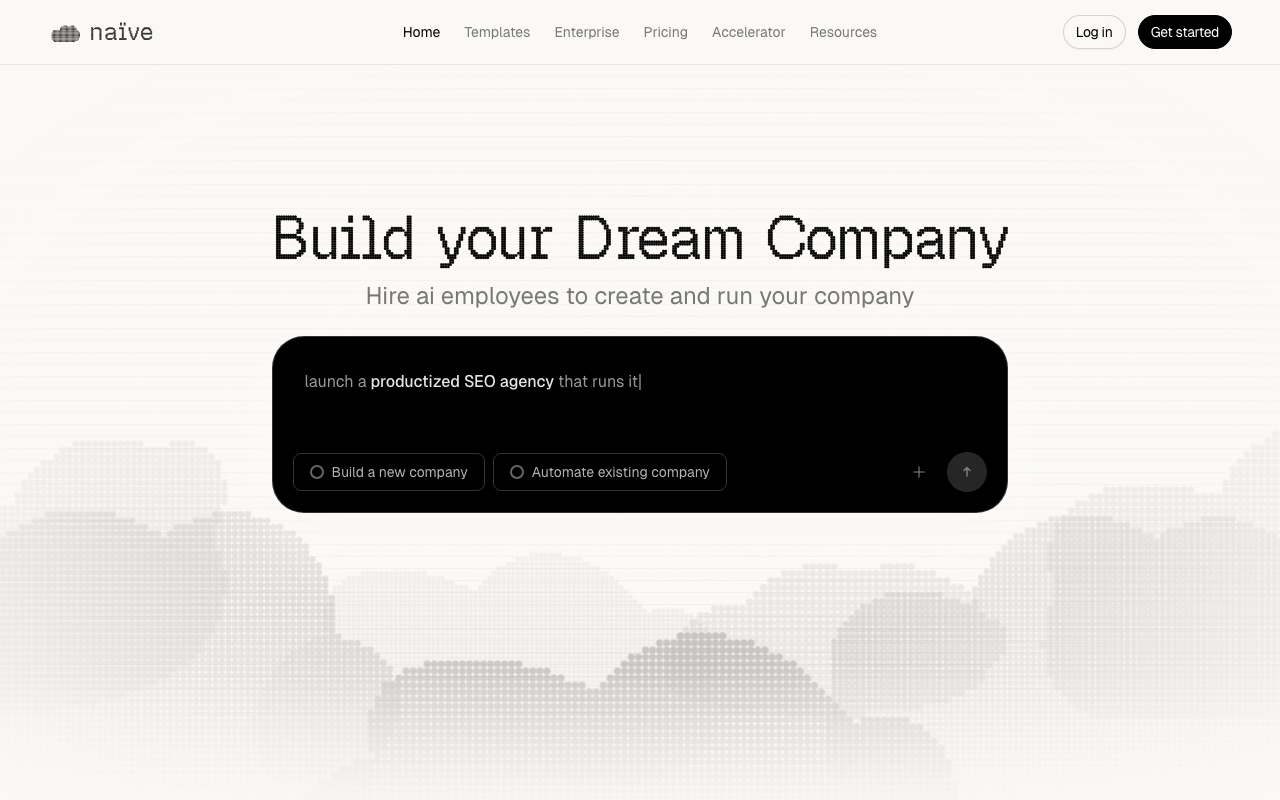
Naïve is the most aggressive swing on autonomy in this category. It calls itself "the company runtime" and promises something Durable, Crevio, and everyone else in this list are careful not to claim: AI employees that own and operate your business end-to-end. The product is Y Combinator-backed, recent, and positioning itself where Durable's vision will go in a few years if everything works.
You describe your business in one sentence. Naïve forms a real registered LLC, opens a business bank account, issues payment cards, and hires a team of AI employees for sales, content, ads, and ops. Each AI employee gets its own email, bank account, browser, and credentials. They sign up for tools, pay for services, and ship work as themselves.
Why people switch from Durable:
- Real operational autonomy, not just a site. Durable builds a website and a CRM. Naïve runs the company: campaigns, outreach, content, deals, customer ops.
- LLC, banking, and payment infrastructure in one flow. Durable assumes you already have a business. Naïve registers the legal entity for you.
- Pre-built company templates. Options include agencies (SMMA, X growth), e-commerce (Shopify dropshipping), and media (faceless YouTube). Good for idea-testing; somewhat eyebrow-raising in places.
- 30+ integrations. Stripe, Slack, HubSpot, GitHub, Vercel, Notion, Shopify, Gmail, Discord. Your AI team plugs into the tools a human team would use.
Naïve pricing:
| Plan | Monthly | Credits | Notes |
|---|---|---|---|
| Free trial | $0 | 20 credits, 7 days | No card required |
| Starter | $49/mo | 50 credits | Custom domain, credit rollover |
| Pro | $149/mo | 200 credits | Team workspace, SSO, RBAC |
| Pay-as-you-go | $0.50/credit | Flexible | No monthly caps |
Pros: The most ambitious autonomy pitch in this category, legal and banking infrastructure included, genuinely novel "AI employees with their own identity" architecture, integrates with the tools you already use.
Cons: Early-stage product with bold promises. Some pre-built templates (prediction market desks, adult creator management agencies) are aimed at attention more than at boring, durable business models. Credit-based pricing means cost is harder to forecast than flat-rate alternatives. If autonomy isn't what you actually need, you're paying for capability you won't use.
Best for: Founders running new, fast-moving ventures where "AI runs it" is the whole point, and who are comfortable betting on an early-stage YC company. Not the right fit if you're looking for a stable, predictable website-plus-CRM setup. That's what Durable is for.
3. 10Web: AI-Generated WordPress Without the Pain
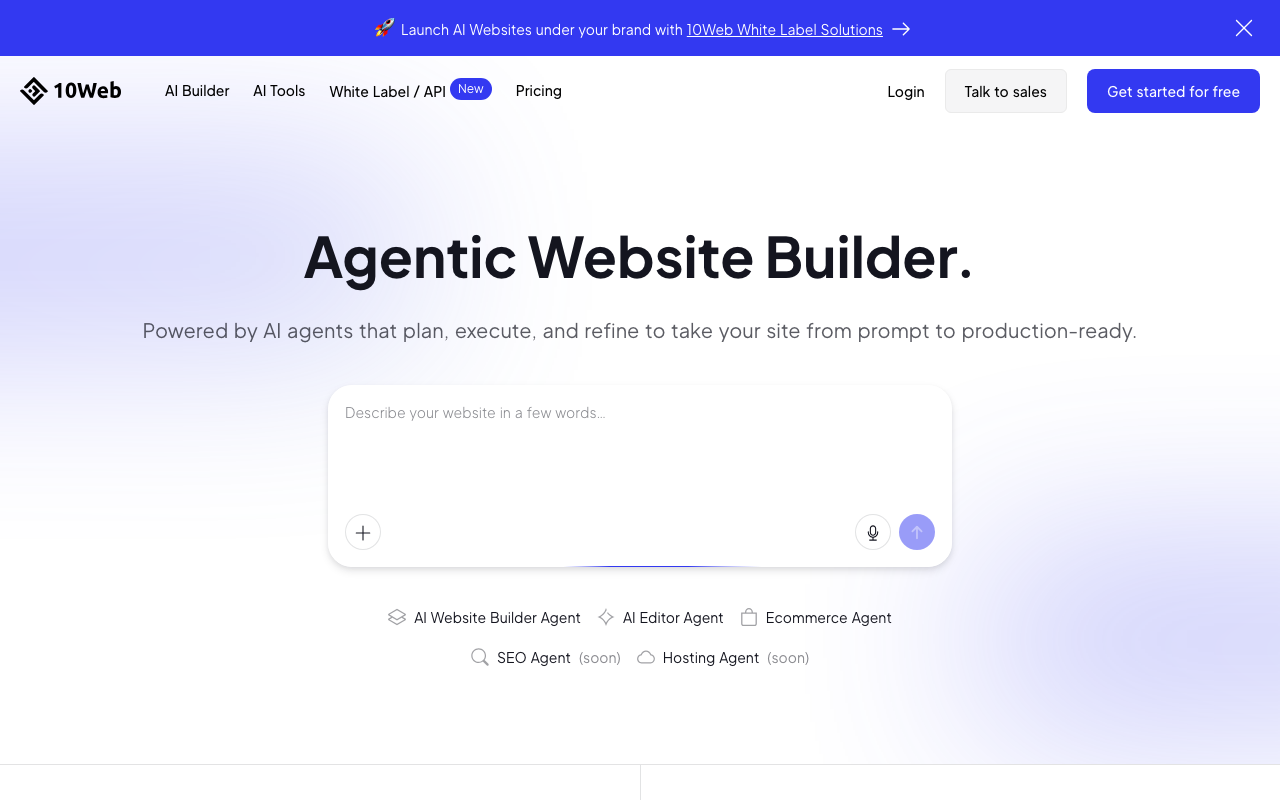
10Web takes a different angle: instead of building a proprietary site, it generates a real WordPress site, hosts it on its own managed infrastructure, and hands you an Elementor-style editor. You can recreate an existing site from a URL, which is genuinely useful if you're migrating.
Why people switch from Durable:
- Real WordPress underneath. Thousands of plugins, proper SEO plugins, portable if you ever leave.
- Managed hosting bundled in. You don't have to learn DevOps to run WordPress.
- Site recreation from URL. Point it at an existing site, get a WordPress version back.
Pros: Serious customization, large plugin ecosystem, portable output, good starting price.
Cons: It's still WordPress. Plugins can conflict, updates can break things, maintenance is never zero. No built-in CRM, invoicing, or business tools, just the site. You'll layer those on yourself.
Best for: Teams who want AI speed on day one and WordPress flexibility on day one hundred.
4. Framer: For Designers Who Refuse to Compromise
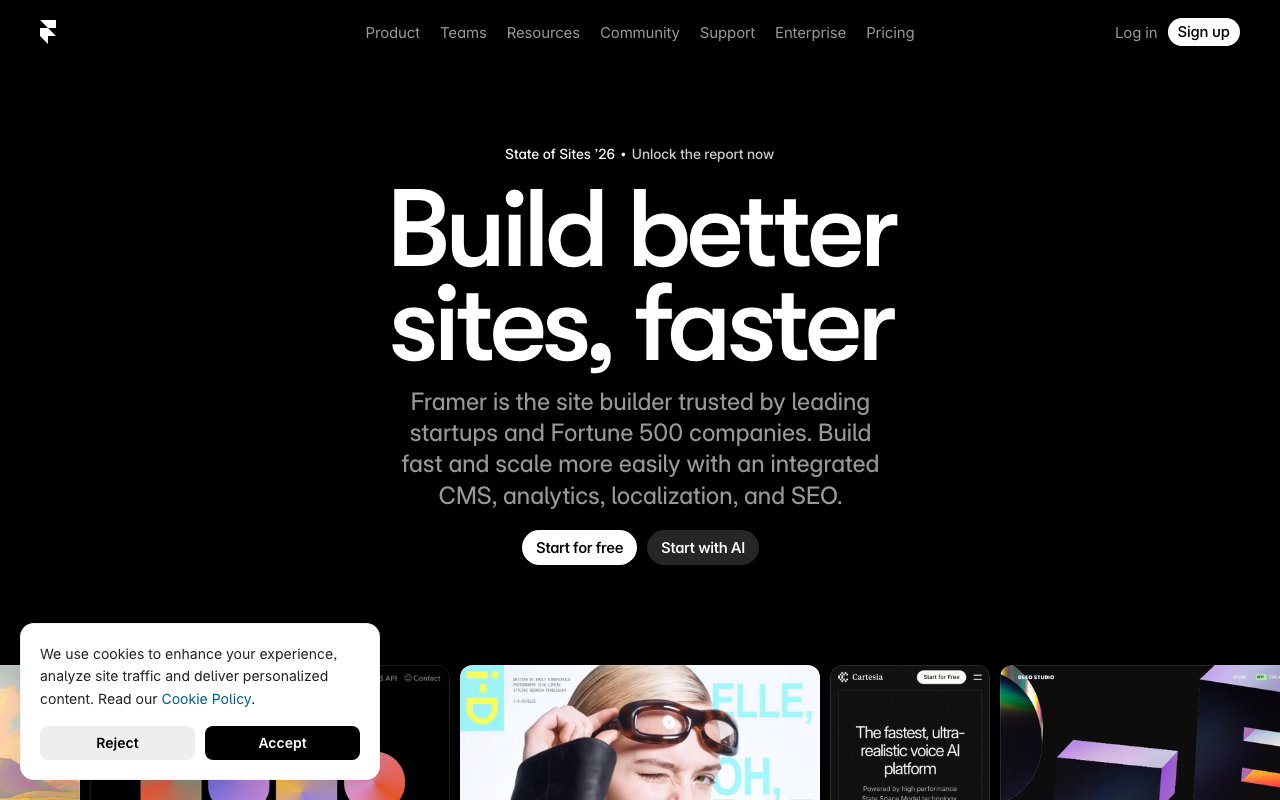
Framer comes at AI websites from the design-tool end. It started as a Figma-adjacent design tool and added AI site generation on top, so the output skews far more polished than Durable's. Drag-and-drop canvas, rich animations, serious CMS, proper publishing infrastructure.
Why people switch from Durable:
- Design quality. If Durable's rigid layouts feel like a limit, Framer is the opposite end of the spectrum.
- Animations and interactions. Real motion design, not just hover states.
- Solid CMS and localization. Supports multilingual sites, blog CMS, e-commerce integrations.
Pros: Best-in-class design flexibility, generous free tier, strong community and templates.
Cons: It's a design-first tool, so the AI does less business setup than Durable does. No CRM, no invoicing, no built-in client tools. The learning curve is real if you don't think in layers and breakpoints.
Best for: Brand-first teams, designers, and agencies who care more about how the site looks than about AI running the back office.
5. Wix: The Broadest AI Website Builder
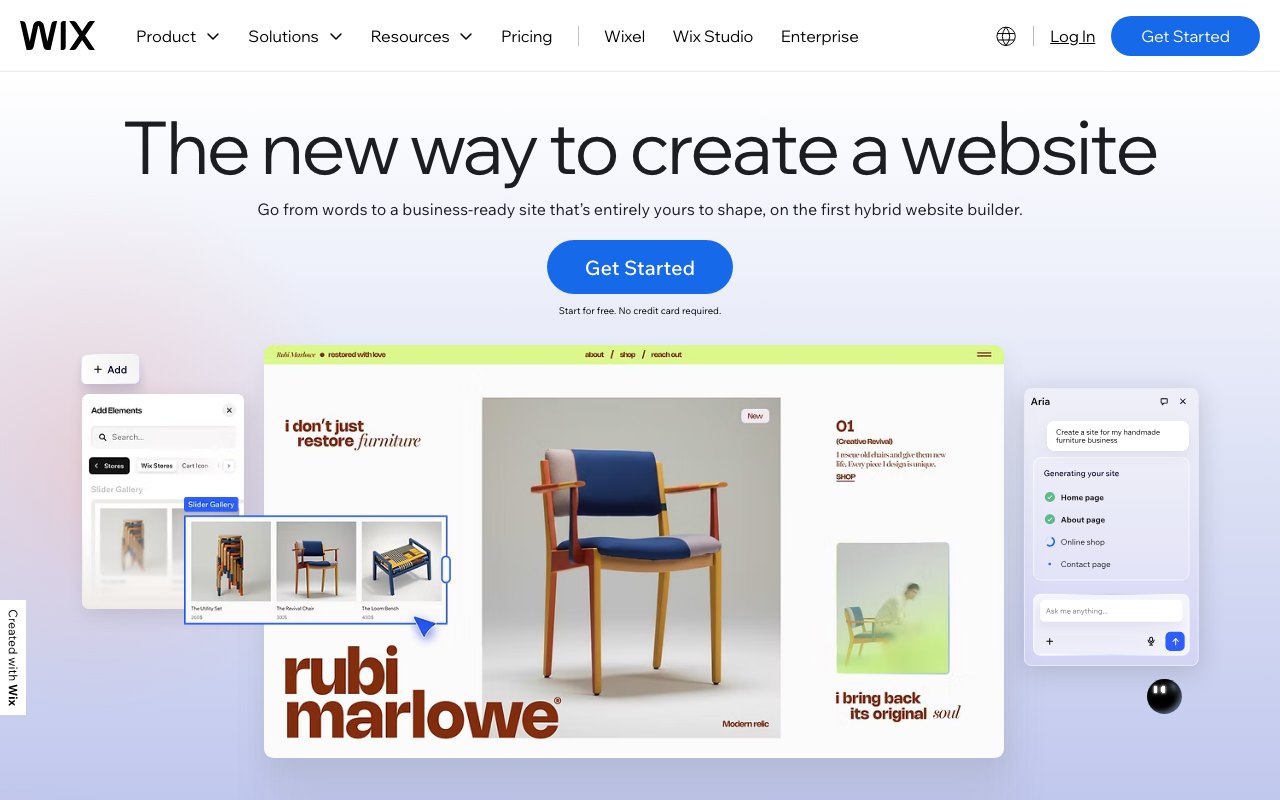
Wix doesn't need an introduction. Its Wix AI website generator has caught up substantially with Durable on speed, and the Wix app marketplace gives you access to thousands of integrations: scheduling, e-commerce, memberships, forums, you name it.
Why people switch from Durable:
- Template and design variety. 900+ templates, plus AI generation.
- Massive app ecosystem. Almost every SaaS integration you'd want is a toggle away.
- E-commerce support. Physical and digital goods, subscriptions, point-of-sale.
Pros: Huge ecosystem, mature editor, real e-commerce, solid SEO tools on paid plans.
Cons: Free plan has Wix branding and a Wix subdomain. The sheer feature count can feel bloated if you came for simplicity. It's an AI website builder with e-commerce, not an AI business builder. There's no unified "describe your business and it sets up" experience the way Durable or Crevio have.
Best for: Small businesses that want variety, a marketplace, and don't need AI to run the business. They just need it to generate the site.
6. Hostinger: Cheapest Route to a Live Site
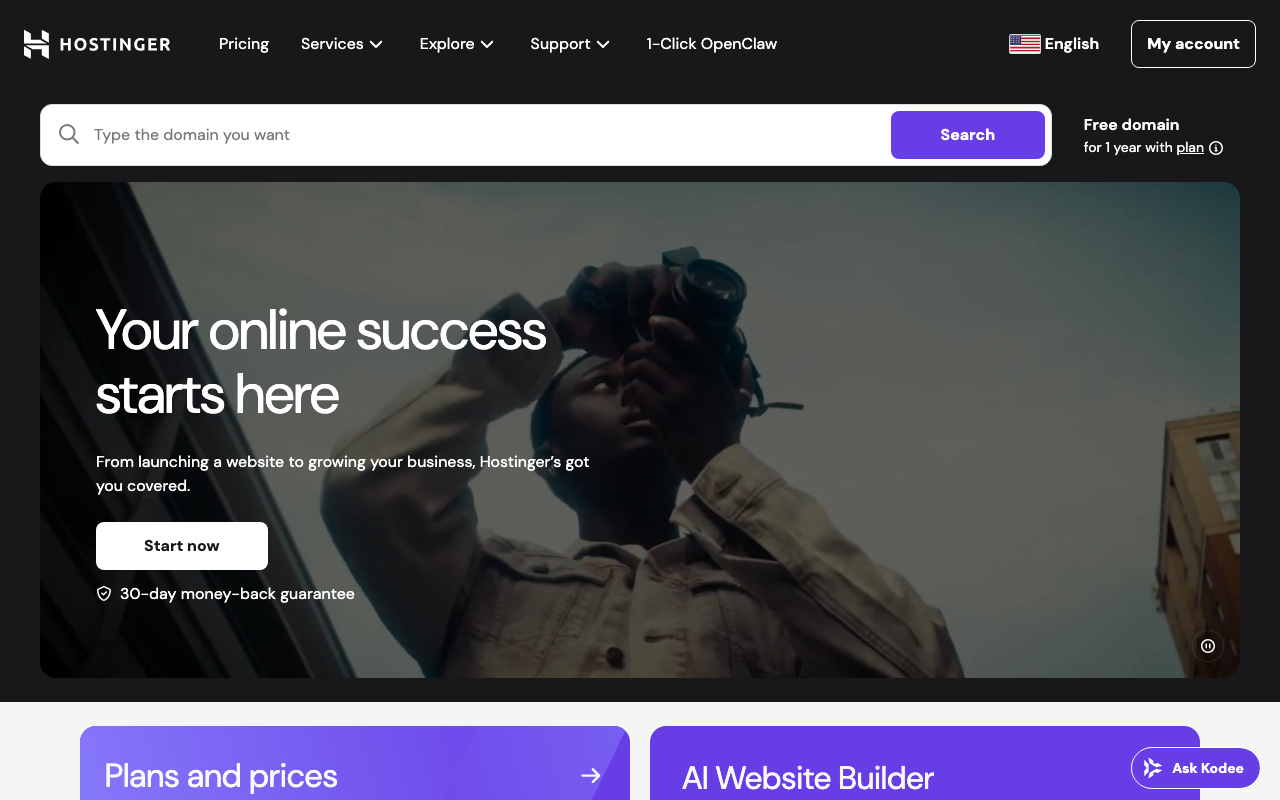
Hostinger bundles an AI website builder, hosting, SSL, and email into one of the cheapest packages on the market. If the goal is "I need a site live this weekend for as little as possible," Hostinger is hard to beat on price.
Why people switch from Durable:
- Sub-$3/month plans when billed annually.
- Hosting, email, and SSL included in the same plan.
- AI content and image generation built into the builder.
Pros: Lowest price in this roundup, reliable hosting, generous introductory terms.
Cons: Price is promotional. Renewal rates are notably higher. AI features are capable but not category-leading. No CRM or business tools.
Best for: Budget-first builders, side projects, and anyone who wants to own the hosting layer without paying SaaS prices.
7. Dorik: Simple AI Websites With a Generous Free Tier
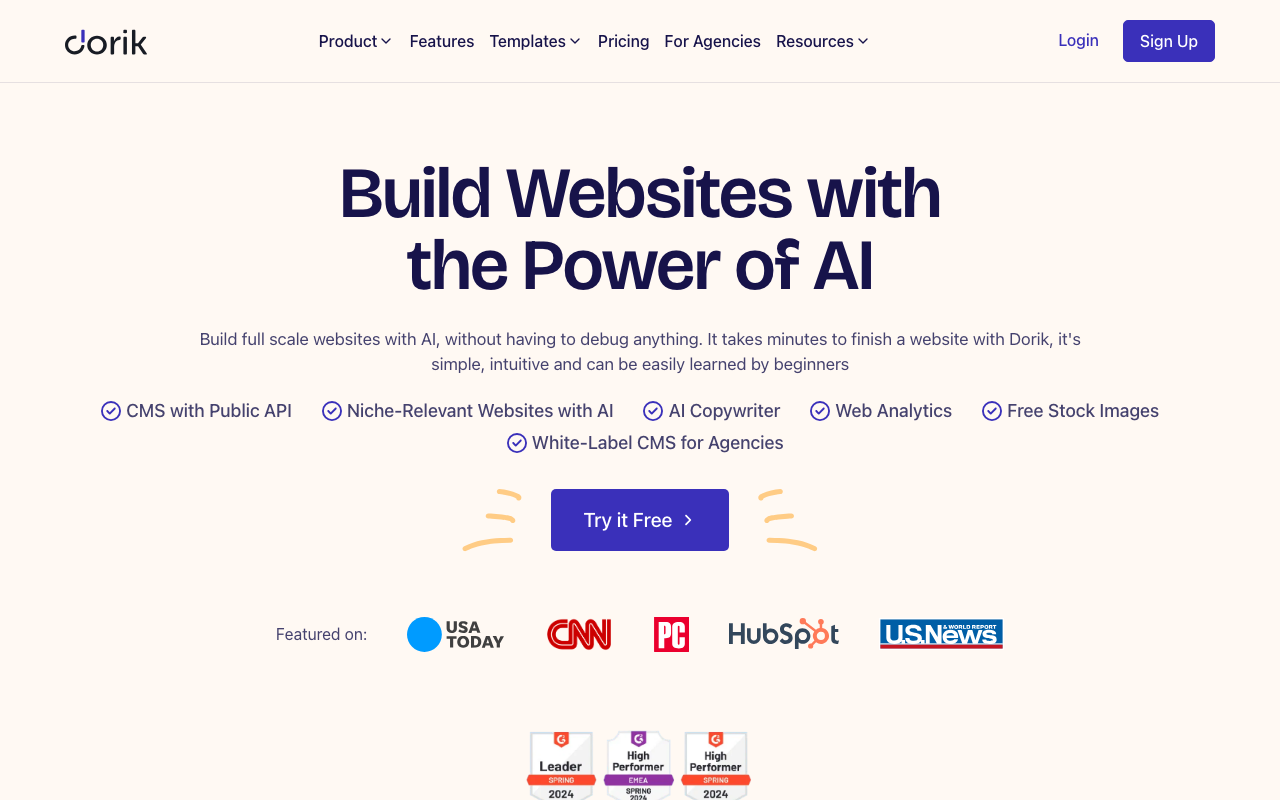
Dorik has quietly become one of the better Durable alternatives for people who want a clean one-pager, portfolio, or small marketing site. Its AI builder is quick, the free plan is usable, and paid tiers stay under most competitors' prices.
Why people switch from Durable:
- Free plan actually works. You can publish on a Dorik subdomain without a paywall for core features.
- Clean, modern templates. Less "generic SMB template" feel than Durable.
- White-label and CMS on paid plans for agencies.
Pros: Affordable, good free tier, modern design defaults, agency-friendly features.
Cons: Smaller ecosystem than Wix or Framer. No built-in CRM, invoicing, or AI business assistant. Strictly a site builder.
Best for: Solopreneurs and small agencies who want a modern site cheaply, without the Durable template baggage.
How to Choose the Right Durable Alternative
Skip the feature-checklist approach. Answer three questions in order, and the shortlist narrows itself.
1. Are you selling digital products or services online, or in-person work?
- Online (courses, downloads, memberships, digital services): You're in Crevio's lane. Durable is the wrong category match.
- Local / in-person service: Stay close to Durable's category. Stay on Durable and upgrade, or fall back to a dedicated website builder.
2. Do you need an AI business builder, or just an AI website builder?
- Business builder (AI runs multiple parts of the business): Crevio, Durable, Naïve.
- Website builder (AI builds the site, you run everything else): 10Web, Framer, Wix, Hostinger, Dorik.
3. How much autonomy and control do you want?
- Maximum autonomy, willing to bet on early-stage: Naïve.
- Proven AI partner with predictable pricing: Crevio, Durable.
- Maximum design control: Framer.
- Practical, done-for-you output: 10Web.
- Quick and cheap: Hostinger, Dorik.
A good gut check: if you're paying for Durable mostly to get a site and you sell online, you're probably overpaying for features you don't use and underpaying in features you need. An AI business builder that matches your audience will usually cost less and do more.
The right question isn't "what's the best Durable alternative?" It's "what was Durable supposed to be doing for me, and is it actually doing that?" Most people who end up here find the answer is no, and the fix is rarely another website builder. It's an AI business builder pointed at the business they're actually running.
Durable Alternatives FAQ
Is there a free alternative to Durable?
Yes. Crevio, Framer, Wix, and Dorik all offer real free plans (not just trials). Crevio is the only one of those that is an AI business builder rather than a website builder, which matters if you're selling digital products.
What is the best Durable alternative for selling digital products?
Crevio. It's built from the ground up for digital products (courses, downloads, memberships, embeds) with Stripe-powered checkout, a built-in link-in-bio storefront, and AI that sets up the products and copy for you. Durable's CRM and invoicing flow assumes you're billing clients for services, not selling digital goods at scale.
Can AI really build and run a business?
It can build a lot of the infrastructure and automate real work across marketing, customer management, and product setup. It cannot run the business fully autonomously yet. The honest framing is: an AI business builder is an exceptional partner that replaces a stack of tools and a chunk of manual setup work. We unpack this in detail in can AI run a business in 2026.
How does Crevio compare to hiring a team?
It's not a like-for-like swap for a ten-person team, but for the setup and optimization work that normally eats the first few hires on a small operation, it's surprisingly close. We broke down the direct comparison in AI business builder vs hiring a team.
Why is Durable popular with service businesses?
Durable started with a clear wedge: local service businesses with a mobile phone, a trade, and no patience for website software. The templates, copy, CRM, and discoverability features are all tuned for that audience. It's a genuinely strong product when the audience fit is right.
Related Blog Posts
What will you sell today?
Describe what you want to sell — Crevio builds, launches, and grows it. Products, payments, and marketing, all on autopilot.
Start for free