Your business,
on autopilot.
One platform for creating, running and growing your business, powered by AI.
7 Best Polsia Alternatives in 2026 (Compared & Reviewed)





Last updated: October 2026
The best Polsia alternative for most people is an AI that runs the business but lets you decide what needs your sign-off, such as spending money or emailing customers. Polsia made "AI that runs your company while you sleep" a category. Since then its pricing has changed twice, and several competitors now do the same job with more control, lower fees, or a narrower focus.
This guide is for founders, solo operators, and creators who want AI to do the work of running a business, not just answer questions about it. It compares seven Polsia alternatives on what matters once real money is involved: what each one actually runs, what it costs, how much of your revenue it takes, and whether you can stop it before it acts.
Key takeaways:
- Polsia now charges a 3% platform fee on customer payments and 20% on ad spend, with plans reported from about $20/month per company. The old 20% revenue share is gone.
- The closest alternatives run the whole business: Crevio, NanoCorp, and Cofounder.co. They differ most on fees, payouts, and approvals.
- Agent builders and workflow tools (Twin, Lindy, Zapier Agents, n8n, Make) automate parts of a business you already run. They don't start or operate one for you.
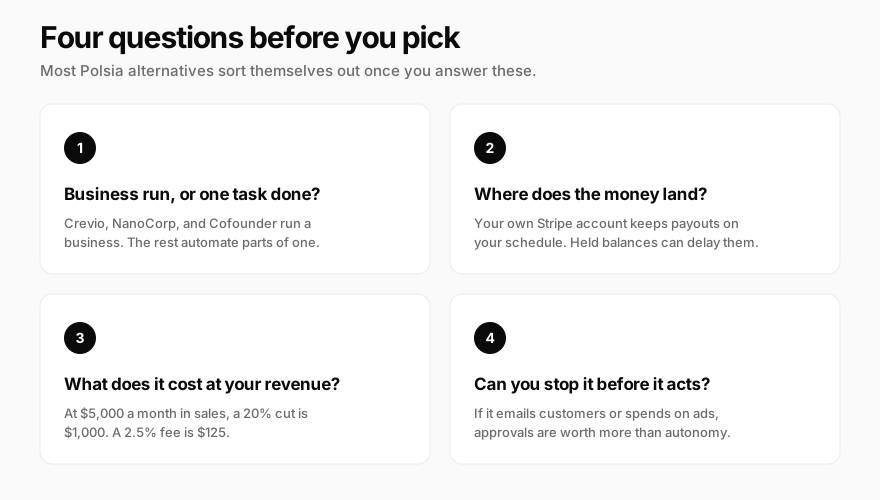
- Check where the money lands. Some platforms hold customer payments in their own balance. Others pay into your own Stripe account.
Polsia Alternatives at a Glance
| Platform | Best for | Starting price | Cut of your revenue | Asks before acting? |
|---|---|---|---|---|
| Polsia (for reference) | Hands-off startup experiments | ~$20/mo per company (reported) | 3% of payments + 20% of ad spend | Mostly autonomous |
| Crevio | Running a business you sell through | Free; Pro $20/mo | 5% to 1% of sales, paid into your own Stripe | Yes, per action you choose; card payments always ask |
| NanoCorp | Testing small software ideas fast | $30/mo after a 3-day trial | 20% of every withdrawal | Budget cap, no per-action approval |
| Cofounder | Department-by-department agents | $120/mo after a 7-day trial | None listed | Yes, nothing ships without approval |
| Twin | Agents for specific jobs across your apps | $29/mo | None | You define each job |
| Lindy | A personal inbox and calendar assistant | $29.99/user/mo | None | Acts within your accounts |
| Lovable | Building the software itself | Free; paid from about $25/mo | None | You drive each change |
| Zapier Agents, n8n, Make | Automating workflows you already run | Free tiers | None | You build the workflow |
Prices were checked on each vendor's site in late September 2026 unless marked as reported.
What Is Polsia?

Polsia is an autonomous AI platform that builds and runs startup-style companies. Founder Ben Cera launched it in late 2025. It raised a $30 million Series A at a $250 million valuation in May 2026, led by Sound Ventures and True Ventures.
Each company gets a team of agents (CEO, engineer, growth) that works in nightly cycles Polsia calls Nightshifts. The agents write code, deploy a site, send email, post to social, and run Meta ads. Each account comes with a web server, database, GitHub repository, inbox, and Stripe checkout.
How much does Polsia cost in 2026?
Polsia's pricing only shows after you sign up, so these figures come from its terms and from reviewers:
- Plans: reported to start around $20/month for one company and scale up to $1,000/month for 50 companies (Preuve AI review).
- Platform fee: 3% of every customer payment, set in mid-September 2026. It replaced the 20% revenue share many older articles still quote.
- Ad spend fee: 20% on top of ads Polsia runs for you.
- Payouts: customer payments collect in a Polsia-held balance with a 31-day settlement period before you can withdraw.
- Task credits: new accounts get about two free credits. Paid plans include one Nightshift task per day plus a monthly credit allowance.
Why people look for a Polsia alternative
Polsia is a real, well-funded product, but results are rare. Founder Ben Cera said in a May 2026 interview that about 10% of companies on Polsia had made at least a dollar, and that around half of customers leave in their first month.
Reviews are split too. As of October 2026 it holds a 3.3 out of 5 rating from 347 reviews on Trustpilot. The most common complaints:
- Tasks marked done that never shipped, with credits spent on failed runs.
- Little say before it acts. The agents are built to work without check-ins, so outreach and changes can go out before you see them.
- Lock-in. Code, hosting, and payments sit on Polsia-managed accounts unless you connect your own.
- Slow payouts. The 31-day settlement hold matters once real customers are paying.
- Slow support, and cancellations that take more than one step.
For the founder's full numbers and the current fees, see Is Polsia legit?
1. Crevio: Best for Running a Real Business With You in Control

Crevio is AI that runs your business. You describe what you want to sell. Crevio builds the site, lists the products, takes the payments, answers the email, posts to social, runs the ads, calls customers back, and reports on what worked. More than 3,000 businesses run on it.
The difference from Polsia is control. Crevio works on its own, including overnight, and you choose which actions wait for your approval. Out of the box, its own actions (refunds, customer emails, ad changes) run automatically, so on day one switch the ones you care about to "Ask for confirmation," or run tasks supervised so every change arrives as a draft. Payments with a saved card always ask, and you can roll your site back to any earlier published version. Polsia's agents are built to act first; Crevio gives you a veto wherever you want one.
What Crevio runs:
- Starting the business. Brand, domain, and even forming an LLC.
- Building it. Real websites and web apps with their own database, custom domain, and deploy history, not page templates.
- Taking the money. Checkout, subscriptions, payment plans, invoices, and refunds, settling into your own Stripe account. Crevio is not the merchant of record, so there's no settlement hold.
- Operating it. A real mailbox on your domain, AI phone calls, a CRM, and support replies.
- Growing it. Social posting, ads on Meta, Google, LinkedIn, TikTok, and Microsoft, and 3,000+ integrations with the apps you already use.
- Working without you. The agent has its own computer, and scheduled tasks keep running when your laptop is closed.
What switching looks like: Andrew, a sous chef building a site of cooking and conversion calculators, ran the same project on Polsia and Crevio. On Polsia's free credits, "I got one calculator that half works." On Crevio: "Yours gave me a fully functioning site that I could test, I could check, I could see how everything worked."
Crevio pricing:
| Plan | Price | Fee on sales | Highlights |
|---|---|---|---|
| Starter | Free | 5% | 20 AI credits/mo, website, up to 2 products |
| Pro | $20/mo | 2.5% | 1,000+ credits, unlimited products, scheduled tasks, custom domain, integrations |
| Business | $50/mo | 1% | 2,500+ credits, custom features, ad accounts, API access, unlimited team |
Yearly billing saves 20%. See full pricing.
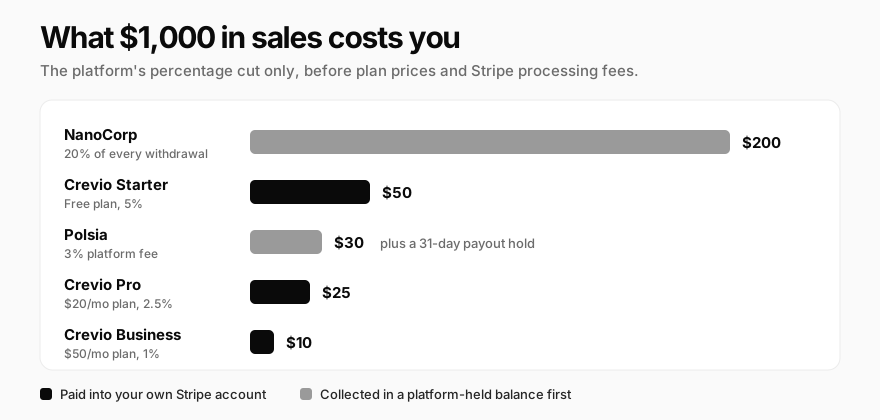
How it compares to Polsia: on $1,000 in sales, Crevio Pro costs $25 in fees plus the $20 plan, paid out on Stripe's normal schedule. Polsia takes $30 in platform fees and holds the payout for 31 days. For the full breakdown, see Crevio vs Polsia.
Best for: founders, creators, and small businesses selling real products, courses, memberships, or services who want AI doing the work without handing over the keys.
Trade-offs: Crevio is built around selling and operating, not autonomous software experiments. Ad accounts and custom features need the Business plan.
2. NanoCorp: Best for Testing Software Ideas Quickly
NanoCorp turns a one-sentence idea into a small software business and runs it with agents. They build a site or app with a database and payments, then prospect, send cold email, and run a Meta ad within a budget cap. NanoCorp also publishes a live feed of the businesses on its platform, which is useful for judging real output.
Pricing: a 3-day free trial with 15 credits, then the Founder plan at $30/month for 30 rollover credits. NanoCorp keeps 20% of every withdrawal, and payments flow through a NanoCorp-managed Stripe account (pricing). Its own live dashboard shows how those businesses are doing; we break it down in Is NanoCorp legit?
How it compares to Polsia: it's the closest match in spirit, since both are built for hands-off experiments. NanoCorp is more transparent about results, but its 20% cut on withdrawals costs more than Polsia's 3% once revenue is real.
Best for: founders who want to test many small software ideas cheaply. See our NanoCorp alternatives or Crevio vs NanoCorp.
3. Cofounder: Best for Agents by Department, With Approval
Cofounder, from The General Intelligence Company of New York, pitches running "an entire company with AI". It sets up agents per department, such as engineering, sales, and marketing. Its core rule is the opposite of Polsia's: nothing ships without your approval.
Pricing: a 7-day free trial, then Pro at $120/month (pricing).
How it compares to Polsia: more oversight and a department-style structure, at about six times Polsia's reported entry price. It suits founders who want to review every output.
Best for: founders who think in departments and want to approve each deliverable.
4. Twin: Best for Custom Agents Across Your Tools

Twin builds agents from a plain-language description of a job, then runs them across your apps and websites, including through browser automation. You don't hand over a business. You hand over specific jobs, such as lead research, reporting, or data entry.
Pricing: Plus $29/month, Pro $149/month, and Store from $399/month, with custom Enterprise pricing (pricing).
How it compares to Polsia: more modular and more predictable, but you decide what each agent does. Nothing picks your next priority for you.
Best for: operators who already run a business and want to automate named, repeatable jobs.
5. Lindy: Best for a Personal AI Assistant
Lindy is an AI teammate for your own work. It triages email, drafts replies, schedules meetings, takes notes, and updates your CRM. It makes the founder faster rather than replacing the founder.
Pricing: Plus $29.99, Pro $99.99, and Max $199.99 per user per month, after a 7-day free trial (pricing).
How it compares to Polsia: Lindy won't build a product, run ads, or take payments. It's the right pick if your bottleneck is your inbox and calendar, not the business itself. See Crevio vs Lindy.
Best for: busy founders and professionals who want admin work off their plate.
6. Lovable: Best for Building the App Itself

Lovable builds full-stack web apps from a conversation, with a live preview, GitHub sync, and one-click deploys. If what drew you to Polsia was its engineering agent, Lovable does that one part in more depth and leaves you in the driver's seat.
Pricing: a free plan with 5 build credits a day (up to 30 a month). Paid plans start around $25/month (pricing).
How it compares to Polsia: Lovable builds the software, but it won't market it, sell it, or run it. You'll need other tools for everything after launch. See our Lovable alternatives.
Best for: non-technical founders whose first job is shipping an app.
7. Zapier Agents, n8n, or Make: Best for Automating Workflows You Already Have

Workflow tools automate the processes you already run. They won't invent or operate a business for you. Pick by how technical you are:
- Zapier Agents adds AI agents to the largest integration catalog. Agents are free for 400 activities a month, and Zapier Professional starts at $29.99/month billed monthly (pricing).
- n8n is open source. It's free to self-host, and cloud plans start at €24/month (pricing).
- Make is a visual, drag-and-drop builder with a free plan. Core starts at $9/month billed annually (pricing).
How they compare to Polsia: full transparency and control, since you see every step, but you design every step too. There's no agent deciding what the business needs next.
Best for: teams with established processes who want reliable automation around them.
How to Choose the Right Polsia Alternative
| If you want… | Choose | Why |
|---|---|---|
| AI that runs your business, with approvals | Crevio | Runs sales, marketing, and operations, with approvals you set per action |
| Cheap, hands-off software experiments | NanoCorp | Idea-to-business in one sentence, with a public results feed |
| Every output reviewed by department | Cofounder | Nothing ships without approval |
| Specific jobs automated across your apps | Twin | Custom agents per task |
| Your inbox and calendar handled | Lindy | A personal AI assistant |
| An app built from a prompt | Lovable | A full-stack AI app builder |
| Existing workflows automated | Zapier, n8n, or Make | Integrations and full control |
FAQ
For running a real business, Crevio is the strongest Polsia alternative. It covers the same ground (site, payments, email, social, ads, and phone), lets you require approval before it spends money or contacts customers, and pays out to your own Stripe account. For quick, hands-off software experiments, NanoCorp is the closest match.
Polsia reportedly starts at about $20 a month for one company and scales to $1,000 a month for 50 companies. On top of the plan, it takes a 3% platform fee on customer payments and 20% of any ad spend it manages. Payouts are held for 31 days.
No. There's no free plan. New accounts get about two free task credits to try it, then need a paid plan. Crevio and n8n (self-hosted) are the Polsia alternatives with genuinely free tiers.
Yes. Polsia is a real, venture-funded company with a working product, and it raised a $30 million Series A in 2026. Reviews are mixed, averaging 3.3 out of 5 on Trustpilot, mostly over unfinished tasks, lock-in, and payouts. We cover this in detail in Is Polsia legit?
Both run businesses autonomously. Polsia takes a smaller cut (3% of payments versus NanoCorp's 20% of withdrawals). NanoCorp is more transparent, with a public feed of its businesses' results. If you're selling to real customers, compare both with Crevio, which charges 1% to 5% and pays into your own Stripe account.
Yes, for most day-to-day work: building the site, listing products, taking payments, answering email, and running marketing. It still works best with a human setting direction and approving anything that spends money or speaks for the brand. We break this down in what AI can and can't run today.
Related Blog Posts
What will you sell today?
Describe what you want to sell — Crevio builds, launches, and grows it. Products, payments, and marketing, all on autopilot.
Start for free