Your business,
on autopilot.
One platform for creating, running and growing your business, powered by AI.
AI Agents for SEO: What to Automate, What They Fake, and 6 Tools Compared





Last updated: September 2026
In 2023, a startup used AI to publish 1,800 articles in a few hours, copying the topics of a competitor's sitemap, and the traffic came fast. Then Google caught up: according to The Decoder, the site fell from about 610,000 monthly visits in October to 190,000 by mid-December, below where it had started. That story is still the best short answer to "should I let an AI agent do my SEO?" Yes for the research, the audits and the reporting. Not for publishing at volume.
AI agents for SEO are software that does search work on its own: it crawls your site, pulls your search data, researches what ranks, drafts and updates pages, and reports back on a schedule, instead of waiting for you to type a prompt. This guide is for small business owners and founders who want organic traffic without hiring an agency. It covers which SEO jobs to hand over, where these agents quietly invent numbers, and which AI SEO agents are worth paying for. (Email, ads and social are in our separate post on AI agents for marketing.)
- Hand over first: technical audits, weekly search reporting, and finding pages that are losing clicks. The output is private, so a bad run costs you ten minutes
- Draft, then approve: content briefs, page refreshes, new posts and internal links
- Never automate: publishing pages at scale. Google calls it scaled content abuse, whatever tool wrote them
- Check the data source: an SEO agent with no connection to Search Console or an SEO database will still give you search volumes and rankings. It makes them up
What AI Agents for SEO Actually Do
An AI SEO tool waits for you. You paste a keyword, it returns a content score or an outline, and the loop ends. An AI SEO agent chains the steps together: it reads your Search Console data, notices a page slipped from position 4 to 9, checks what now outranks it, drafts the update, and sends you the draft with its reasoning. Then it does the same thing next Monday without being asked.
SEO suits agents well because the work is sequential and repetitive. Keyword research feeds the brief, the brief feeds the draft, the audit decides what to fix first, and the whole thing needs redoing every month. It is also why mistakes compound: each step inherits the errors of the one before it.
Industry writers now call this "agentic SEO." The label matters less than the three things that make an agent useful: a trigger (a schedule or an event), access to real data (your analytics, Search Console, an SEO database), and a place to report (email, Slack, a draft in your CMS). If a product has only the middle one, it is a tool with a chat window.
The Data-Source Test: Where AI SEO Agents Make Things Up
Before comparing any tools, learn this one test, because it decides whether an SEO agent is useful or dangerous.
A language model has no idea how many people search for "gluten-free bakery Denver" this month. It has no idea where your page ranks today. Ask anyway, and a capable agent without a data connection will still answer, confidently and in a nice table. Ahrefs' own guide to SEO agents warns about exactly this: agents without authoritative sources produce "fabricated backlink counts, rankings that don't exist."
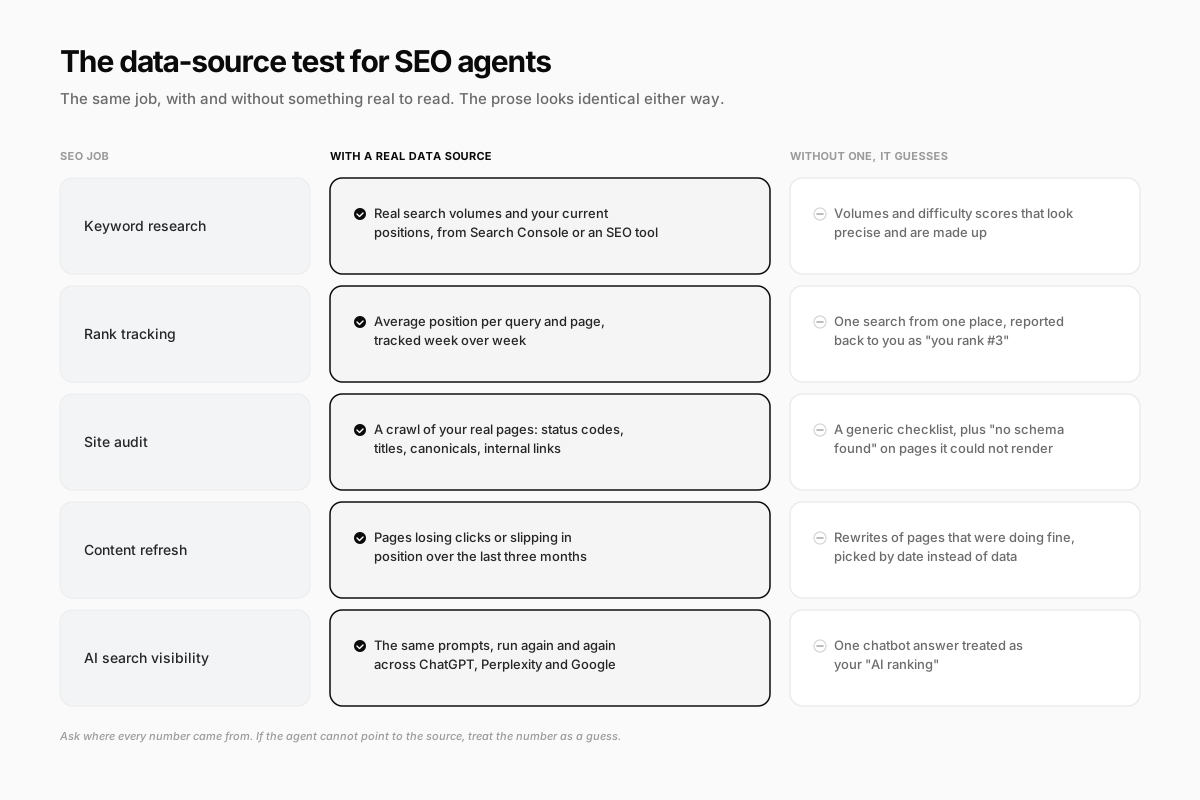
The fix is not a better prompt. It is a connection:
- Google Search Console (free) gives real queries, clicks, impressions and average positions for your own site, for the last 16 months
- An SEO database such as Ahrefs or Semrush gives search volumes, keyword difficulty, competitors' rankings and backlinks
- Your own analytics gives what actually converts, which neither of the above knows
Give the agent one standing instruction: every number in a report must say where it came from. If it cannot point to a source, the number is a guess, and it should say so.
Seven SEO Jobs to Hand an AI Agent, Ranked by Risk
The useful question is not "can the agent do this?" It usually can. It is "what does a mistake cost, and does anyone outside my team see it?"
1. Technical site audits
Hand over fully. Crawling your site for broken links, missing titles, duplicate pages, redirect chains, slow pages and noindex tags left on by accident is tedious for you and easy for an agent. The report is private, and you can verify every finding by clicking the URL.
Watch for one known failure: many sites add structured data with JavaScript, and a simple page fetch cannot see it. An agent that reads raw HTML will report "no schema found" on pages that have it. Ask it to check with a real browser or Google's Rich Results Test before flagging schema.
2. Keyword research
Hand over, with data connected. With Search Console and an SEO database, an agent is good at the grind: pulling the queries you already get impressions for, grouping them by intent, and finding the ones where you sit on page two. Without data, it produces a plausible list with invented volumes. That list is worse than none, because it looks finished.
For a small site, the most valuable keyword research is not new keywords. It is the queries where you already rank 8 to 20, because moving those is far cheaper than starting from zero.
3. Content briefs
Hand over fully. A brief is private and cheap to fix. A good agent opens the top results, notes what they cover and miss, and gives you an outline, the questions to answer, and the sources to cite. This is where agents save the most hours per week for the least risk.
4. Content refreshes
Agent finds and drafts, you publish. Updating a page that is losing clicks is often the highest-return SEO work a small business can do, and agents are good at spotting candidates in Search Console. The draft still needs you: refreshes are where agents quietly change a price, a guarantee, or a date that was correct.
A task that works: "Every Monday, compare the last 28 days of Search Console clicks against the previous 28 for every page. List the five pages that lost the most clicks, what now outranks them, and a suggested update for each. Don't edit anything."
5. Internal linking
Agent suggests, you approve in batches. Finding pages that mention a topic you have a better page for, and suggesting the link, is a classic agent job. Letting it rewrite anchor text across fifty pages on its own is not. Review suggestions in a batch once a week.
6. Rank and traffic monitoring
Hand over fully, with Search Console. A weekly summary of clicks, impressions, average position and the biggest movers is the single best first task, because you already know roughly what the numbers should say, so you can tell quickly whether the agent understands your site.
Keep the agent honest on one point. Search Console reports average position across every searcher and location. An agent that "checks your ranking" by running one search from one server is reporting one sample, not your rank.
7. AI search (GEO) visibility
Hand over the checking, and read the results as a trend. Generative engine optimization, or GEO, means getting your business mentioned in ChatGPT, Perplexity, Gemini and Google's AI Overviews. An agent can run the same set of questions every week ("best bookkeeping service for Etsy sellers") and record whether you are named and which sources are cited.
Treat single answers as noise. When SparkToro and Gumshoe had 600 volunteers run identical prompts nearly 3,000 times, they found less than a 1 in 100 chance that ChatGPT or Google's AI would return the same list of brands twice. An "AI ranking" from one run means nothing. How often you appear across many runs does.
Where AI Agents for SEO Fail
Thin content at scale, and Google's spam policy
Since March 2024, Google's spam policies have a section called scaled content abuse: "when many pages are generated for the primary purpose of manipulating search rankings and not helping users." The first example Google lists is "using generative AI tools or other similar tools to generate many pages without adding value for users."
Two things are true at once. Google's guidance on AI-generated content says appropriate use of AI or automation is not against its guidelines. And the policy is written about purpose and value, not the tool, so an agent that publishes 300 near-identical city pages or "best X for Y" posts with nothing original in them fits the definition exactly, however good the grammar is.
The practical rule: an agent can write every draft, but a person decides what gets published, and nothing ships in bulk. If you would be embarrassed for a customer to read page 47 of the batch, it should not exist.
Changing your live site on autopilot
Some SEO agents edit your site directly. Search Atlas says its OTTO agent "runs on autopilot and deploys optimizations on its own" through a script in your site's header, with an approval mode you can switch on. That is powerful for an agency managing forty sites, and risky for a business whose homepage title is also its brand promise. Start any agent that can change your site in its approval mode, and read a month of its changes before loosening it.
Optimizing for clicks that are disappearing
Ranking is no longer the same as traffic. Pew Research found that Google users clicked a regular result on 8% of visits when an AI summary appeared, against 15% when none did. An agent that celebrates a move from position 3 to 2 on a query now answered by an AI Overview may be celebrating nothing. Ask your agent to report clicks next to positions, never positions alone.
The Best AI SEO Agents in 2026
Most "best AI SEO agents" lists rank a dozen enterprise platforms. These six are the ones a small business can realistically start with, sorted by what they are allowed to touch.
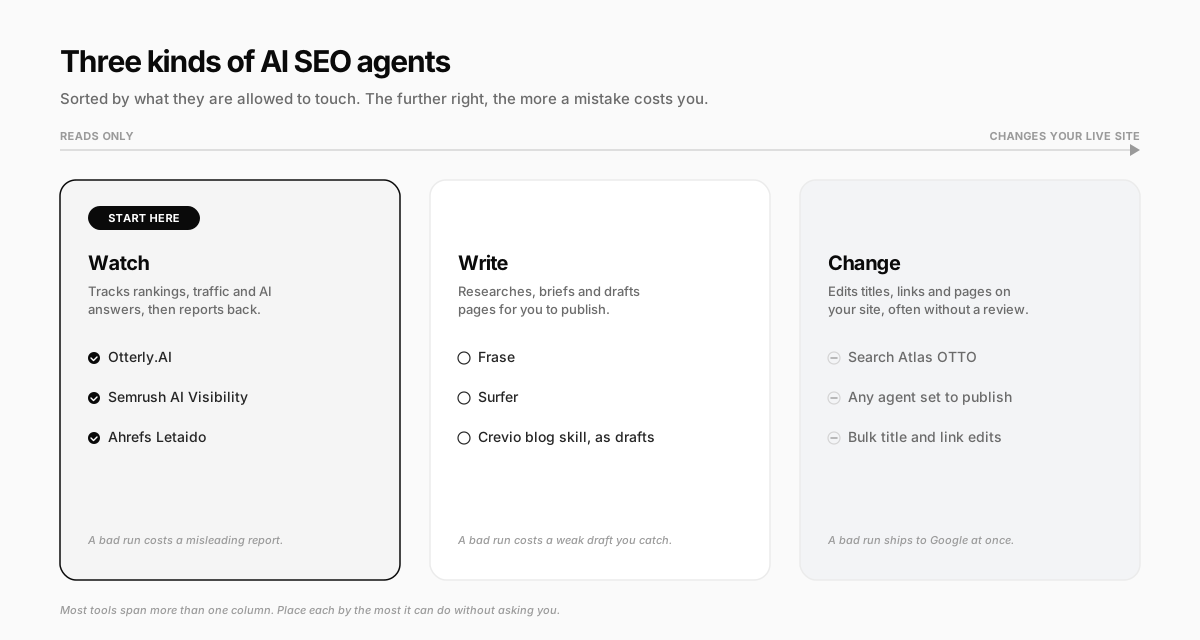
| Tool | Best for | Starting price (Sept 2026) | Where it sits |
|---|---|---|---|
| Ahrefs Letaido | Recurring SEO reports and research on Ahrefs data | $99/mo, plus an Ahrefs plan (from $29/mo) | Watch |
| Semrush + Semrush MCP | Plugging SEO data into an AI assistant you already use | Free plan; SEO plan $139/mo | Watch |
| Frase | Research-to-publish content with SEO and AI search scoring | $39/mo billed yearly, 7-day free trial | Write |
| Surfer | Content optimization plus AI search tracking | From $49/mo billed yearly, free trial | Write |
| Search Atlas OTTO | Fixes deployed straight onto your site | $79/mo, 7-day trial | Change |
| Otterly.AI | Budget AI search visibility tracking | $29/mo for 15 prompts | Watch |
1. Ahrefs Letaido: an agent on top of Ahrefs data
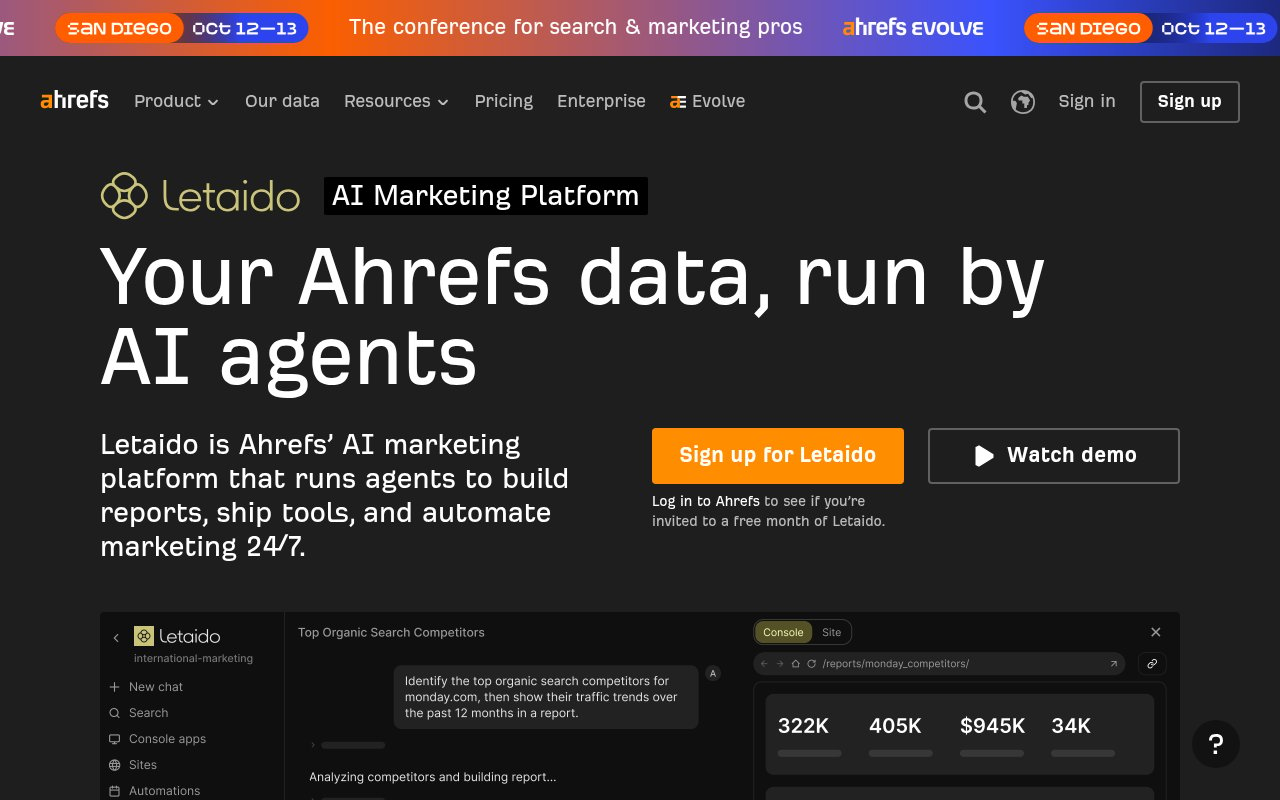
Letaido is Ahrefs' agent workspace. It reads straight from Site Explorer, Keywords Explorer, Site Audit, Rank Tracker and Brand Radar, so the numbers it reports are Ahrefs numbers, not guesses. It runs recurring jobs like monthly reports, content gap checks and competitor monitoring, and connects to tools like Slack, HubSpot and WordPress. It starts at $99 a month with $50 of AI credits included.
Watch out for: you need a separate, active Ahrefs subscription for the data, per Ahrefs' help center. Budget for both.
2. Semrush and Semrush MCP: the data layer for your own agent
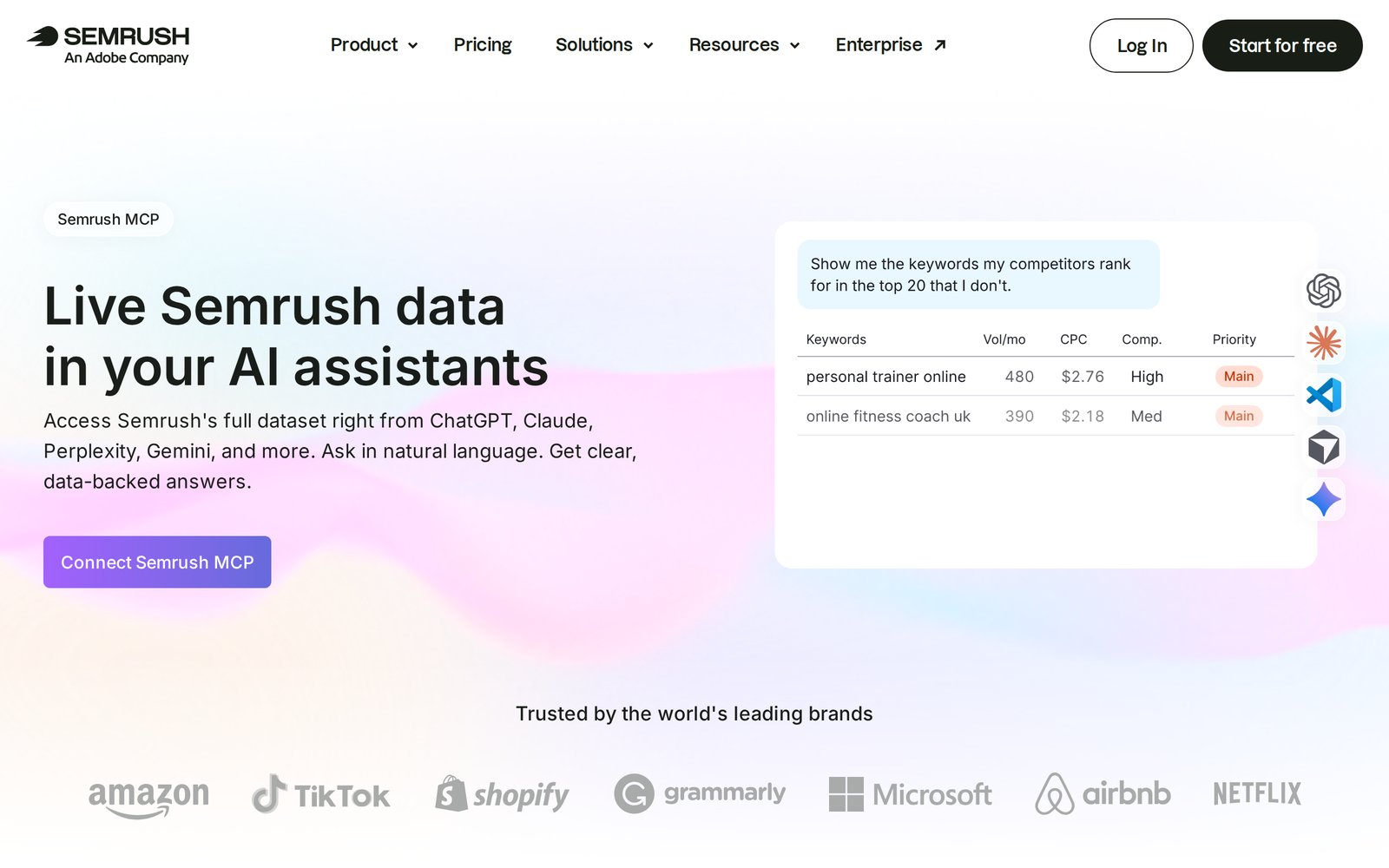
Semrush takes a different route: rather than one branded agent, it offers Semrush MCP, which plugs its keyword, ranking and competitor data into ChatGPT, Claude, Gemini and other AI assistants. That turns a general assistant into an SEO agent with real numbers. The SEO plan is $139 a month, AI visibility tracking starts on the $199 Starter plan with 50 prompts, and there is a limited free plan and a 7-day trial.
Watch out for: MCP requests use the same API units as the regular Semrush API. A chatty agent can spend them faster than you expect.
3. Frase: the content pipeline, end to end
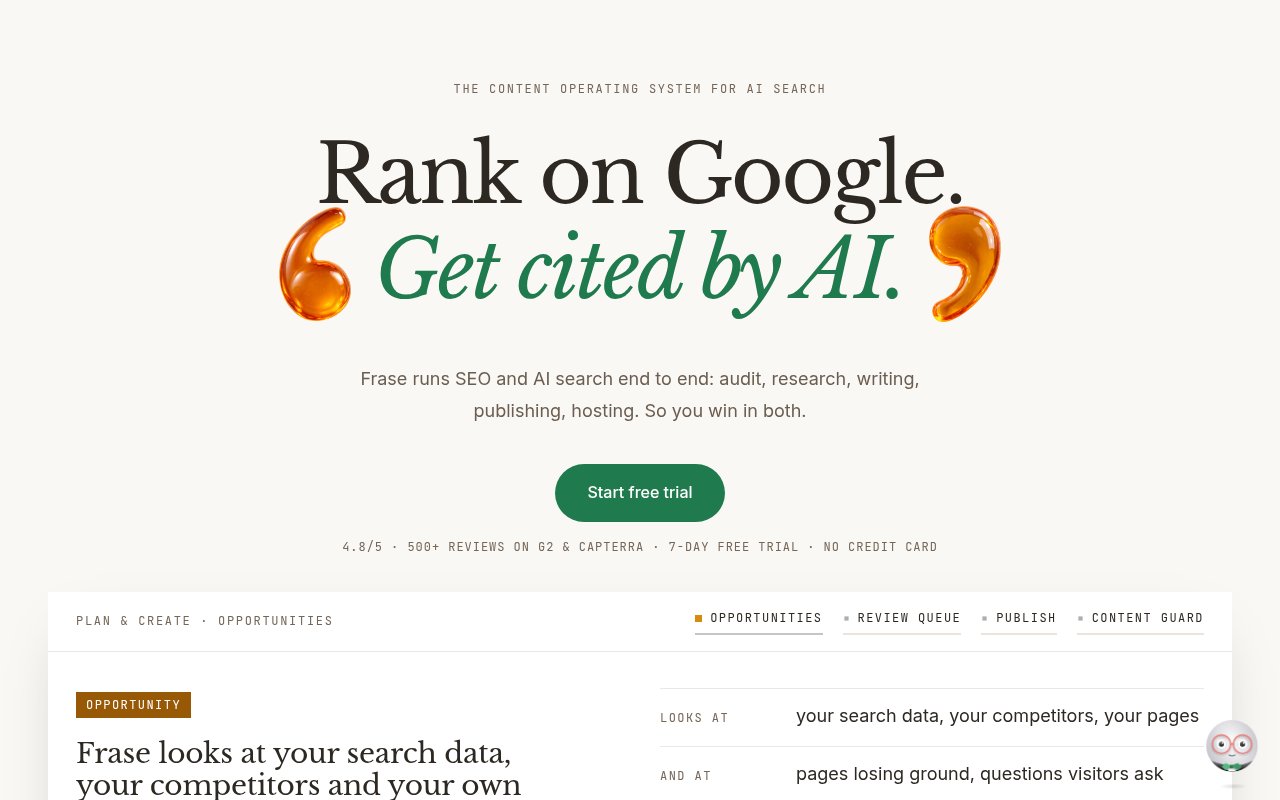
Frase covers audit, research, briefs, writing and publishing to WordPress or Webflow, with scoring for both Google and AI search. The Starter plan is $39 a month billed yearly for one site, 10 articles and 50 audit pages a month. Internal linking suggestions and AI visibility monitoring start on the $103 Professional plan. There is a 7-day free trial with no card.
Watch out for: the article allowance makes it easy to publish on a quota. Ten good pages a month beat ten pages because the plan included them.
4. Surfer: content scoring plus AI search tracking
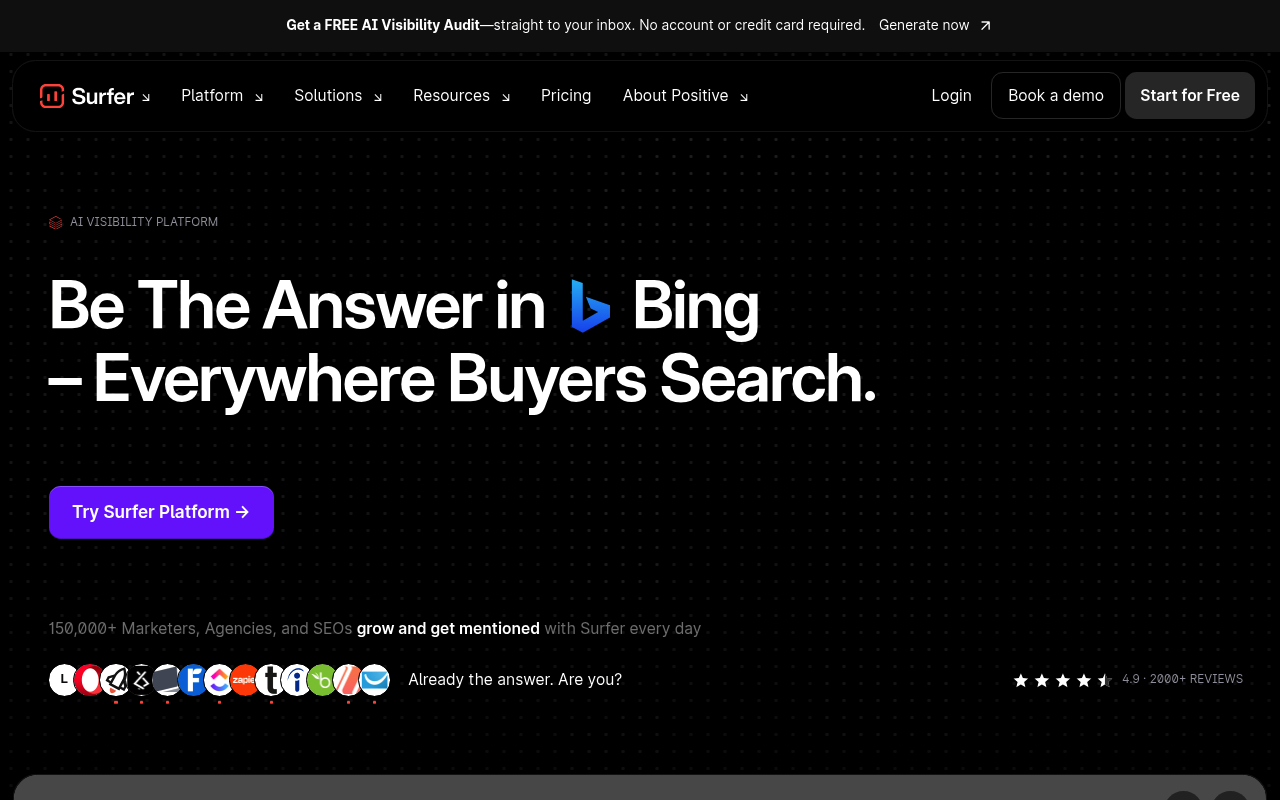
Surfer built its name on content scores against top-ranking pages, and now pitches itself as an AI visibility platform, tracking how brands appear in ChatGPT, Gemini and AI Overviews. Plans start around $49 a month billed yearly for 120 documents; one-click internal linking and daily AI prompt tracking sit on the Pro plan, at about $182 a month billed yearly.
Watch out for: a content score measures resemblance to what already ranks. Chasing a perfect score produces the same article as everyone else, which is the opposite of what a small site needs to stand out.
5. Search Atlas OTTO: the agent that changes your site
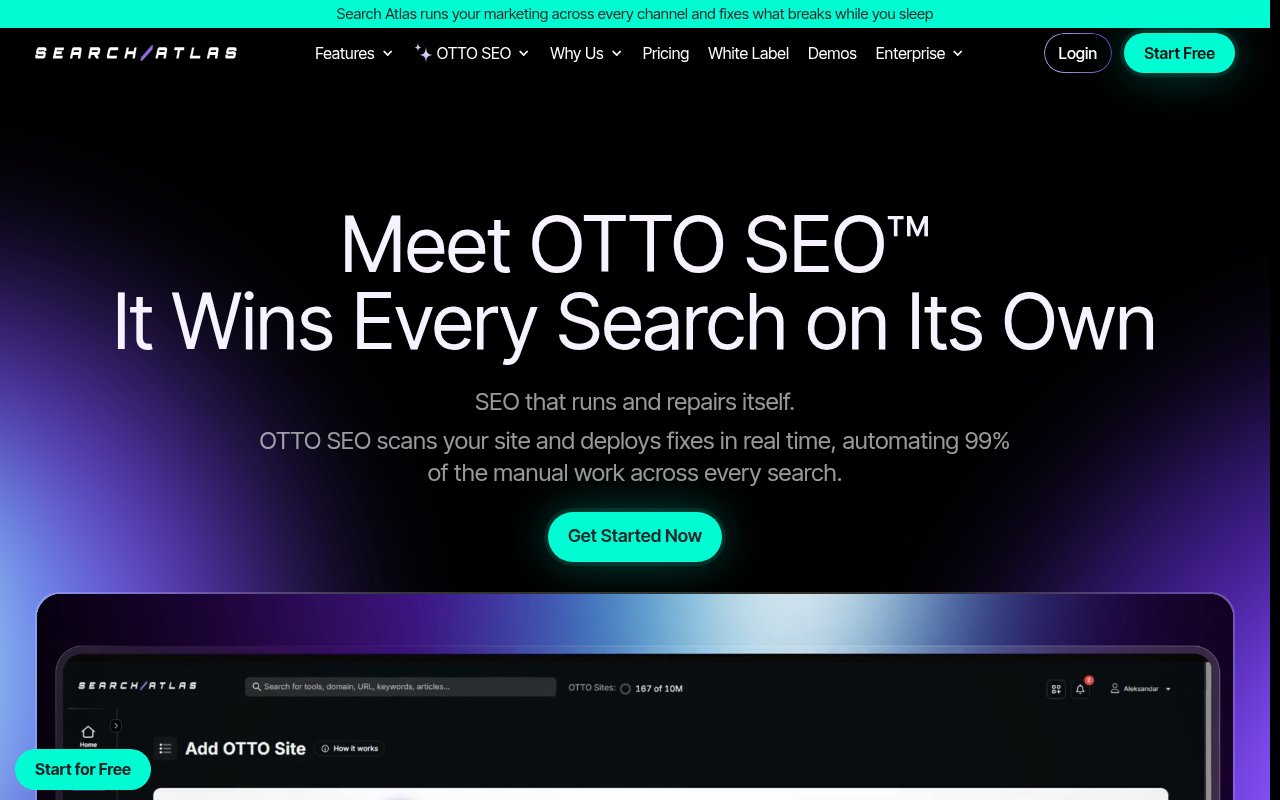
Search Atlas OTTO installs with a script in your site's header and deploys fixes itself: meta tags, schema, canonical tags, broken links, headings, alt text and internal links. Plans start at $79 a month for one project, with a 7-day trial and free onboarding. For a site with hundreds of neglected pages, it clears a backlog nothing else will.
Watch out for: it runs on autopilot by default. Switch on approval mode first, and know that changes applied by a script can be harder to see in your own CMS than edits made there directly.
6. Otterly.AI: cheap AI search monitoring
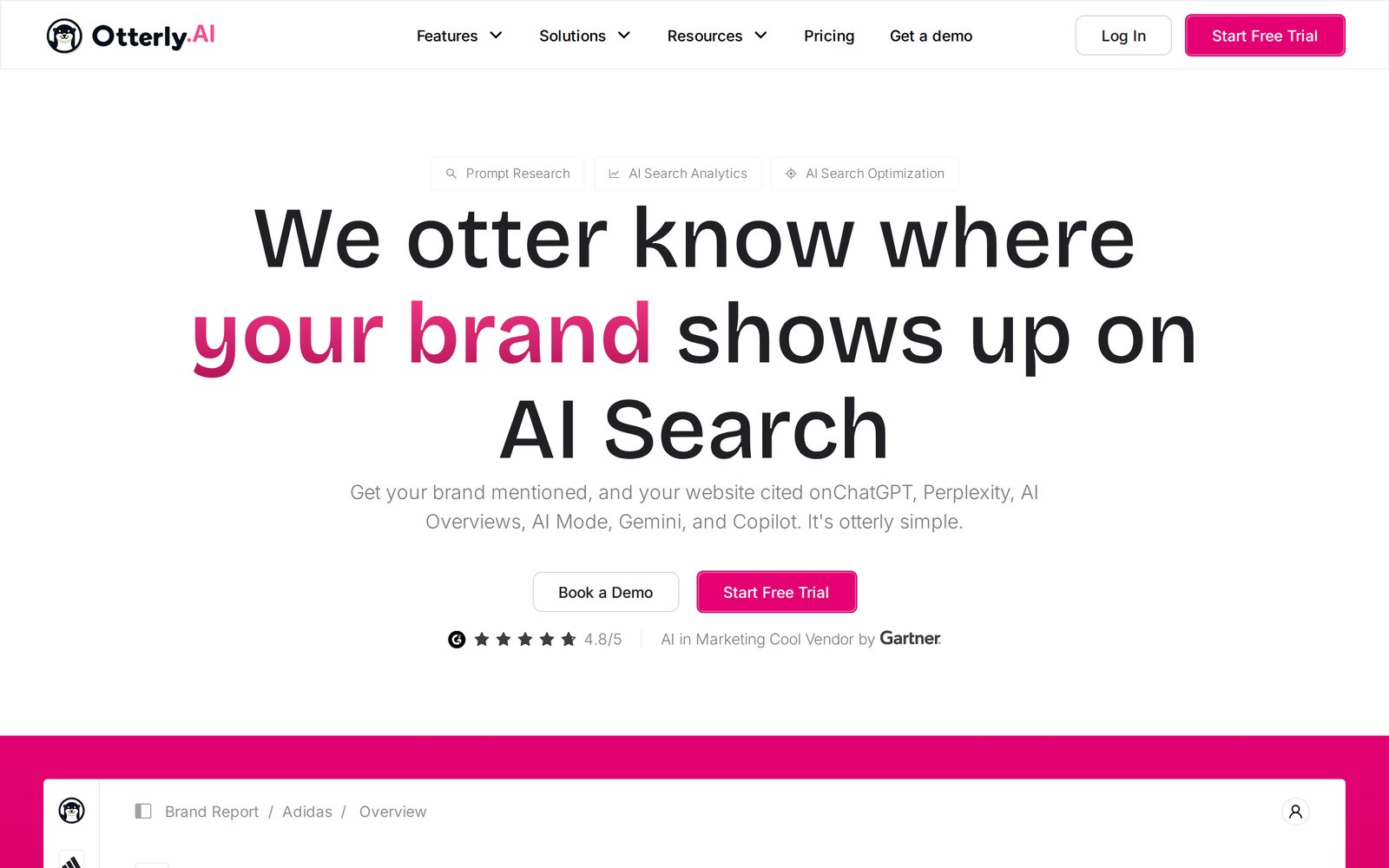
Otterly.AI does one job: it runs your chosen prompts daily across ChatGPT, Google AI Overviews, Perplexity and Microsoft Copilot and tracks whether your brand and site are mentioned or cited. The Lite plan is $29 a month for 15 prompts; Standard is $189 for 100.
Watch out for: 15 prompts is a small sample. Pick them from real customer questions, not the ones you hope to win.
How to Set Up an AI Agent for SEO in One Afternoon
The order matters more than the tool: data first, drafts second, publishing last.
- Connect Search Console. Verify your site in Google Search Console if you have not, and give the agent read access. This one step removes most invented numbers
- Write five rules. Who your customer is, what you sell, three claims the agent must never make (prices, guarantees, results), and "every number cites its source"
- Schedule a Monday report. Clicks, impressions and average position for the week, the five biggest gainers and losers, and pages losing clicks for three weeks running
- Run one audit. Ask for the top ten technical issues ranked by how many important pages they affect, with the URL for each. Fix them yourself or approve the fixes
- Let it draft one refresh a week. Start with the page that lost the most clicks. Edit the draft, and tell the agent what you changed and why
- Add AI search checks last. Ten real customer questions, run weekly, reported as "how often we were mentioned," never as a rank
After a month, move one job from "draft" to "run," starting with whatever you approved without edits three weeks in a row. Keep publishing new pages behind your approval for good. Our guide to scheduling recurring AI agent tasks covers the Monday-report setup in more detail.
Where Crevio Fits
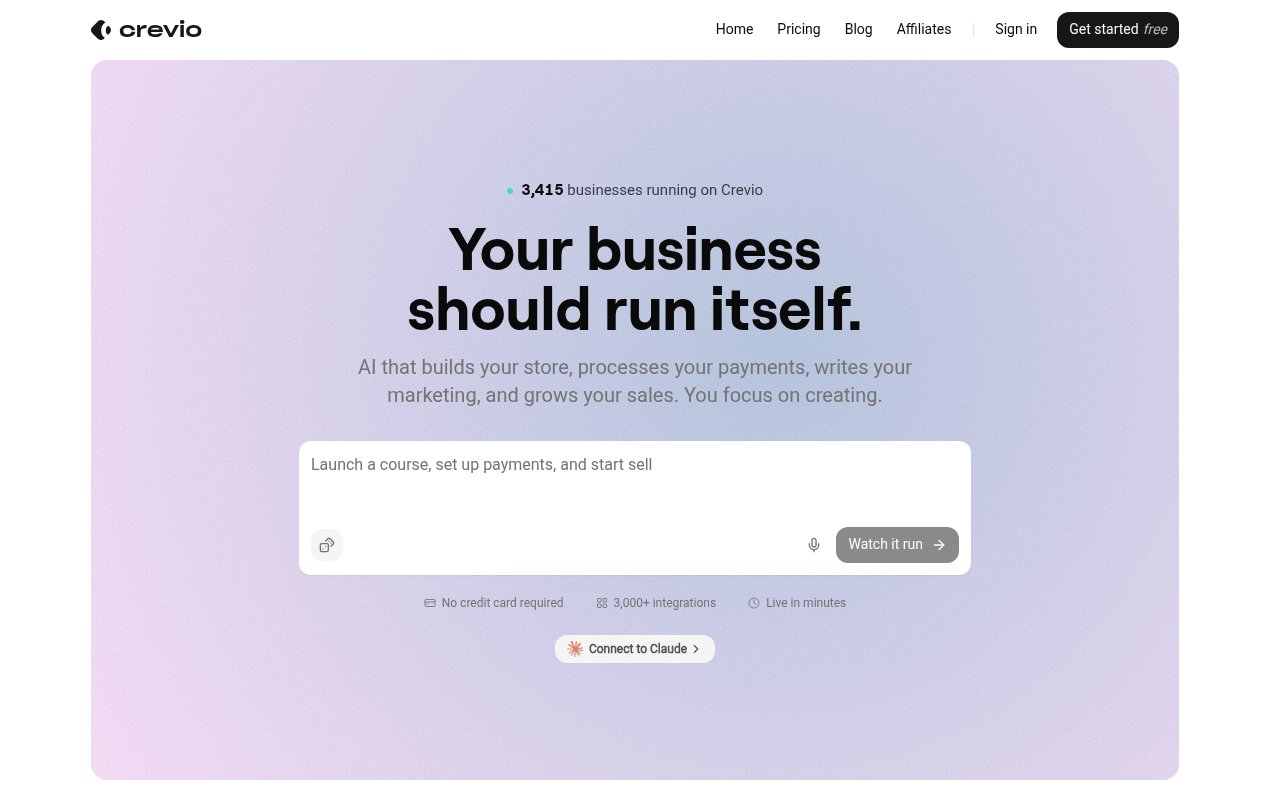
Crevio is an AI business builder: you describe what you want to sell, and its AI builds the site, launches it and works on growing it. For SEO, that means the agent works on the same site it built, with your products, prices and customers in view, which is what keeps a blog post from inventing a price.
What its agent does for SEO today:
- SEO skills built in. The agent ships with an SEO audit skill (crawlability, indexing, speed, on-page, content quality and multilingual sites) and a blog-writing skill that researches keywords and what ranks, checks every claim against what you actually sell, adds internal links, sets the SEO title and description, and links new posts from older ones. It also has a general marketing skill covering schema markup and comparison pages. You can install more skills from the Skills library, which has an SEO category
- Publishing on your own site. Posts go to the blog on your Crevio site, and the writing skill saves the first post as a draft for you to review unless you have told it to publish
- Your traffic data. It can read your Crevio site's analytics: visitors, pageviews, top pages, referrers and campaign tags
- Search Console and other tools. Connect Google Search Console or an SEO tool you already pay for through its 3,000+ integrations, and the agent works from real queries and positions
- Schedules and reports. Run an SEO task weekly or daily, with results by email, in the app, or in Slack, Telegram or Discord
- Research. Web search, plus its own browser for pages that need rendering or a login
Where you should be careful, honestly:
- There is no built-in keyword database, rank tracker or AI visibility tracker. Site analytics shows traffic, not rankings. For search volumes and positions, connect Search Console or an SEO tool, or the agent is estimating
- New tasks start in autonomous mode, and Crevio's own actions, like publishing a blog post, run without asking by default. For a recurring content task, set it to supervised so every post arrives as a draft. Actions in connected apps ask before making changes by default
- The blog skill's grounding is instructions, not a lock. It is told never to invent a fact about your business. Read the first few posts anyway
Starter is free with 20 AI credits a month and a 5% transaction fee. Pro is $20 a month with 1,000 credits and a 2.5% fee, and Business is $50 a month with 2,500 credits and a 1% fee. It will not replace an Ahrefs subscription for competitive research. It will write, publish and report on the site you sell from, with the approvals set as tight as you like.
What Nobody Tells You About AI SEO Agents
- Your best SEO data is free. Paid tools estimate your traffic from the outside. Search Console shows your real clicks and queries. Connect it before you pay for anything
- Refreshes beat new posts. An agent that updates your ten best pages every quarter usually does more than one that adds a post a day
- Agents copy the top ten. Research based on what already ranks produces an average of what already ranks. Your own experience, photos, numbers and customer questions are what the agent cannot make up, so feed them in
- Search Console data lags. Figures usually arrive a day or two late. An agent reporting "yesterday's rankings" is working from partial data
- Twenty approvals a day become zero reviews. Nobody reads the fifteenth link suggestion of the day. Batch them weekly. We cover how to set this up in human in the loop AI agents
AI Agents for SEO FAQ
What is an AI SEO agent?
An AI SEO agent is software that carries out search optimization work on its own once started by a schedule or an event. It reads your site and search data, researches what ranks, drafts or applies changes, and reports back for review. An AI SEO tool, by contrast, waits for a prompt and returns a single output.
Can AI agents do SEO without me?
They can run audits, reporting, keyword research and AI search checks on their own if they are connected to real data. Content briefs are safe to automate. Refreshes, new pages and site-wide changes should arrive as drafts you approve, and publishing in bulk should never be automated, because Google treats mass-produced low-value pages as spam.
Will Google penalize content written by an AI agent?
Not for being AI-written. Google's guidance says appropriate use of AI is not against its rules. Its scaled content abuse policy targets many pages made mainly to manipulate rankings without helping readers, however they were made. One useful, fact-checked post a week is fine. Hundreds of templated pages are not.
What is the best AI SEO agent for a small business?
It depends on the job. For content, Frase or Surfer. For research and reporting on real data, Ahrefs Letaido or Semrush's MCP connected to an assistant. For cheap AI search tracking, Otterly.AI. For an agent that writes and publishes on the site you sell from, Crevio, connected to Search Console.
The Bottom Line
AI agents for SEO are worth using now for research, audits, reporting and drafts, as long as they read real data and you decide what gets published. The ones that burn businesses are not the ones that write badly. They are the ones that publish at volume and report numbers nobody can trace.
Related Blog Posts
What will you sell today?
Describe what you want to sell — Crevio builds, launches, and grows it. Products, payments, and marketing, all on autopilot.
Start for free