Your business,
on autopilot.
One platform for creating, running and growing your business, powered by AI.
What Is an NFT Storefront? Definition, Examples, and How to Build One





Estimates for the global NFT market's 2026 size range from roughly $42 billion to $61 billion, depending on which tracker you trust, and that disagreement tells you something on its own: NFTs never disappeared, they just got quieter and more commercial. If you're a brand, artist, or creator deciding whether to list on someone else's marketplace or build your own NFT storefront, that choice, storefront versus marketplace, is the first decision that shapes everything downstream: your fees, your control, and how much of your own traffic you'll need to bring.
- A storefront is single-seller: one brand controls listings, pricing, and design, unlike an open marketplace where thousands of sellers compete for the same buyers
- You trade reach for control: a storefront gives you pricing freedom and a branded experience, but you lose the built-in discovery a marketplace provides
- The technical stack has layers: a storefront UI, wallet connection, an on-chain smart contract, and a backend indexing service all work together behind every sale
- Costs range enormously: a no-code white-label setup can launch in days; a fully custom build can run past $100,000
What Is an NFT Storefront?
An NFT storefront is a website (or app) owned and operated by a single brand or creator, where that brand lists, sells, and manages only its own NFTs. It's the difference between renting a stall in a crowded market and opening your own shop: the storefront carries your name, your prices, and your rules, and nobody else's listings show up next to yours.
This distinguishes a storefront from an NFT marketplace, which is a shared platform (think OpenSea or Magic Eden) where many independent sellers list assets side by side and the platform takes a cut of every trade. A storefront is the retail-website model applied to NFTs; a marketplace is the shopping-mall model.
The term shows up in two related but distinct contexts:
- Product sense: the branded website where a company sells its own NFT drops directly to fans or customers
- Technical sense: in blockchain development, a "storefront" is often a specific smart contract pattern, like Flow's open-source
NFTStorefrontcontract, that lets an account list its own NFTs for sale without routing through a shared marketplace contract
Both senses point at the same underlying idea: control over your own listings, instead of sharing shelf space.
NFT Storefront vs. NFT Marketplace: What's the Difference?
| Factor | NFT Storefront | NFT Marketplace |
|---|---|---|
| Ownership | Single brand or creator | Shared platform, many sellers |
| Branding | Fully custom, your identity | Platform's identity, your listing is one of many |
| Pricing control | You set every price | You often compete on price with similar listings |
| Discovery | You drive 100% of your own traffic | Platform brings built-in buyer traffic |
| Fees | Payment processing + hosting, no marketplace cut | Marketplace takes a percentage of every sale |
| Setup effort | Ranges from no-code to custom development | Usually just a seller account, minutes to list |
| Best for | Brands with an existing audience and a reason to own the experience | New sellers who need discovery before they have an audience |
 Neither option is objectively better. A marketplace gets you in front of buyers who are already browsing; a storefront gets you full control once you can bring your own audience. Most brands that build storefronts already have one: an existing fanbase, email list, or retail presence they're translating into digital ownership rather than building from zero.
How an NFT Storefront Actually Works
Underneath the branded front end, every NFT storefront runs on the same four layers, whether it's a Fortune 500 brand or a solo artist.
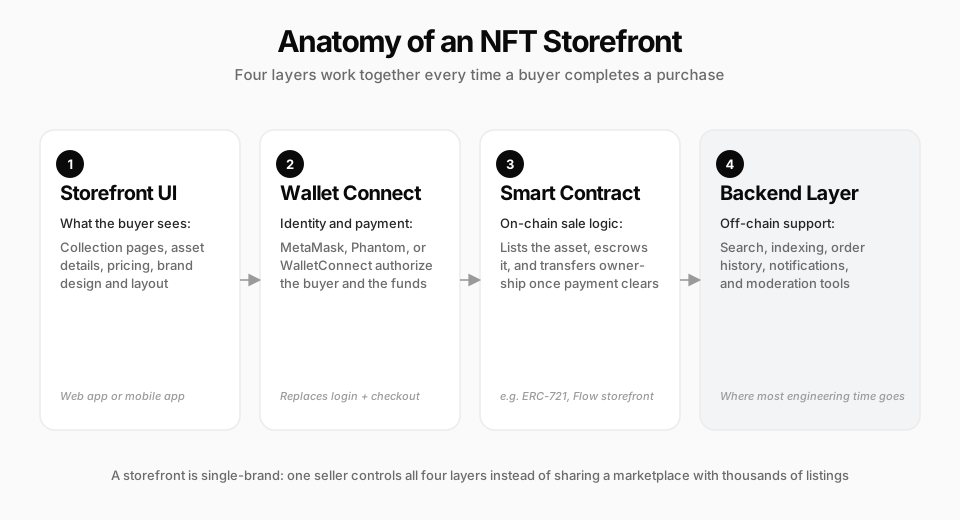
- Storefront UI: The web or mobile app buyers actually see, collection pages, asset detail pages, pricing, and your brand's visual design
- Wallet connection: Integrations with MetaMask, Phantom, Coinbase Wallet, or WalletConnect that authenticate the buyer and move funds, standing in for the login-and-checkout flow of a traditional store. Newer wallets built on account abstraction are starting to soften this step with passkey logins and sponsored gas instead of a seed phrase, though most storefronts still integrate against the older wallet-connect standards first
- Smart contract: The on-chain logic that lists an asset for sale, escrows it, and transfers ownership once payment clears. On Ethereum this typically follows the ERC-721 or ERC-1155 token standards (and some collections go further with dynamic NFTs whose metadata changes after minting); on Flow, projects commonly build on the open-source
NFTStorefrontcontract, which is literally named for this pattern - Backend layer: The unglamorous part that does the most engineering work, indexing listings, powering search, tracking order history, sending notifications, and moderating content
Most of the visible product decisions (design, categories, filters) live in the storefront UI. Most of the actual engineering effort lives in the backend layer and the smart contract integration, which is why "just add an NFT storefront" is rarely as simple as it sounds on a roadmap slide.
Why Brands and Creators Build Their Own Storefronts
The case for owning your storefront:
- You set your own prices. On a shared marketplace, your NFT sits next to thousands of others, and buyers can comparison-shop instantly. On your own storefront, you're not competing on price within the same page, though you still need a defensible number, which is where setting a price on an NFT comes in.
- You own the customer relationship. A storefront can capture emails, run its own loyalty program, and remarket to past buyers directly, none of which a marketplace listing gives you.
- You control the brand experience. Layout, story, drop mechanics, and presentation are entirely yours, which matters when the NFT is one part of a larger brand or fan strategy rather than a standalone collectible.
- You avoid marketplace fee structures. You still pay payment processing and hosting costs, but you're not giving up a marketplace's take on every resale.
The honest tradeoff:
- You inherit the traffic problem. A marketplace's biggest value is built-in buyer discovery. A storefront gives you none of that; every visitor has to come from your own marketing, community, or existing audience.
- You take on more setup and maintenance. Even a no-code storefront still needs wallet integration testing, smart contract auditing (for custom builds), and ongoing infrastructure.
- Liquidity is thinner. Buyers on a storefront usually can't resell as easily as they can on an open marketplace with active secondary trading.
This is the real reason most brand-owned storefronts belong to companies that already have an audience. NBA Top Shot could launch a storefront because Dapper Labs already had the NBA's fanbase to draw from. A brand-new project with no existing audience is usually better served starting on an established marketplace, then building a storefront once it has traction worth owning.
Real-World Examples of NFT Storefronts
- NBA Top Shot: Built by Dapper Labs on the Flow blockchain, this is one of the longest-running brand-owned storefronts, selling officially licensed NBA highlight "Moments" directly rather than through a third-party marketplace. It has generated well over $1 billion in lifetime marketplace sales, even after trading volume cooled significantly from its 2021 peak.
- Nike .SWOOSH: A useful cautionary example rather than a success story. Nike's brand-owned Web3 storefront is being retired on May 5, 2026, following the earlier shutdown of its RTFKT digital sneaker unit. Owning your storefront doesn't guarantee an NFT strategy will pay off, and even a company with Nike's marketing budget didn't sustain buyer demand.
- Mintbase-powered storefronts: A no-code example at the smaller end. Mintbase lets individual creators spin up a basic branded storefront without writing smart contract code, trading customization depth for speed to launch.
 The common thread across all three: staying power comes from a genuine reason to buy directly, licensed collectibles with real utility, or community status attached, not novelty alone. NBA Top Shot's exclusive NBA licensing gave it a moat Nike's sneaker collectibles never found, even with a far bigger marketing budget behind them.
How to Build an NFT Storefront
The No-Code / White-Label Route
Platforms like Mintbase let you launch a basic storefront without custom development. You get a hosted front end, wallet integration, and a pre-built smart contract, in exchange for less design flexibility and platform-specific limitations. This is the right starting point if you want to test demand before committing engineering budget.
The Custom Development Route
A fully custom storefront means building the front end, wiring up wallet connectivity through libraries like web3.js or Wagmi, deploying and (ideally) auditing your own smart contracts, and standing up backend infrastructure for indexing and search. This gives you complete control over UX and functionality, at the cost of a real engineering timeline.
What It Actually Costs
| Approach | Typical Cost | Timeline | Best For |
|---|---|---|---|
| No-code / white-label | $10,000–$50,000 | Days to a few weeks | Testing demand, small drops |
| Mid-tier custom build | $50,000–$150,000 | 2–4 months | Established brands with specific UX needs |
| Enterprise custom platform | $150,000–$500,000+ | 4+ months | Large-scale, high-volume launches |
These figures come from development cost estimates across multiple 2026 agency guides and vary significantly by scope, chain choice, and whether a smart contract audit is included. Treat any single number with skepticism and get quotes for your specific requirements before committing. Whatever you land on, pricing it correctly from launch matters more than the platform you build it on.
Do You Actually Need Blockchain Infrastructure for This?
Here's the question worth asking before any of the above: when a brand says "we want our own storefront, our own pricing, no competing listings, and a direct relationship with our buyers," how much of that actually requires a blockchain?
Wallet connection, smart contracts, and gas fees exist to solve a specific problem: provable, transferable ownership of a unique digital asset on a public ledger. If your product is genuinely about verifiable ownership and resale (limited-edition collectibles, tokenized access rights, secondary-market royalties), that infrastructure earns its complexity. If what you actually want is a branded storefront where you sell digital goods at your own prices without competing against a marketplace full of other sellers, a conventional digital product platform gets you the same outcome without wallets, gas fees, or smart contract audits.
Selling Digital Products Without the Blockchain Overhead
To be direct about it: Crevio is not an NFT platform. It doesn't support crypto wallets, smart contracts, or blockchain-based ownership, and if verifiable on-chain ownership is the point of what you're building, Crevio isn't the right tool.
But if what actually drew you to the idea of "my own NFT storefront" is the underlying need, a branded space to sell digital goods at your own prices, without sharing a page with competing listings, Crevio solves that specific problem for regular digital products. You describe what you want to sell (courses, downloads, memberships, or embedded content), and Crevio's AI builds the storefront, product pages, and checkout flow for you. There's no marketplace of competing sellers on your page: it's your storefront, your pricing, your brand, the same core promise a branded NFT storefront is built to deliver, just without the blockchain layer underneath it. If you're weighing which digital goods are worth building a storefront around at all, our guide to how to sell digital products is a good next stop.
On pricing: Crevio's Starter plan is free with a 5% transaction fee, the Pro plan is $20/month with a 2.5% fee, and the Business plan is $50/month with a 1% fee and no Crevio branding. Every plan runs on Stripe for payment processing, and none of them require the buyer to own a crypto wallet to check out, which removes a real friction point for buyers who aren't already in the Web3 ecosystem.
If your product is fundamentally about tokenized, resellable ownership, stick with the blockchain-native path covered above. If it's about owning your storefront and your pricing for digital goods, it's worth comparing that path against a simpler one before you scope a $50,000+ custom build.
FAQ
No. A marketplace like OpenSea or Magic Eden hosts many independent sellers competing for the same buyers, and takes a fee on every transaction. A storefront is owned by a single brand or creator and lists only that brand's NFTs, trading marketplace-level discovery for full control over pricing, branding, and the buyer experience.
It depends heavily on approach. A no-code, white-label storefront can launch for $10,000–$50,000 in days to a few weeks. A fully custom build with its own smart contracts and backend typically runs $50,000–$150,000 for a mid-tier project, and can exceed $500,000 for an enterprise-scale platform with a full security audit.
Not necessarily. No-code and white-label platforms like Mintbase let you launch a basic branded storefront without writing smart contract code, though you'll have less control over design and functionality than a custom build. Custom development requires blockchain engineering experience, particularly for smart contract work, which is the one piece worth paying a professional to audit rather than shipping and hoping. A bug in a storefront's smart contract doesn't get a quiet patch later; once it's live and holding funds, it gets exploited.
Related Blog Posts
What will you sell today?
Describe what you want to sell — Crevio builds, launches, and grows it. Products, payments, and marketing, all on autopilot.
Start for free