Your business,
on autopilot.
One platform for creating, running and growing your business, powered by AI.
What Is Account Abstraction? A Guide to ERC-4337 Smart Wallets




Account abstraction is the reason a growing share of crypto wallets no longer make you write down twelve random words and guard them with your life. It's the umbrella term for a set of Ethereum standards, chiefly ERC-4337 and EIP-7702, that let a wallet be a small program instead of a single private key. That program can sponsor its own gas fees, recover itself if a device is lost, approve a batch of actions in one signature, and authenticate with a fingerprint instead of a seed phrase. By some trackers, tens of millions of these "smart accounts" are already active on Ethereum and its rollups, and the number climbs every quarter.
- The core idea: replace a wallet whose only logic is "valid signature = full access" with a smart contract that can enforce whatever rules its owner wants
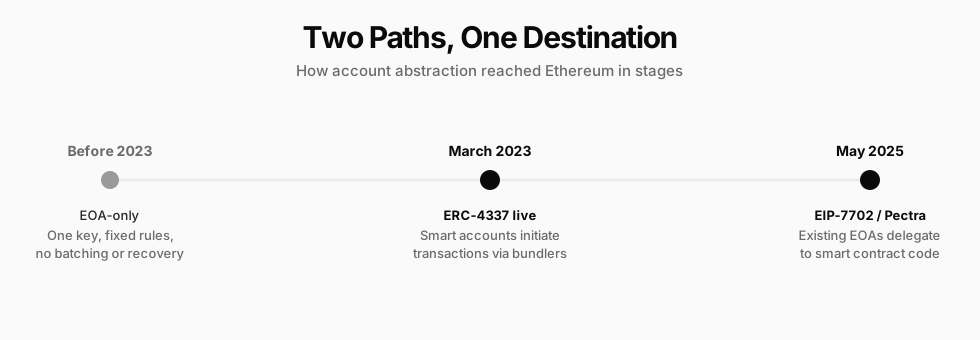
- Two live paths to it: ERC-4337, an application-layer standard live since March 2023, and EIP-7702, a protocol-level upgrade that shipped with Ethereum's Pectra hard fork on May 7, 2025
- What it actually unlocks: gas sponsorship (someone else pays, or you pay in USDC instead of ETH), social recovery instead of a lost seed phrase meaning lost funds, one-signature batched transactions, and session keys for app-specific permissions
- It's not free: extra smart-contract risk, a new class of infrastructure (bundlers, paymasters) that can introduce its own failure modes, and a still-fragmented experience across chains and wallets
What Is Account Abstraction, Really?
Every Ethereum account has historically been one of two types. An externally owned account (EOA) is a public-private keypair: whoever holds the private key has complete, unconditional control, and there is no way to program around that. Lose the key and the funds are gone forever; leak the key and an attacker has already won. A contract account, by contrast, is a smart contract, and smart contracts can hold arbitrary logic: multi-signature requirements, spending limits, time locks, whatever the code says.
The catch, before account abstraction, was that only EOAs could initiate a transaction. Contract accounts could receive funds and execute logic, but something with a private key still had to kick off every action. That asymmetry is what account abstraction removes. It lets a smart contract act as the primary account: the thing that signs, pays gas, and initiates a transaction, with whatever custom validation logic its owner has programmed in. "Account abstraction" is a slightly clinical name for a simple change: your wallet stops being a bare keypair and starts being a program you can shape.
EOAs vs. Smart Accounts
Put side by side, that asymmetry turns into three concrete gaps: an EOA can't sponsor its own gas, can't recover from a lost key, and can't batch multiple actions into one signature. A smart account can do all three, because its validation logic is written in code rather than fixed by the protocol.
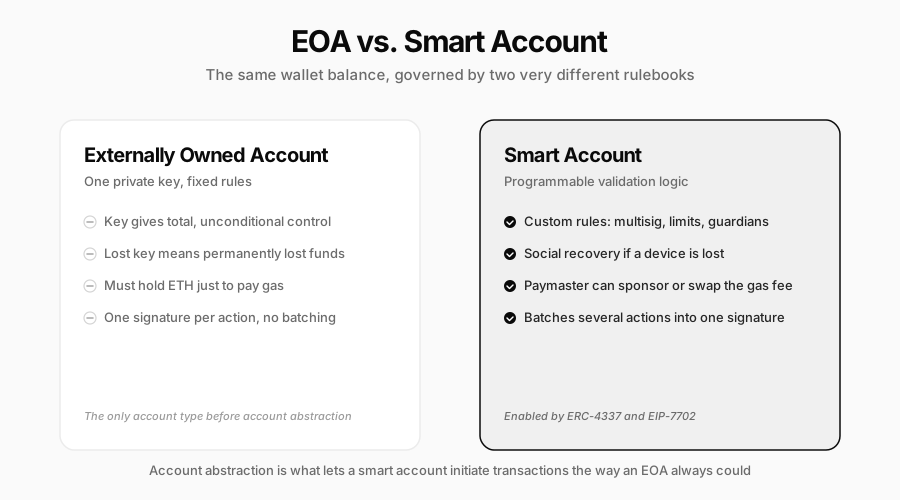
This is also why "smart contract wallet" and "account abstraction wallet" get used almost interchangeably. Safe (formerly Gnosis Safe) has offered multi-signature smart contract wallets since 2018, well before ERC-4337 existed, proving the contract-account idea on its own. What ERC-4337 added wasn't the concept of a smart account, it was a standardized, permissionless way for any smart account to initiate transactions without Ethereum's core protocol needing to change.
How Account Abstraction Works Under the Hood: ERC-4337
ERC-4337, authored by Vitalik Buterin and collaborators and finalized on Ethereum in March 2023, solves a specific problem: how do you let smart contracts initiate transactions without a consensus-layer change to Ethereum itself, which would take years to coordinate and ship? Its answer is a parallel transaction system that sits on top of the existing one.
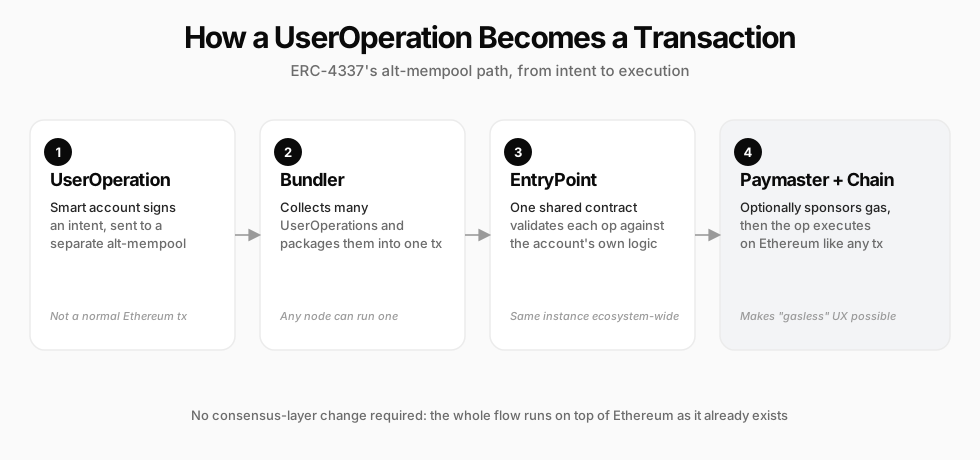
Four pieces do the work:
- UserOperation: a pseudo-transaction object. Instead of signing a standard Ethereum transaction, your smart account signs a UserOperation describing what it wants to do. It isn't broadcast to the normal mempool; it goes to a separate "alt-mempool" built for this purpose.
- Bundler: a node that watches that alt-mempool, collects UserOperations from many users, and packages them into a single real Ethereum transaction, the same way a block builder packages ordinary transactions.
- EntryPoint: a single, publicly verified smart contract (one canonical instance is used across the whole ecosystem) that the bundler calls. It validates each UserOperation against the sending account's own logic, then executes it.
- Paymaster: an optional contract that can agree to cover the gas cost of a UserOperation, either absorbing it entirely or accepting payment in an ERC-20 token like USDC instead of ETH. This is the piece that makes "gasless" apps possible: the user experience shows no gas fee, but a paymaster is quietly paying the bundler in ETH behind the scenes.
None of this required a change to Ethereum's consensus rules, which is precisely the point: ERC-4337 could ship and start processing real transactions immediately, without waiting for a hard fork that every node operator has to adopt. The tradeoff is that it's still bolted on. A wallet has to be deployed as a smart contract to use it, and every one of those UserOperations costs somewhat more gas than an equivalent plain transaction, because the EntryPoint's validation logic runs on top of the underlying execution.
EIP-7702: Account Abstraction Without Leaving Your EOA
ERC-4337's one real limitation is that it only works for accounts that are already smart contracts. The overwhelming majority of existing Ethereum addresses are EOAs, and migrating funds to a brand-new smart account address is friction most people never bother with. EIP-7702, authored by Vitalik Buterin and others and shipped with Ethereum's Pectra upgrade on May 7, 2025, closes that gap at the protocol level instead of the application level.
EIP-7702 lets an EOA temporarily attach, or "delegate," to a piece of smart contract code, using a new transaction type built for exactly this. The EOA keeps its existing address and existing history, but for the duration of that delegation it can execute arbitrary contract logic: batching several calls into one transaction, letting a paymaster sponsor gas, or applying spending rules, all without the user ever moving to a new address. Where ERC-4337 says "let smart contracts act like first-class accounts," EIP-7702 says "let existing accounts act like smart contracts, on demand." The two are explicitly designed to work together: a 7702-delegated EOA can be included in an ERC-4337 bundle, which is why the two are usually described as complementary paths to the same destination rather than competitors.
What Account Abstraction Actually Unlocks
Strip away the acronyms and the practical upgrades are the part that matters to an actual wallet holder.
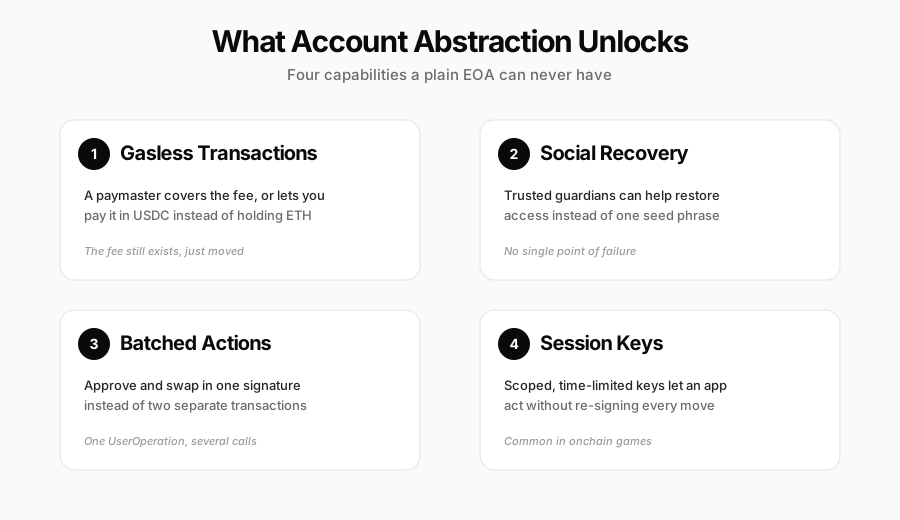
- Gasless transactions. A paymaster covers the gas, or lets you pay it in a stablecoin instead of holding ETH just to transact. This is the single biggest reason mainstream crypto apps have started to feel less like using a foreign currency exchange.
- Social or guardian recovery. Instead of "the seed phrase is the only backup, and losing it means losing everything," a smart account can name trusted guardians (other addresses, a hardware key, a second device) who can collectively help recover access. It's programmable, so the exact rules are up to the wallet's owner.
- Batched transactions. Approving a token and then swapping it used to be two separate signatures and two separate gas payments. A smart account can bundle both into a single UserOperation the user approves once.
- Session keys and spending limits. A game or app can be granted a scoped, time-limited key that can only perform specific low-risk actions, so a player isn't re-signing every single in-game move with their main key.
Wallets shipping these features today aren't hypothetical. Coinbase's Smart Wallet, launched in mid-2024, deploys directly as an ERC-4337 smart account with no seed phrase at all, using device passkeys (Face ID, Touch ID, or a security key) for recovery instead. Safe remains the dominant smart contract wallet for DAOs and treasuries managing large sums, largely on the strength of its multi-signature model predating ERC-4337. Argent built its wallet around social recovery from the start. Infrastructure providers like Alchemy, Biconomy, and ZeroDev supply the bundler, paymaster, and SDK plumbing that lets other apps add these features without building the stack from scratch.
The Gotchas Nobody Mentions
Account abstraction gets pitched as a pure upgrade, and the core idea is sound, but a few honest tradeoffs are worth knowing before you assume every wallet should switch.
- You're trusting more infrastructure, not less. A transaction now depends on a bundler actually including your UserOperation and a paymaster actually being solvent and willing to sponsor it. Neither is a decentralization risk on the scale of a single custodian holding your keys, but it's a real dependency that a plain EOA transaction doesn't have.
- Smart contracts can have bugs. An EOA's only attack surface is its private key. A smart account's attack surface includes whatever validation code it runs. A poorly audited wallet contract is a new kind of risk a seed-phrase wallet simply doesn't carry.
- Gas is not actually cheaper, just moved or hidden. "Gasless" transactions still cost gas; a paymaster is paying it, usually recouping the cost in a token fee or absorbing it as a growth expense. That's a real, valuable UX improvement, but it's not the same claim as "free."
- Adoption is still fragmented. Not every smart account works identically across every wallet provider, and moving a smart account's logic between chains isn't as simple as moving an EOA's private key. The tooling is real and growing (BundleBear and similar dashboards track well over a billion cumulative UserOperations processed since March 2023), but "account abstraction" today means several competing implementations converging on similar standards, not one finished product.
If You're Building or Selling in This Space
Account abstraction is a wallet-layer standard, and Crevio isn't a crypto wallet, a bundler, or a paymaster: none of that is what an AI business builder does, and it shouldn't try to be. But a real number of people building or teaching in this space aren't writing Solidity full time. They're running a course on ERC-4337 development, selling an ebook that walks non-technical founders through smart wallets, or running a membership community for people tracking the account abstraction ecosystem, and all of that is a normal digital-products business sitting on top of a crypto-native topic.
That's the part Crevio actually covers: you describe the course, download, or membership you want to sell, and Crevio's AI builds the storefront, checkout, and customer management around it, on Stripe, with no crypto wallet required from the buyer. It's the same pattern we covered in our guide to building an NFT storefront: if what you're selling is the knowledge about a Web3 concept rather than an on-chain asset itself, you don't need blockchain infrastructure to sell it, you need a normal storefront that happens to be about a Web3 topic.
Account abstraction is what happens when a wallet stops being a password and starts being software: still your money, but now it's code you can actually reason about.
FAQ
Not exactly. A smart contract wallet is the account itself, a contract that holds funds and enforces custom logic. Account abstraction is the broader standard, chiefly ERC-4337, that lets those smart contract wallets initiate transactions the same way a normal wallet does, without needing a separate EOA to kick things off. Safe's smart contract wallets predate ERC-4337; account abstraction is what let that concept become a general-purpose standard instead of one project's design choice.
It depends on the path. Moving to an ERC-4337 smart account (like Coinbase's Smart Wallet) does mean a new address with its own deployment. EIP-7702, live since Ethereum's Pectra upgrade in May 2025, is built specifically so you don't have to: it lets your existing EOA temporarily behave like a smart contract for a given transaction, without migrating funds anywhere.
No. "Gasless" describes who's paying and how, not whether gas exists. A paymaster contract covers the gas fee on your behalf, and it recoups that cost either by charging you in a stablecoin like USDC instead of ETH, or by treating it as a customer acquisition cost the way many apps subsidize a first transaction. The underlying network fee is still paid; account abstraction just moves who pays it and how it's presented to the user.
Related Blog Posts
What will you sell today?
Describe what you want to sell — Crevio builds, launches, and grows it. Products, payments, and marketing, all on autopilot.
Start for free