Your business,
on autopilot.
One platform for creating, running and growing your business, powered by AI.
What Is a Dynamic NFT? How dNFTs Work, Examples, and Use Cases





A dynamic NFT is a token whose image, traits, or description can change after it is minted, according to rules written into its smart contract. A normal NFT is a sealed photograph. A dynamic NFT is closer to a scoreboard: the ownership record stays put, while what you see on it keeps moving with the world around it.
If you have only met NFTs as profile pictures, that distinction is the whole reason dNFTs exist. They turn a one-time collectible into something that can level up, age, reward loyalty, or track real-world data.
- The token ID is permanent, the metadata is not: ownership never changes, but the image and traits the token points to can
- Updates come from rules: a smart contract decides when and how things change, usually fed by an oracle, a timer, or an owner action
- Two storage styles: metadata can be rewritten off-chain (cheap, flexible) or generated fully on-chain (durable, more expensive)
- Not always the right tool: more moving parts means more to build, audit, and explain to buyers
What Is a Dynamic NFT?
A dynamic NFT (dNFT) is, in Chainlink's words, a non-fungible token with encoded smart contract logic that lets it automatically change its metadata based on external conditions. Metadata is the part people actually look at: the name, description, image, and trait list.
Every NFT on the common ERC-721 standard has a tokenURI, a pointer to a JSON file that describes the token. For a static NFT, that pointer is set once and never touched. For a dynamic NFT, the contract is built so the pointer, or the data behind it, can be updated. The ERC-721 specification itself allows this: it describes token metadata as something that may be mutable.
The key idea is that the thing you own is the token ID. The picture is a view onto it.
Static NFT vs Dynamic NFT
Most NFTs in circulation are static. That is a feature, not a flaw: a fixed image is easy to understand, easy to verify, and cheap to mint. A dynamic NFT trades that simplicity for behavior.
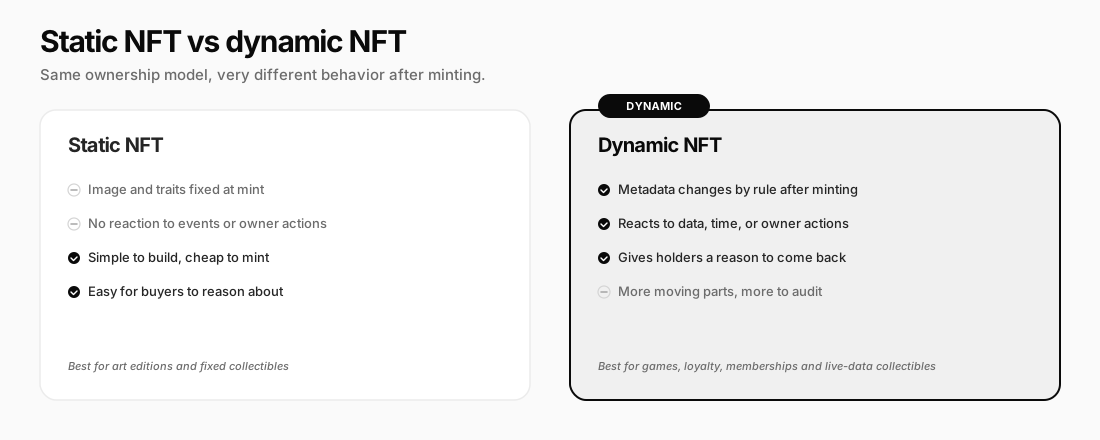
| Factor | Static NFT | Dynamic NFT |
|---|---|---|
| Metadata after mint | Fixed | Can change by rule |
| Reacts to outside data | No | Yes, through oracles or scripts |
| Build complexity | Low | Medium to high |
| Audit surface | Small | Larger: update logic, data feeds, permissions |
| Buyer expectation | "This is what I'm getting" | "This will evolve, and here is how" |
| Typical use | Art editions, collectibles, membership passes | Games, loyalty, live-data collectibles, tokenized assets |
One more difference matters for buyers: with a static NFT, the artwork you buy is the artwork you keep. With a dynamic one, you are buying a set of rules too. Good projects state those rules up front.
How Dynamic NFTs Work
Building a dNFT takes three ingredients, which Chainlink's guide to building dynamic ERC-721 NFTs lays out well:
- A token contract, usually ERC-721 or ERC-1155, with update logic and tight permissions on who or what can trigger it
- A data source, such as an oracle network delivering a price, a sports statistic, or a weather reading
- A trigger, like a scheduled automation job, a game event, or an owner action such as staking or burning another token
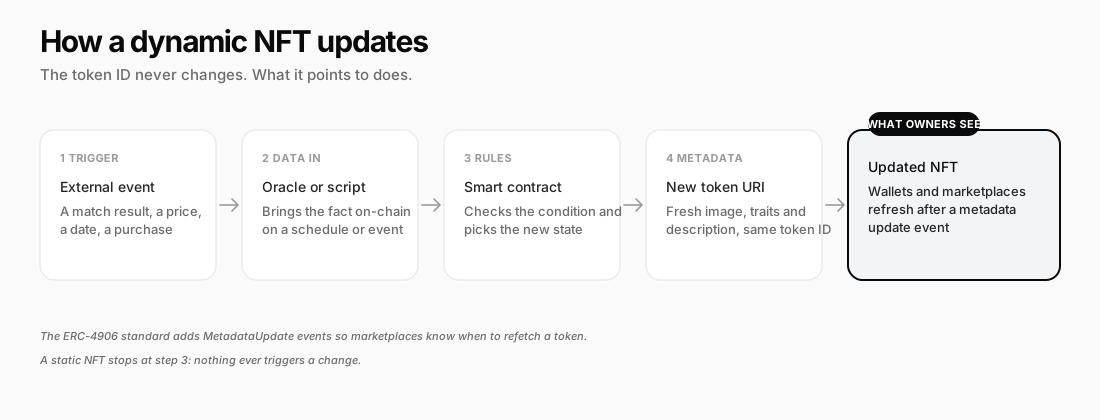
Here is the sequence in practice:
- Something happens: a player wins a match, a price crosses a threshold, thirty days pass.
- An oracle or automation service delivers that fact to the contract.
- The contract checks its rules and chooses the new state.
- It points the token at new metadata, or recomputes the metadata itself.
- Wallets and marketplaces refetch and show the new version.
Off-Chain vs On-Chain Metadata
Where the metadata lives decides how durable your dNFT is.
- Off-chain metadata keeps the JSON and image on a server or storage network. Updating means publishing a new file and changing the
tokenURI, or changing what the server returns. It is cheap and flexible, but holders must trust whoever controls the host. Content-addressed storage like IPFS gives each file a fixed hash, so "updating" really means pointing at a new hash. - On-chain metadata has the contract generate the token description, and often an SVG image, directly from stored state. Nothing external can go missing. The cost is higher gas and tighter limits on how rich the artwork can be.
Many projects land in the middle: traits stored on-chain, artwork rendered from a gateway.
Why ERC-4906 Matters
Updating metadata is only half the job. Marketplaces cache what they show, so a changed token can look stale for days. ERC-4906 fixes this by standardizing two events, MetadataUpdate for one token and BatchMetadataUpdate for a range, so platforms know exactly when to refetch. If you build a dNFT, emit them.
Dynamic NFT Examples
LaMelo Ball Collectibles
The best-known case study is the set of eight collectibles tied to NBA player LaMelo Ball. According to Chainlink's write-up, an oracle brought his game statistics on-chain, and the "Gold Evolve" token changed its image after he won 2020-21 Rookie of the Year. The point was simple: the collectible mirrored a real career instead of freezing one moment.
Regenerative Resources Short Film
The same source describes a short film split across five NFTs, where more frames unlock with each resale until the whole film is revealed. Here the trigger is not outside data at all but the token's own trading history, which shows how flexible "dynamic" can be.
Game Characters and Items
Games are the natural home for dNFTs. A character token starts with base stats in its metadata and gains levels, gear, or scars as the player progresses. The token stays tradable, and its history travels with it.
Dynamic NFT Use Cases
- Gaming: evolving characters, upgradable items, seasonal skins
- Loyalty and membership: a pass that upgrades from bronze to gold as the holder engages, or expires visibly
- Sports and media: collectibles that track live statistics or unlock content over a season
- Real-world assets: a token that reflects maintenance records, valuation, or certificates attached to a physical item
- Generative and living art: pieces that react to time of day, weather, or market data
- Event tickets: a ticket that turns into a proof-of-attendance collectible after the event
The test for a good use case: does the change give the holder something they would not get from a static token? If the answer is "it looks different," keep thinking.
Risks and Trade-Offs
A dynamic NFT creates trust questions that static ones avoid.
- Who holds the update key? If a single wallet can rewrite every token, holders are trusting that wallet forever. Multisigs, timelocks, and rules that cap what can change all help.
- Oracle dependence: a bad or delayed data feed produces a wrong NFT. Use reputable data sources and design a safe fallback state.
- Value perception: collectors sometimes pay for a specific look. If it changes, you can destroy the thing they bought. Disclose the rules before mint.
- Cost: every on-chain update costs gas, so frequent changes need a cheap network or batched updates.
- Marketplace lag: without ERC-4906 events, changes may not show up promptly.
What nobody tells you until you ship: the hard part is rarely the contract. It is the ongoing operations: feeds to monitor, keys to protect, and holders asking why their token changed.
How to Create a Dynamic NFT
You do not need to invent the pattern. A practical path:
- Define the change. Write one sentence: "When X happens, the token does Y." If you cannot, you do not have a dNFT yet, you have an idea.
- Pick the standard and chain. ERC-721 for unique tokens, ERC-1155 for editions. Choose a network where update transactions are cheap enough for your cadence.
- Choose the data source and trigger. An oracle for outside facts, an automation job for time-based changes, or owner-initiated actions.
- Decide where metadata lives. Off-chain for flexibility, on-chain for permanence.
- Lock down permissions. Limit who can update, and what they can change.
- Emit ERC-4906 events so marketplaces stay in sync.
- Test on a testnet with every state transition, including the failure cases.
- Get an independent audit before real money touches it.
Tutorials such as Tableland's guide to dynamic NFTs with Chainlink Automation walk through a working example end to end.
Where Crevio Fits
Be clear about the boundary: Crevio does not mint NFTs or run smart contracts. It is an AI business builder for digital products, courses, memberships, storefronts, and payments through Stripe.
Where the two worlds touch is the business around the token. A dNFT project still needs a place to explain the rules, sell the supporting content, run a members area, and capture leads. If your community also buys courses, downloads, or a membership alongside the on-chain piece, you can describe what you want and let Crevio's AI build and run that side while your contracts live elsewhere.
Crevio starts free, with transaction fees of 5% on Starter, 2.5% on Pro, and 1% on Business. If you are weighing a branded on-chain shop against a conventional one, our guide to the NFT storefront model covers the trade-offs, and Crevio handles the non-blockchain half.
Should You Build One?
Build a dynamic NFT if the change is the product: a character that grows, a pass that evolves with engagement, a collectible tied to something real. Skip it if you just want a more interesting launch. A static NFT with a great community beats a dynamic one nobody understands.

FAQ
Yes, if its contract allows it. The token and your ownership stay the same, but the image or traits may update when the contract's rules fire. Read the project's documentation before buying, so you know what can change and who controls it.
Not automatically. Value depends on demand, utility, and trust in the project, and the same pricing logic as any NFT applies. Dynamic behavior can add utility, but it also adds risk if the update rules are unclear or controlled by one party.
Most are built on ERC-721 or ERC-1155 with extra update logic. ERC-4906 adds metadata update events so marketplaces can refresh what they display. There is no separate "dNFT standard" required.
Only when the change depends on outside data such as sports results or prices. Time-based changes can use automation, and owner-driven changes can be handled by the contract alone.
Yes. A contract can generate metadata and an SVG image from its own stored state, so nothing external is needed. It costs more gas and limits artwork complexity.
Related Blog Posts
What will you sell today?
Describe what you want to sell — Crevio builds, launches, and grows it. Products, payments, and marketing, all on autopilot.
Start for free