Your business,
on autopilot.
One platform for creating, running and growing your business, powered by AI.
Product Drop Strategy: The Playbook Behind a $100K Launch





43% of US shoppers took part in a limited-time product drop, flash sale, or private sale in the last month, according to a 2025 PYMNTS and Scalefast survey of 2,298 shoppers. The format keeps producing numbers that sound made up until you see the receipts: streetwear founder Marshall Crews sold $100,000 of inventory in 30 minutes during a single Black Friday drop, according to a case study Whop published about his brand.
The mechanics behind a number like that aren't a secret and they aren't luck. A product drop strategy is a specific, repeatable structure: build a list, create real scarcity, open a short window, and let inventory, not marketing copy, generate the urgency. This guide breaks down what actually drove Marshall's launch, the six-step timeline behind any drop that works, and how to run the same strategy whether you're shipping hoodies or a cohort-based course.
- A drop has six steps, and five of them happen before the "buy" button goes live. The 30 minutes everyone talks about is the smallest part of the work.
- Scarcity has to be real, not a marketing claim. An "only 3 left" banner that never actually sells out trains your audience to stop believing your urgency.
- The list is the asset, not the product. Marshall's $100K drop sold to a 12,000-person SMS list built over months, not to cold traffic that happened to see an ad.
- Drops aren't exclusive to physical goods. Cohort-based courses, limited coaching seats, and numbered digital bundles run on the identical mechanic.
What a Product Drop Actually Is (and Why It Works)
A product drop is a release of a fixed quantity of a product at a scheduled time, sold until it runs out and then, deliberately, not restocked. That's different from a flash sale (same inventory, temporary discount) and different from a normal launch (available indefinitely once it ships). The constraint is the entire point: a drop trades reach for intensity. Fewer units, sold in a compressed window, to an audience that already wants in before the price is even visible.
The psychology is old and well documented: scarcity increases perceived value independent of the product itself, and a hard deadline converts "I'll think about it" into "I'll buy it now." What's changed is distribution. A creator with an SMS list and a following doesn't need a retail calendar or a wholesale relationship to run one. The entire mechanism now fits inside a single storefront and a countdown timer.
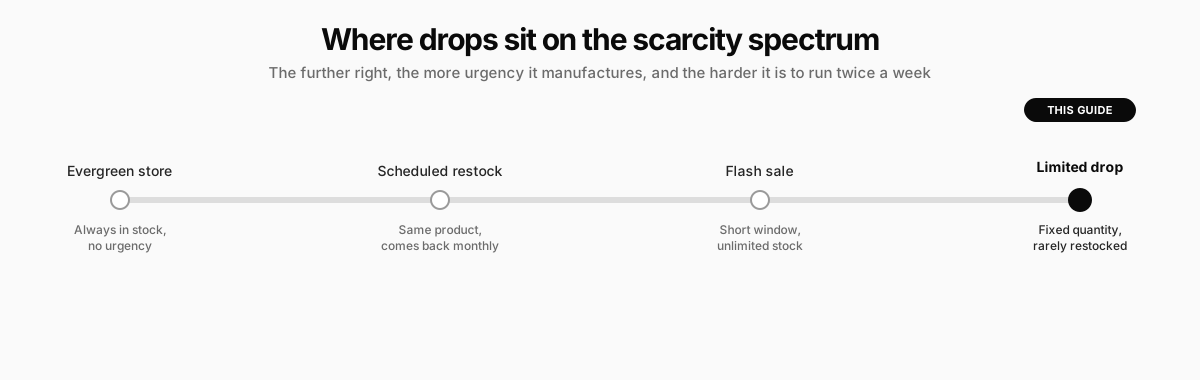
Not every business should run drops. An evergreen store optimizes for steady, predictable revenue and low operational overhead. A drop optimizes for a single moment of maximum demand, at the cost of being genuinely hard to run more than a handful of times a year. Pick the model that matches what you're actually selling, not the one that looks most exciting on social media.
The $100K Drop: What Marshall Crews' Launch Actually Proves

Marshall Crews and his best friend Joey co-founded Tamed Psychotic, a streetwear label, and according to Whop's case study, their most recent Black Friday drop generated $100,000 in revenue in 30 minutes. It wasn't a one-off spike: the drop before it made $80,000 in 10 minutes, and the one before that made $50,000. Marshall reportedly reinvested nearly everything back into the business, taking only around $5,000 in personal profit across six months while the brand grew.
Strip away the headline number and three decisions explain most of the result:
- The audience came first, the drop came second. Tamed Psychotic built over 1 million followers across Instagram and TikTok, plus a 12,000-person SMS list, before this specific launch. The drop converted an audience that already existed; it didn't build one from scratch on launch day.
- Production time bought urgency. Reports describe roughly six months of product development and three months of marketing planning behind a single drop, including a produced short film. A drop feels spontaneous to the buyer because the seller spent months making sure it wasn't.
- Every prior drop was a rehearsal. A brand doesn't jump straight to $100K in 30 minutes. Each smaller drop before it functioned as a live test of demand, pricing, and messaging, feeding directly into the next one.
None of this means you need a million followers to run a drop that works. It means the drop itself is the last step of a much longer process, and the size of the number scales with how much of that process actually happened first.
The Product Drop Strategy: A 6-Step Timeline
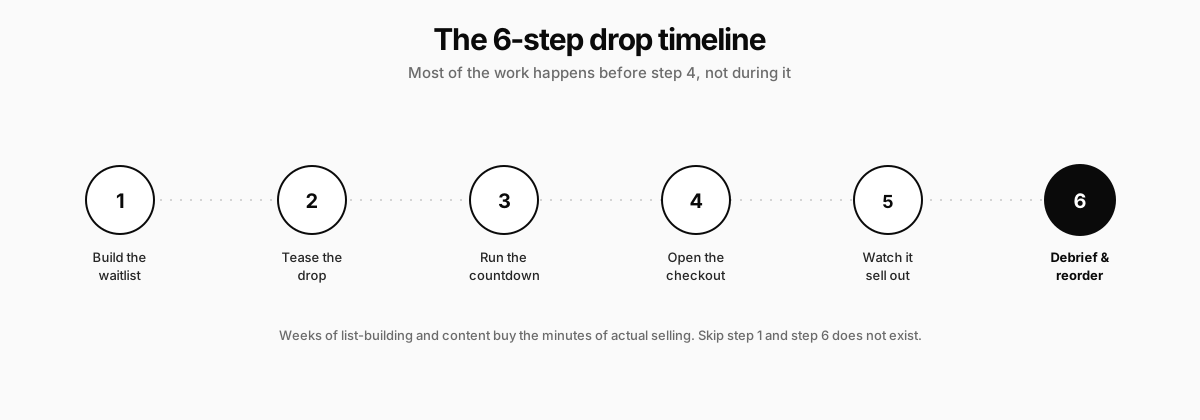
1. Build the waitlist
Email or SMS, not a follower count you don't own. A waitlist person has already raised their hand, which is a completely different buyer than someone scrolling past an ad. Give people a genuine reason to join early: first access, a lower price window, or a size/seat guarantee that closes once the list is full.
2. Tease the drop
Show the product, the story, or the process, without opening the checkout. This is where the six months of production work Marshall's team put in actually pays off: content made in advance gives you a full week of teasing material instead of one rushed announcement post.
3. Run the countdown
A visible, specific countdown (not "coming soon") turns passive followers into people checking the clock. 48 to 72 hours is usually the sweet spot: long enough to build anticipation, short enough that people don't forget.
4. Open the checkout
The moment the drop is genuinely live. Set the actual available quantity before you open it, not an aspirational one, and make sure your pricing is final. If you don't know your real inventory limit going in, you can't manufacture real scarcity going out.
5. Watch it sell out
A drop that doesn't sell out isn't a failed drop. It's data. Track how fast each tier or size moved. That's the number that tells you what to make more of, not the total revenue.
6. Debrief and reorder
Decide, deliberately, what happens next: a restock, a new drop, or nothing. Leaving buyers who missed out with silence is a wasted opportunity; a short "missed it, here's what's next" message keeps the list warm for the next round.
Drops Aren't Just for Streetwear
The mechanic behind Tamed Psychotic's launch has nothing to do with clothing specifically. It's inventory plus a deadline. That applies just as well to:
- A cohort-based course with a hard cap on seats, sold in a single enrollment window a few times a year instead of always-open.
- A limited coaching package, capped at a fixed number of clients per quarter.
- A numbered digital bundle, templates, presets, or a resource pack, released in a batch and retired once it's gone.
The one thing all of these need that a normal "buy now" product page doesn't: a way to set a real, enforced quantity limit and a place for people to join a waitlist once it sells out. Selling digital goods doesn't automatically give you either of those. Most storefronts treat digital inventory as infinite by default.
Where Crevio Fits
Crevio is an AI business builder: you describe what you want to sell and it builds the storefront, checkout, and payment flow around it. For a drop specifically, every price on Crevio can carry a hard quantity_available limit with database-level locking, so two buyers can't both claim the last unit, and once it hits zero, would-be buyers can join a native waitlist tied to that exact product instead of bouncing to a competitor's page.
That covers the mechanics of steps 4 through 6 above: the quantity limit, the sold-out state, and the list of people to notify for the next round. It doesn't replace steps 1 through 3. No platform can build your audience or produce your teaser content for you. But it means the moment the drop opens, the inventory logic that decides who gets in and who gets the waitlist is already handled correctly.
| Platform | Starting Price | Transaction Fee | Best For |
|---|---|---|---|
| Shopify | $39/mo ($29/mo billed annually) | 2.9% + $0.30 with Shopify Payments | Physical inventory, fulfillment, and large-scale drops |
| Whop | Free | Roughly 2.7% + $0.30 per domestic card charge, plus optional add-ons | Communities, cohort courses, and marketplace discovery (alternatives) |
| Crevio | Free (Starter plan) | 1–5% depending on plan | AI-built storefront for digital products, with native quantity limits and waitlists |
Crevio's free Starter plan caps you at two published products and one admin seat, so a single well-scoped drop product fits comfortably before you'd need to upgrade.
Common Mistakes That Kill a Drop
- Fake scarcity. Listing "limited quantity" without an actual cap that enforces itself. The first time a customer notices the "sold out" item restock quietly, your next countdown means nothing.
- No waitlist for the people who miss it. A sold-out drop with no way to capture demand for the next one is a list-building opportunity thrown away.
- Underestimating demand and overselling. Without inventory locking at the checkout level, two people can both "win" the last unit, and the refund conversation that follows costs you more trust than the sale was worth.
- Skipping the debrief. Treating each drop as an isolated event instead of a data point means you re-learn the same pricing and sizing lessons every single launch.
- Running drops too often. A drop's power comes from scarcity of the moment, not just the product. Running one every week turns it into a regular sale with extra steps.
- Planning for the 30 minutes and not the week after. The order volume that hits in a sell-out window shows up again as support tickets, shipping questions, and fulfillment work at several times your normal rate. Founders who only plan the drop, not the week after it, burn out fast.
A drop that works looks effortless from the outside for exactly 30 minutes. Everything before and after those 30 minutes is the actual job.
FAQ
A flash sale discounts existing, uncapped inventory for a limited time. A product drop caps the actual quantity available and sells it at full price; the scarcity is real inventory, not an artificial expiration on a discount.
Enough to be a meaningful launch, few enough to sell out before the hype fades. Most creators start smaller than feels comfortable: a drop that sells out in 10 minutes and could have sold twice as much is a better outcome than one that lingers half-sold for a week.
Yes. A cohort course with capped enrollment, a numbered batch of templates, or a limited-seat coaching round all use the same mechanic: a hard quantity limit, a deadline, and a waitlist for anyone who misses the window.
Related Blog Posts
What will you sell today?
Describe what you want to sell — Crevio builds, launches, and grows it. Products, payments, and marketing, all on autopilot.
Start for free