Your business,
on autopilot.
One platform for creating, running and growing your business, powered by AI.
How Much Money Does YouTube Pay Per View? Real Earnings Explained





YouTube does not pay a fixed amount per view. There is no "$0.01 per view" rule. What you earn depends on how many of your views show ads, what advertisers pay to reach that audience, and how much of that revenue YouTube shares with you. Two channels with 100,000 views can earn wildly different amounts.
This guide shows how the math works, which numbers to watch, and why smart channels stop treating ad revenue as their only paycheck.
- You are paid per 1,000 monetized playbacks, not per view. The key metric is RPM (revenue per mille).
- Niche and audience location drive the biggest differences. Finance and software topics tend to earn more than entertainment, though results vary widely.
- Ad revenue is the smallest lever for many channels. Products, courses, memberships and sponsorships often pay more per viewer.
Does YouTube Pay Per View?
Not directly. YouTube pays creators who are accepted into the YouTube Partner Program (YPP), and it pays based on ad revenue generated around your videos, not on raw view counts.
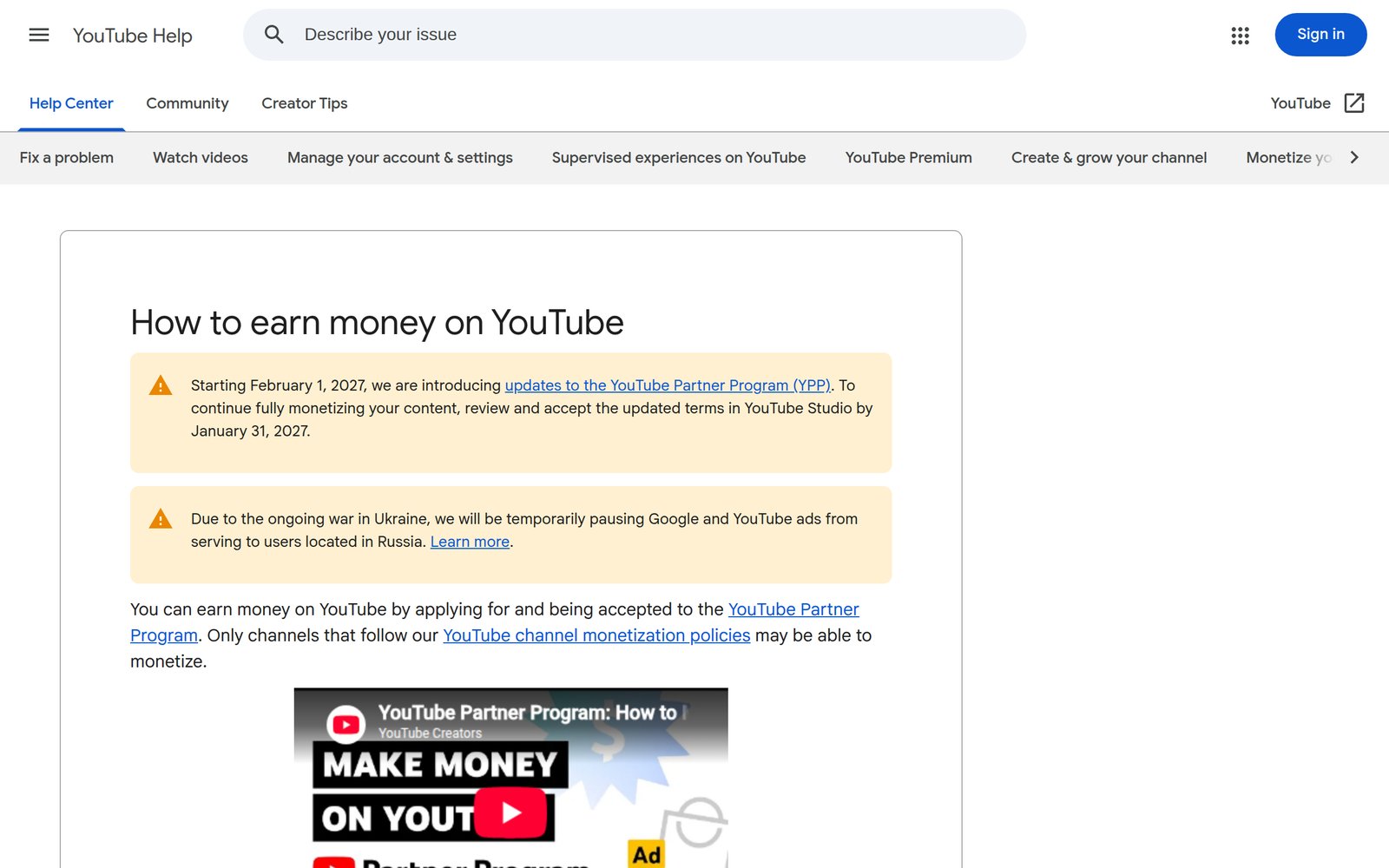
A view on a video with no ads earns nothing from ads. A view where an advertiser paid a high price to show an ad earns more. That is why the same 100,000 views can produce very different paychecks.
The Numbers That Matter: CPM, RPM and Monetized Playbacks
Three terms come up in every YouTube earnings conversation:
| Term | What it means | Why it matters |
|---|---|---|
| Views | Total times your video was watched | Reach, but not directly income |
| Monetized playbacks | Views where at least one ad was shown | The count you are actually paid on |
| CPM | What advertisers pay per 1,000 ad impressions | Advertiser-side price before YouTube's share |
| RPM | Your revenue per 1,000 total views, after YouTube's cut | The number that predicts your paycheck |
CPM is what advertisers pay. RPM is what you keep, measured against your views. RPM is almost always lower than CPM because YouTube keeps a share, and because not every view is monetized. You can find your own RPM in YouTube Studio analytics once you are monetized.
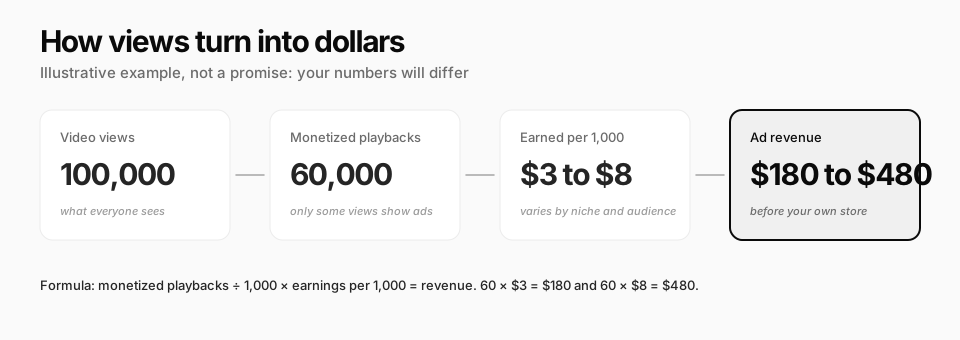
A worked example
Say a video gets 100,000 views and 60,000 of them show ads. If you earn between $3 and $8 per 1,000 monetized playbacks, that video makes roughly $180 to $480. Those figures are an illustration, not a benchmark: some channels see far less, and some niches see far more. Use your own analytics.
How Much Does YouTube Pay for 1,000, 100,000 and 1 Million Views?
Because there is no fixed rate, treat the table as scenarios, not promises.
| Views (all monetized) | At $2 RPM | At $5 RPM | At $10 RPM |
|---|---|---|---|
| 1,000 | $2 | $5 | $10 |
| 100,000 | $200 | $500 | $1,000 |
| 1,000,000 | $2,000 | $5,000 | $10,000 |
In real life, only some views are monetized, so actual earnings usually sit below these numbers. Most creators are better off predicting income from their last 28 days of Studio data than from generic averages.
What Affects Your YouTube Earnings?
Niche and advertiser demand
Advertisers pay more to reach audiences likely to buy expensive products. Topics like business, software, personal finance and real estate often earn higher RPMs than gaming or general entertainment. That is a pattern, not a rule, and it shifts with the season.
Audience location
Advertisers in some countries pay more per impression than in others. A channel whose viewers are mostly in high-spend markets will usually see a higher RPM than one with the same view count elsewhere.
Video length and ad placement
Longer videos can carry more ad slots, which is one reason many creators aim for videos over eight minutes when the content supports it. Stuffing in filler to reach a length usually hurts watch time, so add length only when it adds value.
Seasonality
Ad prices rise in the fourth quarter when brands spend heavily and dip in early January. Expect your RPM to move even when your views stay flat.
Advertiser-friendliness
Videos that don't meet advertiser-friendly guidelines may earn limited or no ad revenue. Check the status icons in YouTube Studio if a video earns less than you expected.
Shorts vs long-form
Shorts revenue is calculated differently from long-form ad revenue and is usually much lower per view. If your goal is income per viewer, long-form videos generally give you more room to earn, both from ads and from linking to your own offers.
How to Join the YouTube Partner Program
YouTube changes its requirements from time to time, so read the current rules on the official YouTube for Creators site. At the time of writing, the general path looks like this:
- Build eligibility. YouTube sets subscriber and watch-time (or Shorts views) thresholds for different levels of the program.
- Follow the channel monetization policies. Original, reused-content and misleading-metadata rules are enforced.
- Turn on 2-step verification and link an AdSense account for payments.
- Apply in YouTube Studio and wait for review.
Do not build a business plan around a specific threshold. Read the current requirements when you apply.
Why Ad Revenue Alone Is a Weak Business Model
Ad revenue is real money, but it has three problems:
- You don't control it. Policy changes, demonetization and algorithm shifts can cut income overnight.
- It is low per viewer. At a few dollars per 1,000 views, you need huge reach to earn a living.
- You don't own the audience. Subscribers can be hidden from you by the platform's recommendations at any time.
Creators who make sustainable income usually treat YouTube as the top of a funnel. The video builds trust, and something you own converts that trust into money.
Ways to earn more per viewer
- Digital products. Templates, guides, presets and downloads have high margins. Our post on how to sell digital products walks through the basics.
- Courses. If your videos teach, a structured course is a natural next step. See the online course launch checklist.
- Memberships. Recurring revenue from your most engaged viewers can be steadier than ads. Compare membership vs one-time sales before you choose.
- Affiliate links. Recommend tools you actually use and disclose the relationship.
- Sponsorships. Once your audience is steady, brands pay for access.
Even a small share of viewers buying a $29 product can outearn the ads on the same video. Suppose 100,000 people watch a video and 0.5% buy a $29 download. That is 500 buyers and $14,500, compared with a few hundred dollars from ads at typical RPMs. The exact conversion rate will vary, but the gap is why product income often dominates.
Set Up a Store for Your Audience With Crevio
Selling to your viewers requires a place to send them. Crevio is an AI business builder: describe what you want to sell, and it helps you build the storefront, set up payments with Stripe, and manage customers. You can sell downloads, courses and memberships from one place instead of stitching together separate tools.
You can start on the free plan, which includes 2 published products and a 5% transaction fee. Paid plans lower the fee to 2.5% on Pro and 1% on Business, so the cost falls as your sales grow. Put your store link in your video descriptions and pinned comment, and every video becomes a sales asset.
What Nobody Tells You
- Your RPM will surprise you. Two videos on the same channel can differ several times over.
- Views from Shorts can lower your channel-wide averages. Look at long-form RPM separately.
- Payments arrive after a delay. YouTube pays monthly once you reach the payment threshold, so plan around cash flow.
- A big viewership can hide a small business. Revenue per viewer is the number that scales.
FAQ
It varies from under $1 to well over $10 per 1,000 monetized playbacks depending on niche, location, season and ad demand. Check your own RPM in YouTube Studio for the number that applies to you.
Shorts earn through a separate revenue-sharing model, and the amount per view is generally lower than for long-form videos. Confirm the current rules on YouTube's help pages.
Views alone do not unlock payments. You must qualify for the YouTube Partner Program first, then earn based on monetized playbacks.
Rarely on its own. Most successful channels combine ad revenue with products, memberships, affiliate income or sponsorships.
Related Blog Posts
What will you sell today?
Describe what you want to sell — Crevio builds, launches, and grows it. Products, payments, and marketing, all on autopilot.
Start for free