Your business,
on autopilot.
One platform for creating, running and growing your business, powered by AI.
How to Make Money Online Without Selling Anything: 10 Real Ways




57.55% of affiliate marketers earn less than $10,000 a year, according to an industry benchmark analysis by Influencer Marketing Hub. That statistic matters here because affiliate marketing is the method almost every "make money online without selling anything" list leads with. It is real. It is also, for most people who try it, a lot of unpaid work before the first real paycheck. The same honest math applies to most of the methods on this page: none of them require you to build, manufacture, or ship a product, but almost all of them require you to build something else first, usually an audience, a skill, or an asset you already own.
This guide covers 10 legitimate ways to earn money online without selling a product, what each one actually pays a normal person (not the outlier screenshots), how long it takes to see your first dollar, and the catch nobody puts in the headline.
- The short version: every method here falls into one of three buckets: audience-based (ads, affiliate links, sponsorships), task-based (surveys, testing, freelancing), or asset-based (renting what you own, earning interest on savings). Audience methods pay the most but take the longest to start paying anything.
- The realistic numbers: median affiliate income sits closer to $1,200 to $3,500 a month for people who stick with it, not the six-figure "average" that gets quoted. Paid user testing realistically pays $40 to $400 a month, not $60 an hour. Set your expectations from the middle of the distribution, not the top.
- The honest catch: "without selling anything" does not mean "without doing anything." Every method below still costs you time, an audience you have to build, or an asset you already own. The methods that skip that trade (surveys, cashback apps) pay the least of all.
Is It Actually Possible to Make Money Online Without Selling a Product?
Yes, in the specific sense that matters here: none of the 10 methods below require you to create a product, hold inventory, ship anything, or handle customer support for a thing you made. That rules out dropshipping, print-on-demand, digital downloads, and courses, which are genuinely popular ways to sell digital products online but involve selling a product by definition.
One honest caveat before the list: a few of these methods (freelancing, consulting, coaching) technically involve selling something, your time and expertise, even though there's no product to build or ship. Most "make money without selling" articles quietly include freelancing anyway, so it's here too, but it's worth naming clearly: trading hours for money is a real category, and it is a different trade than the audience-based and asset-based methods around it.
Quick Comparison
| Method | Time to first $ | Ongoing effort | Realistic monthly ceiling (side-hustle pace) |
|---|---|---|---|
| Affiliate marketing | Weeks to months | Ongoing content and promotion | $1,200–$3,500 |
| Ad revenue (blog, YouTube, podcast) | Months (eligibility bars just rose) | Ongoing content | $500–$3,000 |
| Sponsorships and brand deals | Months (needs an audience first) | Negotiated per post | $200–$2,000 per deal |
| Freelance services | Days to weeks | Active, hours-for-dollars | $500–$5,000 |
| Paid surveys and user testing | Same day | Low effort, low pay | $40–$400 |
| Renting what you own | Days to weeks | Low once listed | $300–$1,200 per asset |
| Licensing photos, video, or audio | Months (portfolio takes time) | Low once uploaded | $20–$500 |
| Donations, tips, and paid access | Weeks (needs some audience) | Ongoing | $0–$1,000+ |
| Cashback and reward apps | Same day | Passive, capped | $10–$50 |
| Dividend and interest investing | Immediate | None, beyond having capital | About 4% APY on savings |
10 Ways to Make Money Online Without Selling Anything
1. Affiliate Marketing
You recommend someone else's product with a tracked link and earn a commission when someone buys through it. No inventory, no product, no shipping. It works best when you already have some kind of audience, a blog, a newsletter, a YouTube channel, or even a well-followed social account in a specific niche.
The honest range: industry income breakdowns put more than half of affiliate marketers below $10,000 a year, while a small top tier clears six figures. The gap comes down almost entirely to whether you built a real audience first or just dropped links into a room nobody trusts yet. Recommend things you'd actually use. Audiences notice the difference between a genuine recommendation and a commission grab within a few posts. Pinterest in particular rewards this method well, since pins behave more like search results than social posts and can keep earning long after you publish them.
2. Ad Revenue From a Blog, YouTube Channel, or Podcast
Once you have consistent traffic or watch time, you can run display ads (Google AdSense on a blog) or join a platform's ad-revenue program (YouTube Partner Program, podcast ad networks). The platform sells the ad space against your content; you take a cut.
 This is the method where "getting in" just got harder. YouTube now requires 8,000 watch hours in the trailing 12 months for new creators to join the Partner Program, double the previous 4,000-hour bar, effective February 2027. That's not a small footnote: it means the "post videos and monetize in a few months" version of this plan is largely gone for new channels. A blog with AdSense has a lower bar to entry but a much lower payout per visitor, typically a few dollars per thousand page views. Treat ad revenue as a bonus on top of an audience you're building for other reasons, not the reason to build one.
3. Sponsorships and Brand Partnerships
Once an audience exists, brands pay directly for a mention, a dedicated post, or a placement, independent of any platform's ad program. Rates are negotiated one-on-one, and they scale with how specific and engaged your audience is, not just how big it is. A tightly focused audience of 5,000 people who trust your judgment on one topic often out-earns a generic 50,000-follower account.
The catch is sequencing: you need the audience before the sponsorship, and building that audience is itself unpaid work that can take months. Set a rate card once you're getting inbound interest, require payment upfront, and cap how often you run sponsored content so it doesn't erode the trust that made you valuable to advertisers in the first place.
4. Freelance Services
Writing, design, bookkeeping, virtual assistance, video editing, coding: if you have a marketable skill, marketplaces like Upwork and Fiverr connect you to clients within days, in exchange for a service fee. If Fiverr's 20% cut stings, there are lower-fee Fiverr alternatives worth a look. This is the fastest method on this list to produce a real paycheck, because you're not waiting on an algorithm or an audience, and it's the same skill-first logic behind most of the ideas in our guide to making extra income while working full-time.
Say the quiet part clearly: this is selling your time and expertise, not "nothing." It just doesn't require a product, a storefront, or inventory, which is what most people mean when they search for this topic. The ceiling is real too: your income is capped by your hours, and hour 500 pays roughly the same as hour 50 unless you raise your rates.
5. Paid Surveys and User Testing
Sites like UserTesting pay for recorded feedback on websites and apps, typically $10 for a 20-minute test up to $30 to $120 for longer live interviews. Survey panels like Crowdtap pay less per task but require even less setup: sign up, answer, get paid.
 The realistic numbers matter more here than almost anywhere else on this list, because the marketing around these platforms leans hard on the per-test rate rather than the monthly total. Most active testers report $40 to $70 a month, with part-time users landing in the $150 to $400 range, once you account for acceptance rates of only 15% to 25% on the tests you're offered. This is genuinely the fastest way to make your first online dollar with zero setup. It is not a meaningful income on its own.
6. Renting Out What You Already Own
Turo (cars), Neighbor (storage and parking), and Airbnb (spare rooms) turn assets you already have sitting idle into income, with the platform handling the marketplace and the payment. This is the closest thing on this list to actually passive: once the listing is live, most of the ongoing work is scheduling and maintenance rather than active selling.
The math depends entirely on what you own. Turo hosts earn roughly $10,000 to $11,000 a year per car on average, though economy vehicles land closer to $300 to $600 a month, SUVs run $700 to $1,200, and luxury or EV listings can clear $2,000 or more. Factor in wear, insurance gaps, and platform fees before counting the revenue as pure profit: the "passive" framing undersells how much this is still a small logistics business.
7. Licensing Photos, Video, or Audio
Upload stock photography, video clips, or royalty-free music to marketplaces like Shutterstock, Adobe Stock, or Artlist, and earn a small royalty every time someone licenses your work. You create the asset once and it can sell indefinitely without further action from you, which makes this one of the more genuinely passive methods here after the initial work.
The catch is volume and competition: individual licenses typically pay cents to a few dollars, so meaningful income requires either a large back catalog or a specific, underserved niche (a particular industry, a distinctive visual style) rather than generic stock content competing against millions of existing files.
8. Donations, Tips, and Paid Community Access
A tip jar (Ko-fi, Buy Me a Coffee), platform-native tipping (Telegram Stars, YouTube Super Thanks), or a paid tier for closer access to you lets an audience support you directly, without you ever framing it as a sale. This is less a monetization strategy on its own and more a way to test whether an audience is willing to pay you anything before you invest in a full paywall or product.
It rarely replaces real income by itself. What it's genuinely good for is signal: if a meaningful share of your audience tips voluntarily, that's a strong indicator they'd pay for something more substantial, which is useful information whether or not you ever act on it.
9. Cashback and Reward Apps
Apps like Rakuten, Fetch, and various banking cashback programs pay you a small percentage back on purchases you were already going to make, or reward points for scanning receipts and completing simple offers. There is no selling involved at all, which makes this the most literal answer to the search query, and also the smallest one.
Realistic expectations: this typically adds up to $10 to $50 a month for an average household's normal spending. It's free money in the sense that it costs you nothing beyond using an app you'd have used anyway, but it will never be a meaningful income stream on its own.
10. Dividend and Interest Investing
Money in a high-yield savings account or dividend-paying investments earns you a return without you doing anything beyond having the capital and leaving it alone. High-yield savings accounts are currently paying around 4% APY, against a national average closer to 0.6% for a standard savings account, so the account you choose matters as much as the amount you save.
This is the one method on this list where "no selling" is completely literal, but it comes with the opposite catch from everything else: instead of trading time, you're trading capital. $10,000 at 4% APY earns about $400 a year, before taxes. It's a real return with zero ongoing effort, and it's not going to replace an income on any realistic savings balance most people have starting out.
What Nobody Tells You About "Passive" Online Income
Every method above has a real catch, and they cluster into three patterns worth naming directly.
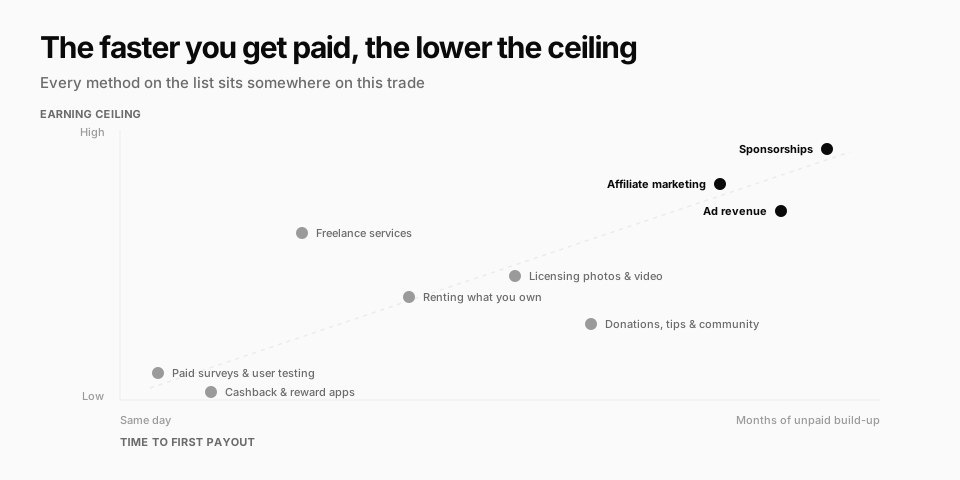 The audience-based methods aren't passive, they're deferred. Affiliate income, ad revenue, and sponsorships all require building an audience first, and that building phase is unpaid, uncertain, and usually takes months, not weeks. The income feels passive once the audience exists. Getting there rarely does.
The instant-payout methods have the lowest ceilings by design. Surveys, user testing, and cashback apps pay out same-day with zero setup, and that's exactly why they cap out at a few hundred dollars a month at most. There's an inverse relationship on this whole list between how fast you get paid and how much you can eventually earn.
Platform rules change under you with no warning. The YouTube watch-hour requirement doubling for 2027 is the clearest recent example: an entire monetization path got significantly harder overnight, for reasons entirely outside any individual creator's control. Every method on this list that depends on a platform's ad program, algorithm, or terms of service carries that same risk. It rarely gets mentioned in the "10 ways to make money online" genre, but it's the single biggest reason income built this way can disappear faster than it took to build.
Once You Have Something to Sell, Here's the Part That Gets Easier
Everything above is a legitimate way to earn online without a product. It's also worth being honest about where most of these methods eventually lead: the affiliate marketer who builds a real audience, the freelancer who packages a repeatable process, the tester who notices a gap nobody's filling, most of them eventually have something worth turning into an owned product, a template, a short course, a paid community, a simple service package they can sell directly instead of splitting the revenue with a platform.
 That's a different problem than the one this article solves, and it's the one Crevio is built for. Crevio is an AI business builder: you describe what you want to sell, and its AI sets up the storefront, payments, and product pages, then helps you launch and grow it, so you're not learning checkout infrastructure and email tooling from scratch on top of everything else. The Starter plan is free with a 5% transaction fee, so there's no cost to test whether an idea sells before you commit to it. Paid plans at $20 and $50 a month drop the fee to 2.5% and 1% as revenue grows. It handles digital downloads, courses, memberships, and simple service offers, which covers the natural next step for most of the methods above. It won't build the audience or the expertise that makes people want to buy from you in the first place. That part stays yours, same as it always was.
If you're not there yet, that's fine. Plenty of real income gets made without ever taking that step, and this list covers ten honest ways to do it. If you do want the fuller playbook for turning any of this into a real business, our guide to how to start an online business is the practical next read.
FAQ
Yes. Affiliate marketing, ad revenue, freelance services, paid testing, renting assets you already own, and interest on savings all generate real income without you creating, holding, or shipping a product. The tradeoff is that most of these methods still require real input, usually time spent building an audience or a skill, or capital you already have. "Without selling a product" is accurate. "Without effort" generally isn't.
Paid user testing and freelance services produce a first payment the fastest, often within days, because neither requires you to build an audience first. Renting an asset you already own (a car, a spare room, storage space) is also fast once the listing is live. Affiliate marketing, ad revenue, and sponsorships take the longest because they depend on an audience that doesn't exist yet.
For affiliate marketing, ad revenue, sponsorships, and paid community access, yes, meaningfully so. For freelancing, paid surveys and testing, renting what you own, licensing stock content, and interest on savings, no audience is required at all. If you're starting from zero followers, the task-based and asset-based methods on this list are the realistic starting point, not the audience-based ones.
Related Blog Posts
What will you sell today?
Describe what you want to sell — Crevio builds, launches, and grows it. Products, payments, and marketing, all on autopilot.
Start for free

