Your business,
on autopilot.
One platform for creating, running and growing your business, powered by AI.
How to Make Extra Income While Working Full-Time: 9 Realistic Ideas for 2026





The median side hustler makes $200 a month. The average makes $885. That gap, reported in Bankrate's side hustle survey, is the most useful fact in this entire genre, and almost every "make extra income" article hides it. Half of the people earning extra income while working full-time make less than $200 a month, while a smaller group earns enough to pull the average up more than fourfold. The difference is rarely talent or hours. It is which kind of income they chose to build.
This guide covers how to make extra income while working full-time without burning out or violating your employment agreement: the three lanes every idea falls into, 9 ideas that hold up in 2026, and the boring-but-critical stuff (employer policy, taxes) that listicles skip.
- The short version: Income ideas fall into three lanes: trading time, building assets, or renting what you own. Time-trading pays fastest, assets compound, rentals are nearly passive but capped.
- Realistic numbers: Per Bankrate, 58% of side hustlers clear $100 a month, 25% clear $500, and 14% clear $1,000. Plan around those odds, not the outlier screenshots.
- The play that compounds: Start in a fast-cash lane if you need money now, then reinvest your hours into a digital product or audience, the lane where income keeps arriving whether or not you worked that week.
Why Extra Income Matters More in 2026
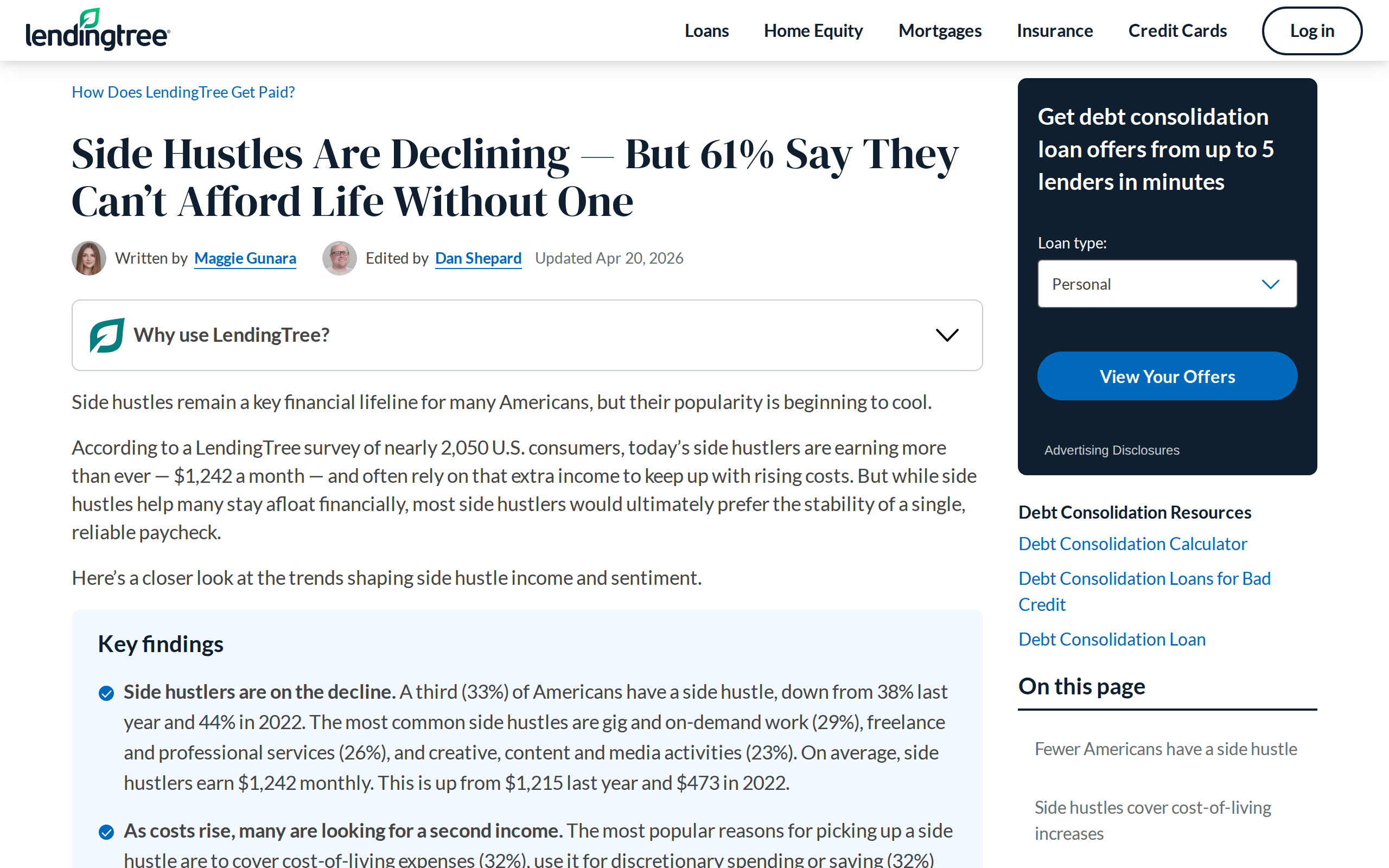
This is not a hypothetical for most people. LendingTree's survey found that 3 in 5 side hustlers say the extra income is essential to making ends meet, not fun money. At the same time, Bankrate reports that 27% of U.S. adults currently run a side hustle, down from 36% in 2024. Fewer people are doing it, but the ones who are depend on it more.
 There is also a structural tailwind for one specific lane. Goldman Sachs projects the market for individually created content and products will roughly double from $250 billion to $480 billion by 2027. Selling knowledge and digital products is no longer a fringe activity. It is a real market that a full-time employee can participate in from a laptop, on their own schedule.
Three Ways to Make Extra Income While Working Full-Time
Every idea you will ever read about fits one of three lanes, and the lane matters more than the idea.
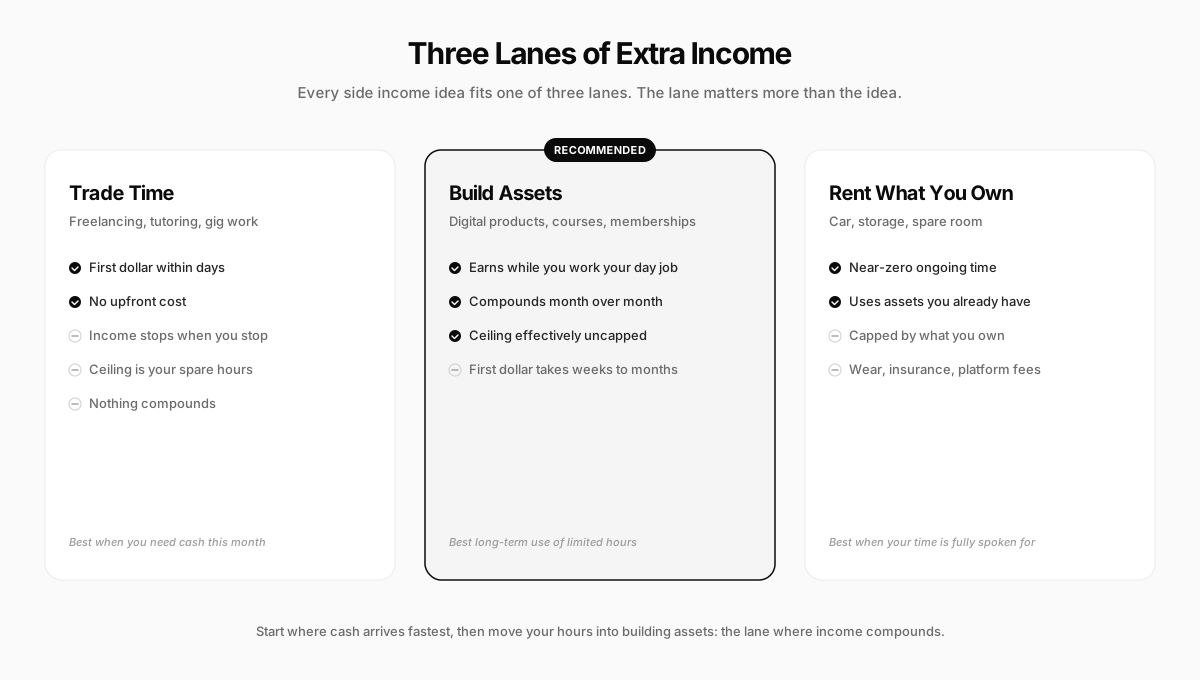
Most people should start wherever cash arrives fastest for their situation, then deliberately move hours into the asset lane. A freelance client pays this month's bill. A template, course, or membership you build once keeps paying long after the hours are spent. That migration, not any single idea, is what separates the $200-a-month median from the top 14%.
9 Realistic Ideas, Sorted by Lane
Lane 1: Trade Time for Money
1. Freelance your day-job skill. The fastest route to meaningful extra income is selling the exact skill you are already paid for: writing, design, bookkeeping, coding, marketing. You skip the learning curve entirely, and clients pay a premium for demonstrated professional experience. Marketplaces like Upwork and Fiverr solve distribution early on, in exchange for a service fee (we compared the cheaper Fiverr alternatives), and direct referrals from your network usually pay better once you have two or three projects to show.
2. Tutor or coach in your area of expertise. If you can explain something well, one-hour sessions on evenings or weekends are among the most schedule-friendly options that exist. Academic tutoring, language practice, interview prep, and career coaching all run over video calls, and session-based work has a natural boundary that protects your day job.
3. Structured gig work. Delivery, rideshare, pet sitting, and task apps are the floor of this list, not because they are bad but because the ceiling is low and nothing compounds: hour 500 pays the same as hour 1. They are the right choice when you need money this week with zero setup. Treat them as a bridge, not a destination.
Lane 2: Build Assets That Pay Repeatedly
4. Sell digital products. Templates, spreadsheets, ebooks, checklists, presets: you make them once and every sale after that costs you nothing to fulfill. This is the lane with the strongest fit for full-time workers because production happens on your schedule and sales do not require you to be present. The catch is honest: the first dollar is slower, usually weeks to months, and marketing is a real skill you will have to practice. We wrote a full playbook on how to sell digital products if this lane fits you.
5. Create an online course. Courses are digital products with a higher price point and a higher production bar. One well-made course at $50 to $300 can outearn hundreds of small template sales, and your day-job expertise is usually the raw material. Do not build for months in secret: outline it, pre-sell to a handful of people, and only record once someone has paid. Our online course launch checklist walks through that sequence.
6. Run a paid membership or newsletter. Recurring revenue is the most valuable kind of extra income because it decouples earnings from any single week's effort: 100 members at $10 a month is $1,000 that renews. It is also the slowest to build and the most demanding to maintain, since members expect ongoing value. Best for people who already enjoy publishing or community-building and would do a version of it for free. A paid Telegram channel is one of the lower-friction ways to test this before building a full membership site; we cover the tradeoffs in our guide to Telegram monetization.
7. Content plus affiliate income. A niche YouTube channel, blog, newsletter, or Pinterest account monetized with affiliate links and sponsorships. The honest framing: this is the longest runway on the list, often 6 to 12 months before meaningful money, but the audience you build makes every other idea on this list easier. If you go this route, treat the audience as the asset and affiliate income as a byproduct. Many people now use AI to compress the production work; our guide to AI side hustles that actually work covers which of those plays hold up.
Lane 3: Rent What You Own
8. Rent your car, parking space, or storage. Peer-to-peer platforms like Turo (cars) and Neighbor (storage and parking) turn idle assets into income with almost no ongoing time, one of several ways to make money online without selling anything. Run the math honestly: factor in wear, insurance gaps, and platform fees before counting the revenue.
 9. Rent a spare room. The highest-earning idea in this lane by far, and the one with the most real-life friction: a spare room on Airbnb in the right city can outearn every other idea on this list, but you are trading privacy, dealing with local regulations, and doing hospitality work. It suits homeowners in high-demand areas who genuinely do not mind guests.
How the Lanes Compare
| Trade time | Build assets | Rent assets | |
|---|---|---|---|
| First dollar | Days to weeks | Weeks to months | Days to weeks |
| Income when you stop working | Stops immediately | Continues | Mostly continues |
| Ceiling | Your spare hours | Effectively uncapped | Capped by what you own |
| Upfront cost | Near zero | Near zero (digital) | You must own the asset |
| Compounds over time | No | Yes | No |
Before You Start: Employer Policy and Taxes
Most extra-income guides skip these two topics entirely, and either one can undo everything.
Check your employment agreement first. Look for moonlighting clauses, non-compete terms, and intellectual property assignment language. That last one matters most for the asset lane: some agreements claim ownership of anything you create using company time or equipment. Build your side income on your own devices, on your own time, in a domain that does not compete with your employer, and you avoid nearly all of the risk. If the agreement is ambiguous, asking HR before you earn is far cheaper than a dispute after.
Set money aside for taxes from the first dollar. Side income is generally self-employment income in the U.S., which means income tax plus self-employment tax and, once you are earning steadily, quarterly estimated payments. A common rule of thumb is to park 25% to 30% of side earnings in a separate account, and the IRS Gig Economy Tax Center explains the actual filing requirements. The upside people forget: legitimate business expenses (software, equipment, courses) are generally deductible against that income.
How to Fit Extra Income Around a Full-Time Job
The constraint is never ideas. It is that you have perhaps 5 to 10 genuinely usable hours a week, and motivation that fluctuates. Four rules protect you:
- Pick one idea and give it 90 days. Switching hustles monthly is the most common failure pattern. Nothing on this list shows real results in three weeks.
- Timebox it like a class, not a mood. Two fixed evenings a week beats "whenever I have energy," because after a full workday you rarely have energy. Scheduled hours happen; aspirational hours do not.
- Sell before you build. For anything in the asset lane, get one real person to pay (or at least pre-commit) before you spend 40 hours producing. A minimum version that earns $50 teaches you more than a polished product that earns nothing.
- Let software do the admin. Your scarce resource is attention. Every hour spent wiring up checkout pages, hosting, email tools, and invoices is an hour not spent on the thing customers pay for.
That last rule is where the setup burden traditionally kills asset-lane projects, and it is the specific problem a new class of tools now solves.
Using Crevio to Build the Asset Lane in Hours, Not Weekends
The classic objection to selling digital products alongside a full-time job is that the business around the product eats your limited hours: storefront, payments, product pages, email capture, marketing. Crevio is an AI business builder designed to collapse exactly that overhead. You describe what you want to sell, and its AI builds the storefront and product setup, then helps launch and grow it, so your evenings go into the course or template itself rather than the plumbing around it.
For a full-time employee testing this lane, the economics are the point: the Starter plan is free with a 5% transaction fee, so there is no monthly cost while you validate whether anyone will buy. If it works, paid plans ($20 and $50 a month) drop the fee to 2.5% and 1%. Payments run on Stripe, and it handles digital downloads, courses, and memberships, which covers ideas 4, 5, and 6 on this list with one tool. It will not do the one thing no tool can, which is create expertise worth paying for. That part is still yours.
FAQ
Anchor on the survey data, not success stories: Bankrate found the median side hustler earns about $200 a month and the average $885, with 25% clearing $500 and 14% clearing $1,000. Time-trading ideas reach a few hundred dollars a month fastest; asset-building ideas usually start slower but are the ones that reach four figures without consuming more of your week.
Usually no law requires it, but your employment agreement might: check for moonlighting, conflict-of-interest, and IP assignment clauses before you start. If your side work is in a different domain, done on your own time and equipment, most employers have no claim and many do not care. When the agreement is unclear, a short conversation with HR up front removes the risk entirely.
Renting assets you already own is the least time-intensive option. If you want something that grows, a small digital product is the best fit for tight schedules because production is asynchronous: you build in scattered evening hours, and selling does not require you to be present. Start with the smallest version, a template or short guide priced simply (see our guide to pricing digital products), and expand only after strangers have paid.
Related Blog Posts
What will you sell today?
Describe what you want to sell — Crevio builds, launches, and grows it. Products, payments, and marketing, all on autopilot.
Start for free

