Your business,
on autopilot.
One platform for creating, running and growing your business, powered by AI.
Influencer Business Plan: The 6-Part Framework (With a Worked Example)




An influencer business plan is what separates someone who posts content from someone who runs a business that happens to post content. The difference shows up the first time a platform changes its algorithm, a brand deal falls through, or a bad month reminds you that "engagement" doesn't pay rent. This guide gives you a 6-part framework, a worked example you can copy, and the monetization math most influencer guides skip entirely.
- A business plan reframes your account as an asset, not a hobby, which changes which content, platforms, and deals you say yes to
- The framework has 6 parts: brand, audience, content, owned audience, monetization, budget. Skip step 5 or 6 and the other four are just a nicer content calendar
- Diversify beyond brand deals. Sponsorships pay fastest but cap your income at whatever a brand's budget allows, and rates run from roughly $50 for nano creators to $25,000+ for accounts over 100K followers; digital products and memberships don't have that ceiling
- A plan is a working document, not a PDF you write once. Revisit it every quarter as your numbers change
Why an Influencer Business Plan Actually Matters
Most creators skip this step because "business plan" sounds like something you'd write for a bank loan. But the exercise isn't the paperwork, it's the decisions it forces you to make before you're mid-negotiation with a brand or three months into a content pillar nobody's watching.
Three concrete things change once you have one:
- You stop taking every deal. Without a plan, "someone offered to pay me" is the only qualification a brand partnership needs. With one, you know your rates, your audience fit, and your walk-away point before the DM arrives
- You catch a single-point-of-failure income before it fails. If 90% of your revenue comes from one platform's creator fund or one recurring sponsor, a plan is where that shows up as a number, not a surprise
- You can tell if a slow month is actually a problem. A plan gives you a baseline (target audience growth, target revenue by stream) to measure against, instead of just a gut feeling that things are "off"
The 6-Part Influencer Business Plan Framework
Work through these in order. Each one narrows the next: your brand narrows your audience, your audience narrows your content, and so on down to the budget.
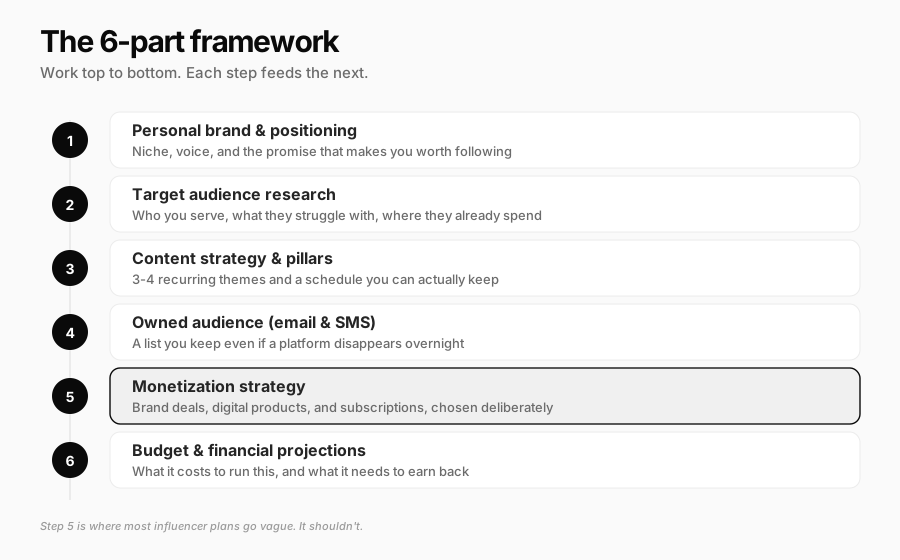
1. Personal Brand & Positioning
Write down, in one sentence, what you're the go-to person for and who you're the go-to person for. "Fitness content" is not a position. "Strength training for women over 40 who are done with influencers half their age" is.
Include in this section:
- Your niche, specific enough that someone can describe it back to you in one sentence
- Your voice: 3-4 adjectives that describe how you sound, not what you post about
- A quick competitor scan: 3-5 accounts in your space, what they do well, and the gap you fill that they don't
2. Target Audience Research
Your content strategy is downstream of this section, so don't skip straight to platforms and posting schedules. Define:
- Demographics: age range, life stage, income bracket, where they already spend time online
- Pain points: the specific problem your content solves, described in their words, not marketing language
- Where they already are: which platforms, which creators they already follow, which paid products they already buy in this space (this tells you what they're willing to pay for)
3. Content Strategy & Pillars
Pick 3-4 content pillars, recurring themes you can produce content about indefinitely without repeating yourself. A pillar isn't a topic ("fitness"), it's a lens ("form breakdowns," "what I eat as a 45-year-old lifter," "myths my clients believe"). Then set an upload schedule you can sustain for six months, not the one that looks ambitious in a planning doc. Post timing matters too: the same content posted at the wrong hour for your audience's timezone loses reach before it's even had a chance.
4. Owned Audience (Email & SMS)
This is the section most influencer plans treat as optional and shouldn't. Every platform you don't own can change its algorithm, ban your account, or shut down, and your audience goes with it. An email list is the one channel where you control delivery and ownership. Start collecting emails from day one, even before you have anything to sell, a lead magnet (a free template, guide, or checklist related to your niche) is enough to start.
5. Monetization Strategy
This is where most plans get vague, and vague is expensive. Pick a primary stream deliberately instead of defaulting to whichever one showed up first.
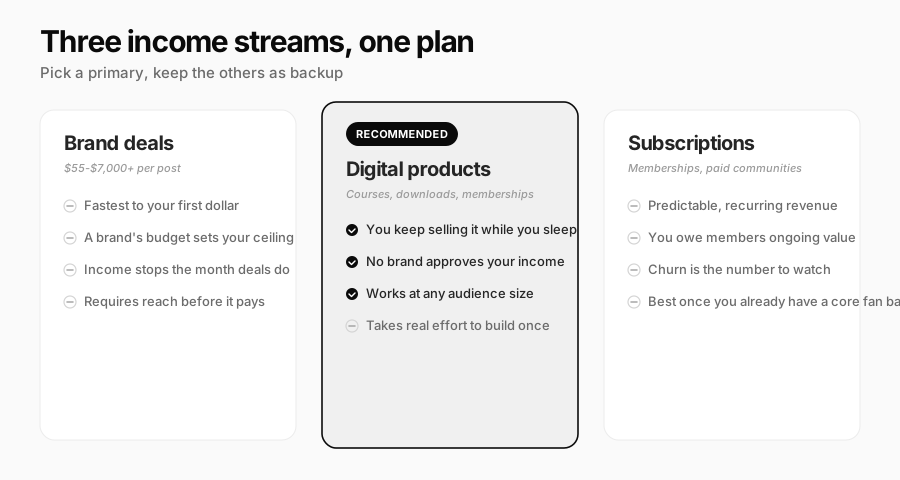
Brand partnerships pay fastest, typically $50-$300 per post for nano creators (1K-10K followers), $200-$2,500 for micro creators (10K-100K), and $2,500-$25,000+ above that, but a brand's budget sets your ceiling, and the income stops the month the deals do.
Digital products (courses, templates, downloads, guides) have no such ceiling. You build it once and it sells while you sleep, at any audience size, with no brand approval standing between you and the sale. The tradeoff is real effort upfront: you have to actually make the thing.
Subscriptions and memberships give you predictable, recurring revenue, but they come with an ongoing obligation to deliver value to paying members every month, and churn becomes the metric that determines whether the model works.
Most sustainable influencer businesses run at least two of these at once: brand deals for near-term cash flow, and a digital product or membership for revenue that doesn't depend on someone else's marketing budget.
6. Budget & Financial Projections
List what it actually costs to run this: editing software, a scheduling tool, any contractors, the platform fees on whatever you sell. Then project revenue by stream for the next two quarters using conservative numbers, not best-case ones. If the math doesn't work at your current audience size, that's useful information now, not a surprise in month six.
A Filled-Out Example
Here's a condensed version of what Part 5 and 6 might look like for a creator with 40,000 followers in the productivity-tools niche:
| Stream | This quarter's target | Notes |
|---|---|---|
| Brand deals | $2,400 (2 deals) | Rate: $1,200/post, based on 40K followers and 4% engagement |
| Digital product | $1,800 | A $39 Notion template, targeting 45 sales from an email list of 1,800 |
| Membership | $600 | A $10/mo community, targeting 60 members by quarter end |
| Total target | $4,800 | Monthly costs: ~$180 (editing tool, email platform, scheduling) |
Notice what this table does that "I want to make more money from my platform" doesn't: it turns each stream into a number you can actually miss or hit, which is what makes the plan a management tool instead of a wish list.
Common Mistakes That Sink Influencer Business Plans
- Writing it once and never opening it again. A plan that isn't revisited quarterly is a snapshot of what you thought six months ago, not a plan
- Chasing every platform at once. Spreading content pillars across five platforms usually means five mediocre presences instead of one strong one
- Skipping the owned-audience step because it's slower. Email lists compound; platform followers don't transfer if the platform changes the rules
- Treating monetization as "brand deals, eventually." Waiting until you're "big enough" for sponsors means your first 12-24 months of income depend entirely on someone else's budget
Turning the Plan Into a Running Business
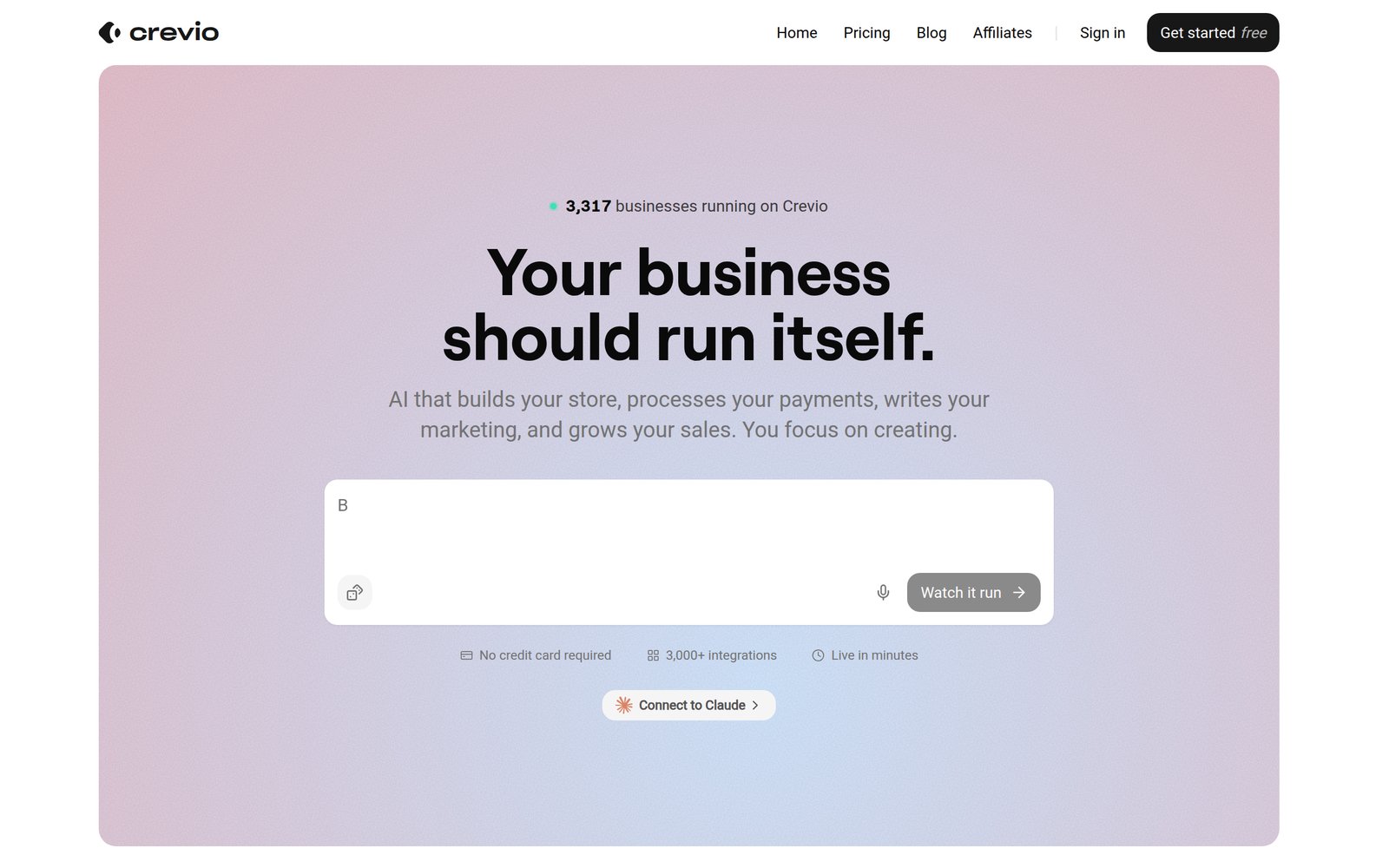
A business plan tells you what to build. Actually building it, a storefront, an email sequence, a checkout that doesn't drop 20% of buyers at payment, is where most influencer plans stall out. This is the part Crevio is built for: describe the digital product or membership you want to sell, and the AI builds the store, sets up the checkout, and helps you launch it, rather than you piecing together a website builder, an email tool, and a payment processor separately.
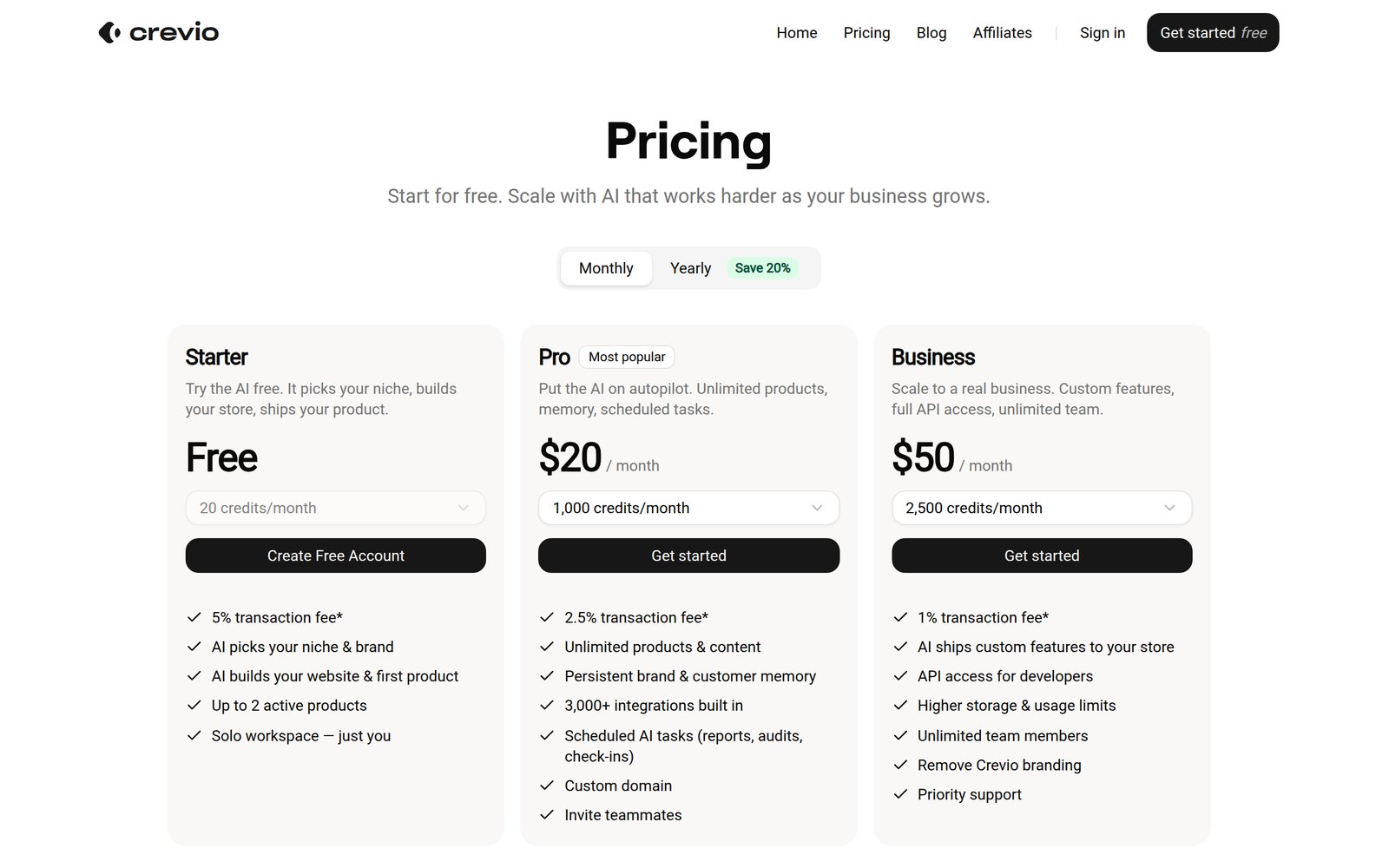
Crevio starts free, with paid plans at $20/mo and $50/mo as you scale, and transaction fees that drop from 5% down to 1% rather than staying fixed regardless of your volume.
It's not a replacement for the brand-deal or content side of your plan, Crevio doesn't pitch sponsors for you, but it's built specifically for Part 5: turning a monetization strategy into an actual storefront without a separate developer or a stack of disconnected tools.
FAQ
Long enough to answer all 6 sections honestly, usually 2-4 pages. The goal is a working document you'll actually reread, not a comprehensive report that impresses nobody but sits unopened after week one.
Yes, arguably more so. Deciding your niche, audience, and content pillars before you've posted 200 pieces of unfocused content saves you from having to rebrand later. Monetization strategy can stay light until you have an audience, but positioning and audience research pay off from post one.
Distribution. A traditional business plan usually starts with a product and works backward to an audience. An influencer business plan usually starts with an audience (your following) and works forward to which products or partnerships that audience will actually pay for.
Related Blog Posts
What will you sell today?
Describe what you want to sell — Crevio builds, launches, and grows it. Products, payments, and marketing, all on autopilot.
Start for free